Loading...
Done
In this photo taken Thursday, May 7, 2015 photo,  remains of Soviet soldiers killed during World War II lay in a coffin prior to a reburial ceremony at the Sinyavino Heights memorial near the village of Sinyavino, 50 km (31 miles) east of  St. Petersburg, Russia. Hundreds of people came to a World War II battleground outside St. Petersburg this week to bury the remains of 964 Soviet soldiers recovered by volunteer search teams. (Photo by Dmitry Lovetsky/AP Photo)

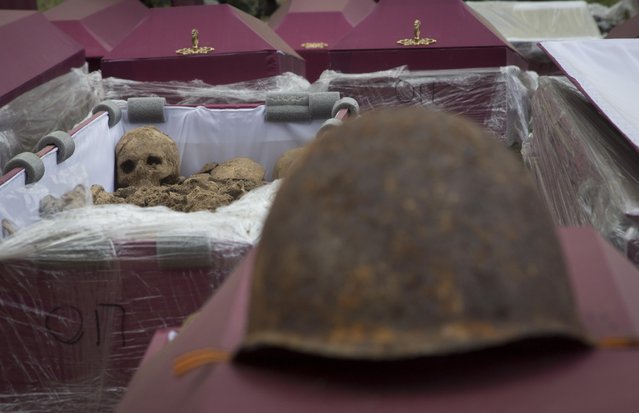
In this photo taken Thursday, May 7, 2015 photo, remains of Soviet soldiers killed during World War II lay in a coffin prior to a reburial ceremony at the Sinyavino Heights memorial near the village of Sinyavino, 50 km (31 miles) east of St. Petersburg, Russia. Hundreds of people came to a World War II battleground outside St. Petersburg this week to bury the remains of 964 Soviet soldiers recovered by volunteer search teams. Fifty crimson coffins containing skulls and bones were solemnly buried at the Sinyavino Heights memorial as Russian war songs played and an honor guard fired a salute. (Photo by Dmitry Lovetsky/AP Photo)
Details
10 May 2015 11:12:00
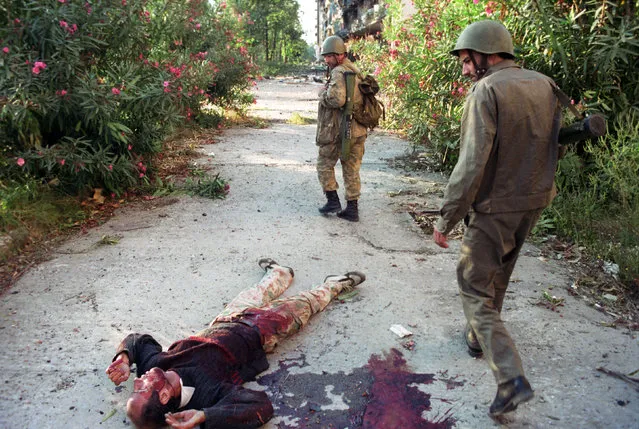
Abkhazia. Sukhumi, 1993. A house-to-house combat. (Photo by Andrei Solovyov/ITAR-TASS)

The War in Abkhazia from 1992 to 1993 was fought between Georgian government forces for the most part, and Abkhaz separatist forces, Russian armed forces and North Caucasian militants. Ethnic Georgians who lived in Abkhazia fought largely on the side of Georgian government forces. Ethnic Armenians and Russians within Abkhazia's population largely supported the Abkhazians, and many fought on their side. The separatists received support from thousands of North Caucasus and Cossack militants and from the Russian Federation forces stationed in and near Abkhazia. Here: Abkhazia. Sukhumi, 1993. A house-to-house combat. (Photo by Andrei Solovyov/ITAR-TASS)
Details
29 Sep 2017 07:31:00
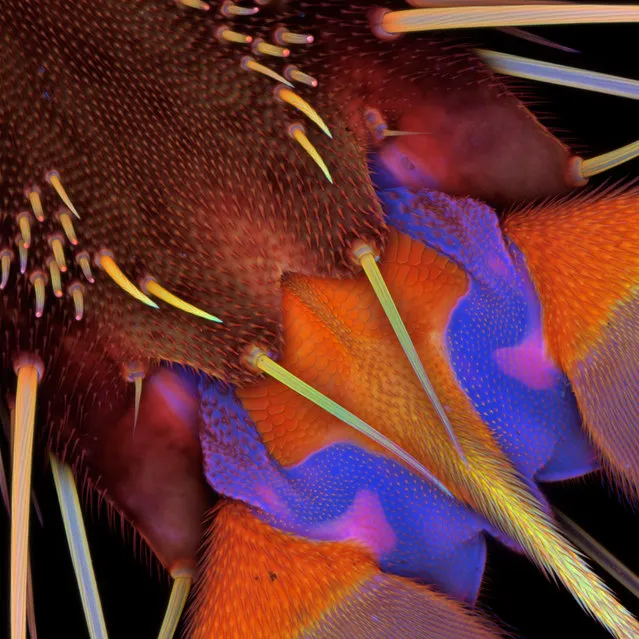
Pretarsus of the third leg of a female drone fly (Eristalis tenax), ventral view, by Dr. Jan Michels, Institute of Zoology, Christian-Albrechts-University of Kiel, Germany. (Photo by Olympus BioScapes)

“Microscope images forge an extraordinary bond between science and art, said Hidenao Tsuchiya, Olympus America's Vice President and General Manager for the Scientific Equipment Group. We founded this competition to focus on the fascinating stories coming out of today's life science research laboratories. The thousands of images that people have shared with the competition over the years reflect some of the most exciting work going on in research today – work that can help shed light on the living universe and ultimately save lives. We look at BioScapes and these beautiful images as sources of education and inspiration to us and the world”. – OlympusBioScapes

Photo: Pretarsus of the third leg of a female drone fly (Eristalis tenax), ventral view, by Dr. Jan Michels, Institute of Zoology, Christian-Albrechts-University of Kiel, Germany. (Photo by Olympus BioScapes)
Details
29 Jul 2012 09:20:00
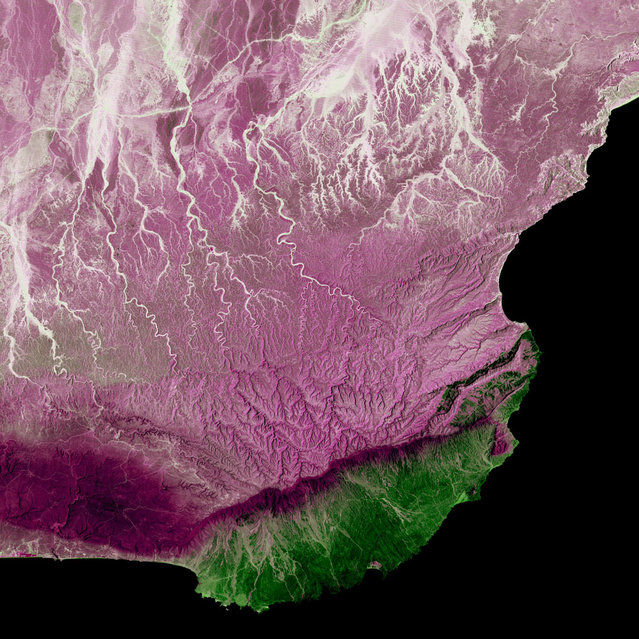
Dhofar Region, Oman. Much of Oman is desert, but the Arabian Sea coast in the Dhofar region represents a startling difference in climate. This coastal region catches the monsoon rains, or khareef, during the summer months. Drenching rains fall primarily on the mountainous ridge that separates the lush, fertile areas along the coast from the arid interior, recharging streams, waterfalls and springs that provide plentiful water supplies in the fertile lowlands for the remainder of the year. Image taken by Landsat 5 on April 2, 2005. (Photo by USGS/NASA)

Dhofar Region, Oman. Much of Oman is desert, but the Arabian Sea coast in the Dhofar region represents a startling difference in climate. This coastal region catches the monsoon rains, or khareef, during the summer months. Drenching rains fall primarily on the mountainous ridge that separates the lush, fertile areas along the coast from the arid interior, recharging streams, waterfalls and springs that provide plentiful water supplies in the fertile lowlands for the remainder of the year. Image taken by Landsat 5 on April 2, 2005. (Photo by USGS/NASA)
Details
25 Dec 2012 11:13:00
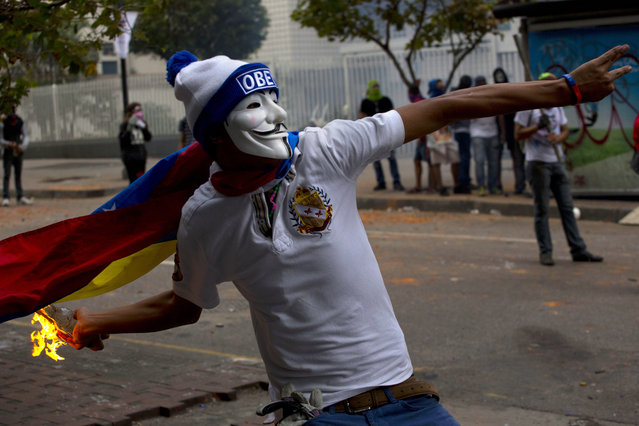
Venezuela: An anti-government protester wearing a Guy Fawkes mask throws a molotov cocktail at the Bolivarian National Police during clashes in Caracas, Venezuela, Thursday, April 17, 2014. Opposition protesters have been demonstrating against high crime, high inflation and shortages of basic goods since mid-February. (Photo by Ramon Espinosa/AP Photo)

Venezuela: An anti-government protester wearing a Guy Fawkes mask throws a molotov cocktail at the Bolivarian National Police during clashes in Caracas, Venezuela, Thursday, April 17, 2014. Opposition protesters have been demonstrating against high crime, high inflation and shortages of basic goods since mid-February. (Photo by Ramon Espinosa/AP Photo)
Details
04 Jan 2015 12:54:00
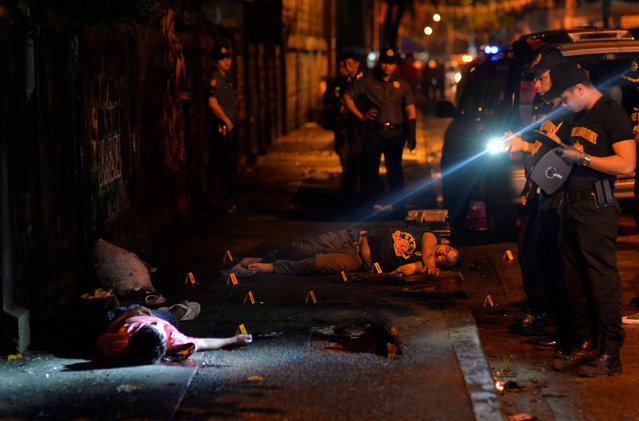
Police investigators inspect the bodies of two men lying on a sidewalk, who police said were killed after a drug “Shabu” (Methamphetamine Chloride) buy-bust operation in Quezon city, Metro Manila Philippines, October 9, 2016. (Photo by Ezra Acayan/Reuters)

Police investigators inspect the bodies of two men lying on a sidewalk, who police said were killed after a drug “Shabu” (Methamphetamine Chloride) buy-bust operation in Quezon city, Metro Manila Philippines, October 9, 2016. (Photo by Ezra Acayan/Reuters)
Details
10 Oct 2016 10:11:00
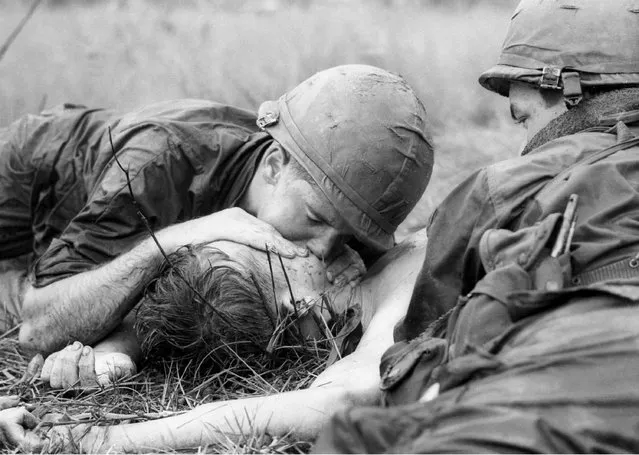
Medic James E. Callahan of Pittsfield, Mass., gives mouth-to-mouth resuscitation to a dying soldier in war zone D, about 50 miles northeast of Saigon, June 17, 1967. Thirty-one men of the 1st Infantry Division were reported killed in the guerrilla ambush, with more than 100 wounded.  (Photo by Henri Huet/AP Photo)

Medic James E. Callahan of Pittsfield, Mass., gives mouth-to-mouth resuscitation to a dying soldier in war zone D, about 50 miles northeast of Saigon, June 17, 1967. Thirty-one men of the 1st Infantry Division were reported killed in the guerrilla ambush, with more than 100 wounded. (Photo by Henri Huet/AP Photo)
Details
27 Jun 2017 08:38:00
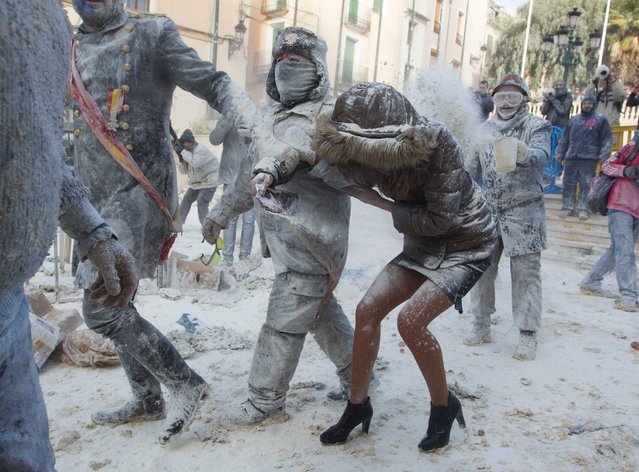
Revellers dressed in mock military garb take part in the “Els Enfarinats” battle in the southeastern Spanish town of Ibi on December 28, 2017. (Photo by Jaime Reina/AFP Photo)

Revellers dressed in mock military garb take part in the “Els Enfarinats” battle in the southeastern Spanish town of Ibi on December 28, 2017. During this 200-year-old traditional festival participants known as Els Enfarinats (those covered in flour) dress in military clothes and stage a mock coup d'etat as they battle using flour, eggs and firecrackers outside the town hall as part of the celebrations of the Day of the Innocents. (Photo by Jaime Reina/AFP Photo)
Details
30 Dec 2017 06:08:00