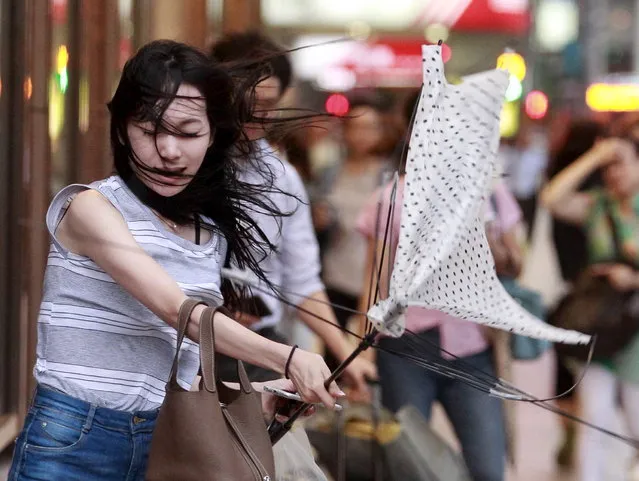
A woman holds her umbrella while walking against strong winds as Typhoon Soudelor approaches Taiwan in Taipei, August 7, 2015. (Photo by Pichi Chuang/Reuters)
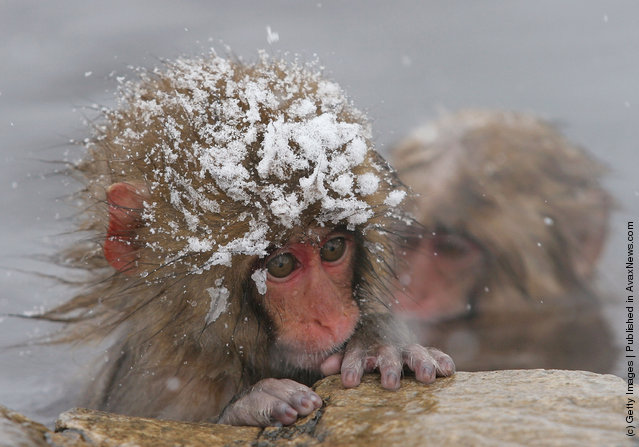
Japanese macaque monkeys enjoy sitting in the hot springs at Jigokudani-Onsen (Hell Valley) on January 23, 2005 in Jigokudani, Nagano-Prefecture, Japan. Japanese Macaques, also known as snow monkeys are the most northerly nonhuman primate in the world. In 1963 a female Macaque ventured into the hot springs to retrieve some soybeans. This behaviour was adopted by other monkeys, and eventually by the entire troop. This Macaque troop regularly visits the Jigokudani-Onsen springs to escape the cold. The hot springs are said to help relieve nerve pain and fatigue. (Photo by Koichi Kamoshida/Getty Images)
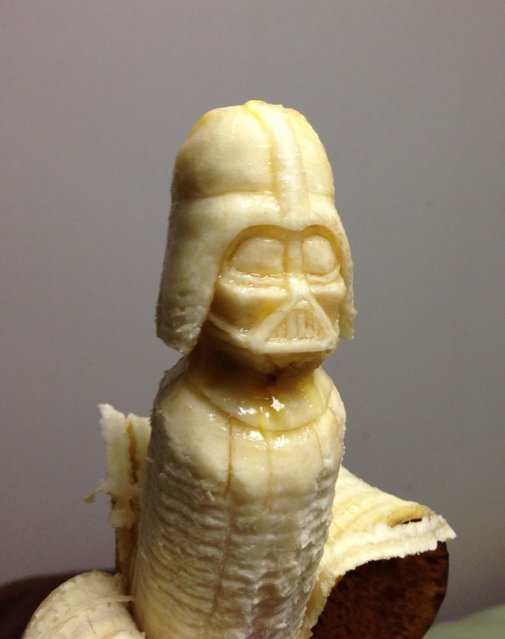
This is the work of Keisuke Yamada, a banana artist Kotaku first profiled in 2011. To make these sculptures, Yamada, an electrician by trade, must work fast, or the banana will start to go bad.
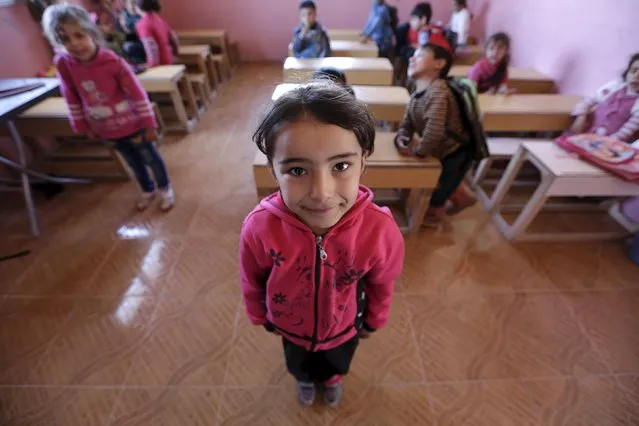
Five-year-old Ghazal al-Hussein poses inside a classroom in the rebel-controlled area of Maarshureen village in Idlib province, Syria March 12, 2016. March 15 marks the 5th anniversary of peaceful protests against Syria's President Bashar al-Assad, leading to the devastating civil conflict in the country. These are portraits of five-year-old Syrian children who have only known conflict in their country. (Photo by Khalil Ashawi/Reuters)
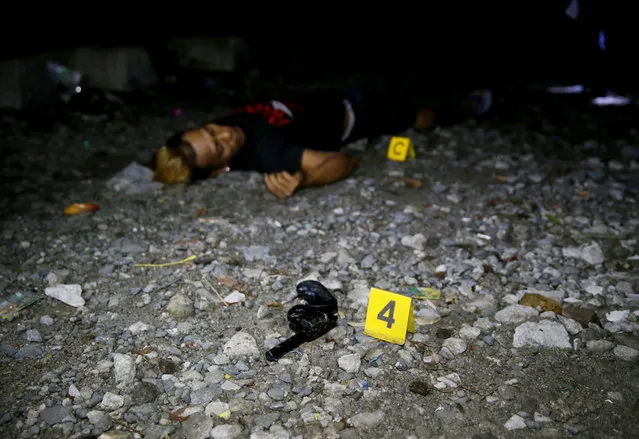
A pistol is lies near the body of a drug suspect who was killed with two others in an alleged “buy-bust” operation before dawn on Friday, September 30, 2016, in Caloocan city, north of Manila, Philippines, in the continuing “War on Drugs” campaign of President Rodrigo Duterte. Duterte said he would be “happy to slaughter” 3 million addicts. (Photo by Bullit Marquez/AP Photo)
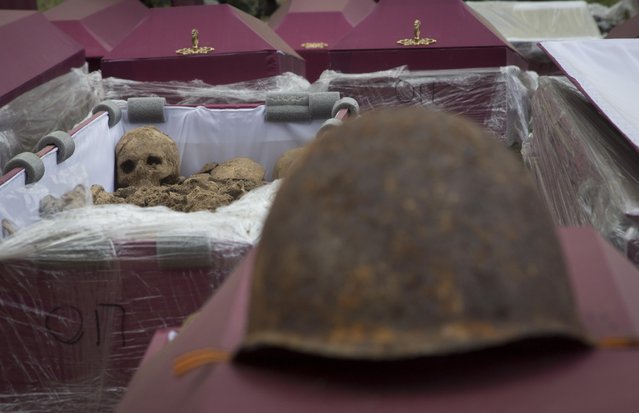
In this photo taken Thursday, May 7, 2015 photo, remains of Soviet soldiers killed during World War II lay in a coffin prior to a reburial ceremony at the Sinyavino Heights memorial near the village of Sinyavino, 50 km (31 miles) east of St. Petersburg, Russia. Hundreds of people came to a World War II battleground outside St. Petersburg this week to bury the remains of 964 Soviet soldiers recovered by volunteer search teams. Fifty crimson coffins containing skulls and bones were solemnly buried at the Sinyavino Heights memorial as Russian war songs played and an honor guard fired a salute. (Photo by Dmitry Lovetsky/AP Photo)
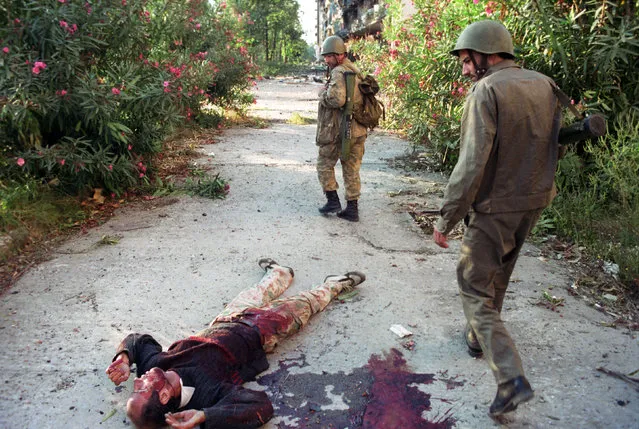
The War in Abkhazia from 1992 to 1993 was fought between Georgian government forces for the most part, and Abkhaz separatist forces, Russian armed forces and North Caucasian militants. Ethnic Georgians who lived in Abkhazia fought largely on the side of Georgian government forces. Ethnic Armenians and Russians within Abkhazia's population largely supported the Abkhazians, and many fought on their side. The separatists received support from thousands of North Caucasus and Cossack militants and from the Russian Federation forces stationed in and near Abkhazia. Here: Abkhazia. Sukhumi, 1993. A house-to-house combat. (Photo by Andrei Solovyov/ITAR-TASS)