Loading...
Done
MB&F Horological Machine No. 6 Space Pirate

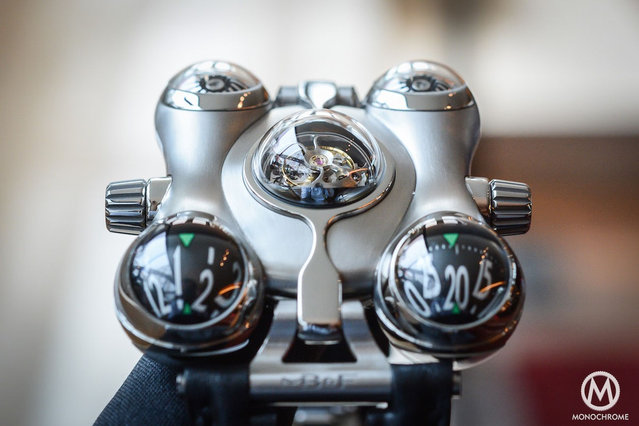
All throughout history of mankind people were fascinated by time, its flow, and how to measure it. Thus, the science of horology can into being, as people invented more and more sophisticated ways of measuring the passage of time. Truly, it’s one of the most profound characteristics of being a human, to feel and to ponder the meaning of time, its properties, and will we ever be able to move through it, not with it. Now, however, horology is mainly referred to the art of mechanical watchmaking. (Photo by MB&F)
Details
14 Nov 2014 13:51:00
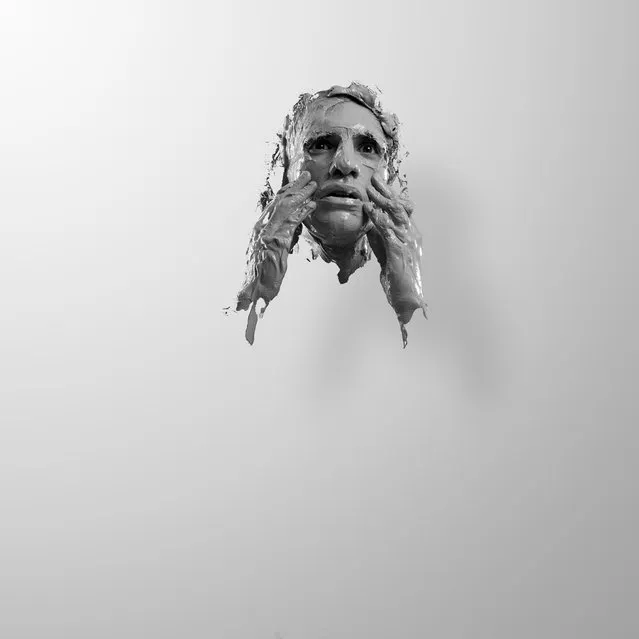
Mud Makes Man By Alejandro Maestre Gasteazi

31-year-old Alejandro Maestre Gasteazi has created an incredibly interesting photographic series about the struggle of an artist. First, though, you may be asking yourself these questions: Exactly, what are we looking at? How did the photographer achieve this strange, sculpture-like illusion?

Gasteazi asked his friend Julián to cover himself with a mixture of blue paint and mud. He then photographed Julián at various stages. Later, in Photoshop, Gasteazi cut around his subject's body to make him appear like a floating sculpture.
Details
06 Jun 2015 09:18:00


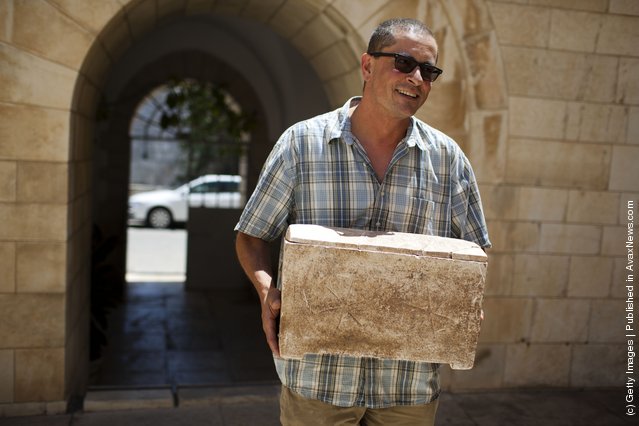
Doctor Boaz Zissu of the Bar Ilan University shows the inscription on a 2,000-year-old ossuary at the Rockefeller Museum on June 30, 2011 in Jerusalem, Israel. The Israel Antiquities Authority have confirmed the credibility of the ancient ossuary, otherwise known as a stone chest in which to store bones, as bearing the name of a relative of the high priest Caiaphas from the New Testament. Laboratory tests have come back saying that the inscription with the name of “Miriam daughter of Yeshua son of Caiaphas, priest of Maaziah from Beth Imri” is both “genuine and ancient”. (Photo by Uriel Sinai/Getty Images)
Details
01 Jul 2011 11:35:00


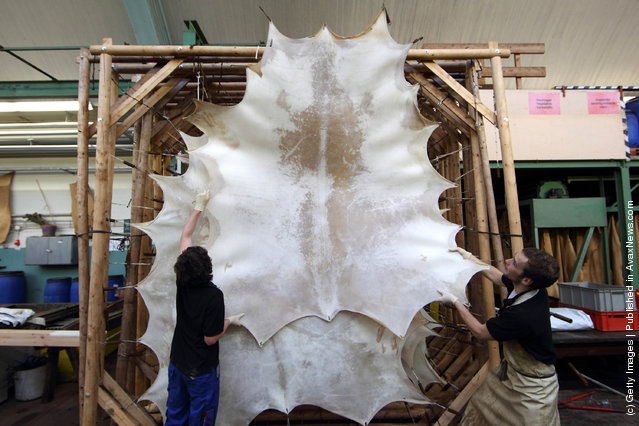
REUTLINGEN, GERMANY - NOVEMBER 17: Students hang out finished parchment leather at the LGR (Lederinstitut Gerberschule Reutlingen) tannery school on November 17, 2010 in Reutlingen, Germany. Even in early antiquity and up their hair or dried goat and sheep skins were used as material for documents. In the small Asian city Pergamon these skins were processed in large quantities for this purpose, so they formed the main trading arm of the city, of which the name is parchment is derived. In medieval times, reached the parchment is of great importance, it was such as France's production under the supervision of the University of Paris. Even now, important documents, placed on their unlimited shelf life as possible large value (eg diplomas, addresses, memory, writings, documents for primary and keystones) written on parchment...
Details
20 Nov 2011 18:17:00
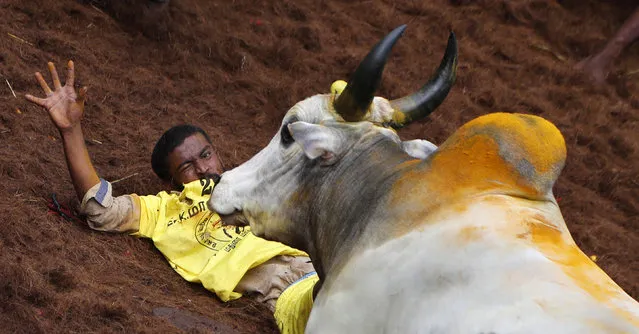
In this Thursday, January 17, 2019, photo, an Indian tamer reacts as a bull charges towards him during a traditional bull-taming festival called Jallikattu, in the village of Allanganallur, near Madurai, Tamil Nadu state, India. (Photo by Aijaz Rahi/AP Photo)

In this Thursday, January 17, 2019, photo, an Indian tamer reacts as a bull charges towards him during a traditional bull-taming festival called Jallikattu, in the village of Allanganallur, near Madurai, Tamil Nadu state, India. Jallikattu involves releasing a bull into a crowd of people who are expected to hang on to the animal's hump for a stipulated distance or hold on to the hump for a minimum of three jumps made by the bull. The sport, performed during the four-day “Pongal” or winter harvest festival, is hugely popular in Tamil Nadu. (Photo by Aijaz Rahi/AP Photo)
Details
21 Jan 2019 00:01:00
The Perth-based photographer and journalist Frances Andrijich has travelled the Western Australian coast since the early 90s, capturing clotheslines in all their glory. In her images they take the roles of play equipment, Christmas trees and, in the summer, a homemaker’s dream. Andrijich admits she is hopelessly hung up on clotheslines; her latest book celebrates them under the spotlight of the Australian sun. (Photo by Frances Andrijich)

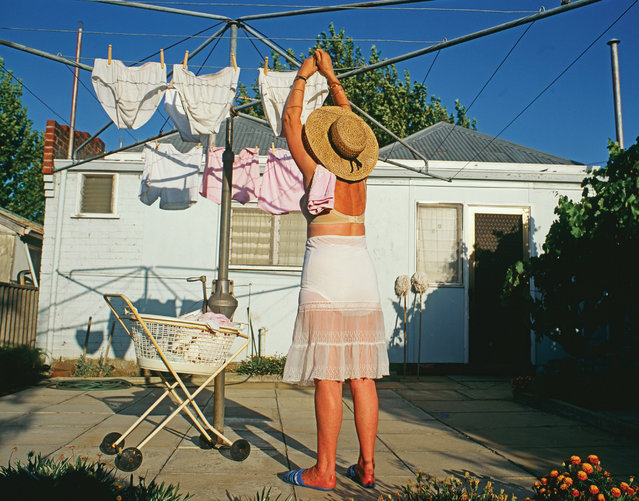
The Perth-based photographer and journalist Frances Andrijich has travelled the Western Australian coast since the early 90s, capturing clotheslines in all their glory. In her images they take the roles of play equipment, Christmas trees and, in the summer, a homemaker’s dream. Andrijich admits she is hopelessly hung up on clotheslines; her latest book celebrates them under the spotlight of the Australian sun. Here: Vera Germanis hangs out underwear in Frances Andrijich’s grandparents’ backyard. This was the photographer’s first clothesline shot, taken in Midland Junction in 1991. (Photo by Frances Andrijich)
Details
29 Mar 2016 11:58:00
Camp director and “duck walk” inventor Rodin Gilbert Flores, 2nd R) teaches aspiring beauty queens how to “duck walk” at a beauty boot camp in Manila in this picture taken on March 8, 2015. From wading in muddy Philippine rice paddies, former housemaid Janicel Lubina now struts down runways for the country's top designers, and is poised to be crowned among the world's most beautiful. (Photo by Noel Celis/AFP Photo)

Camp director and “duck walk” inventor (Rodin Gilbert Flores, 2nd R) teaches aspiring beauty queens how to “duck walk” at a beauty boot camp in Manila in this picture taken on March 8, 2015. From wading in muddy Philippine rice paddies, former housemaid Janicel Lubina now struts down runways for the country's top designers, and is poised to be crowned among the world's most beautiful. Lubina is a star recruit in one of Manila's beauty pageant boot camps, where shy, lanky teenage girls from remote farming provinces are transformed into poised Barbie dolls who can preach about world peace in six-inch heels. (Photo by Noel Celis/AFP Photo)
Details
15 Mar 2015 06:51:00
A love story with two log choppers. “In 1993, I was working on a project about life in the Olomouc region of Czechoslovakia. One day, I came to the village of Dlouhá Loučka-Křivá and went into a courtyard where I saw two old people, a husband and wife, sawing firewood for winter. They were working quietly, concentrating. I watched them fetch a beam from a wrecked barn, but they didn’t discuss how they planned to carry it to the saw. The woman faced one way, the man the other. When they realised, the woman eventually turned and followed her husband. The picture I took is the picture of many relationships – when each partner wants something different, but they have to come to an agreement, pull together eventually”. (Photo by Jindrich Streit)

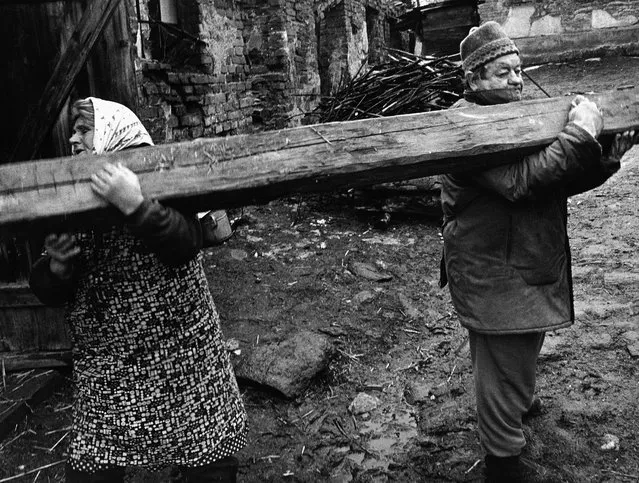
A love story with two log choppers. “In 1993, I was working on a project about life in the Olomouc region of Czechoslovakia. One day, I came to the village of Dlouhá Loučka-Křivá and went into a courtyard where I saw two old people, a husband and wife, sawing firewood for winter. They were working quietly, concentrating. I watched them fetch a beam from a wrecked barn, but they didn’t discuss how they planned to carry it to the saw. The woman faced one way, the man the other. When they realised, the woman eventually turned and followed her husband. The picture I took is the picture of many relationships – when each partner wants something different, but they have to come to an agreement, pull together eventually”. (Photo by Jindrich Streit)
Details
04 Aug 2016 12:34:00