Loading...
Done
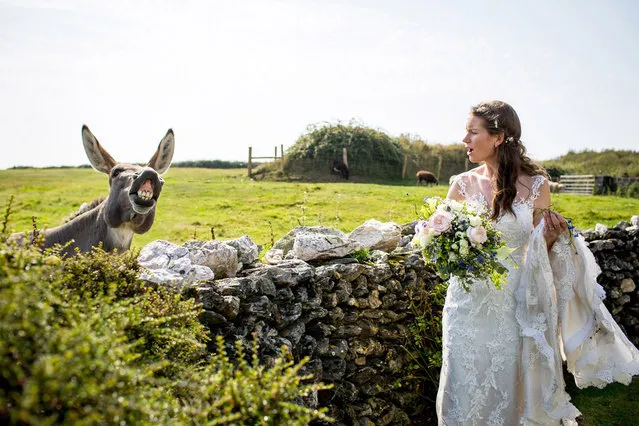
A donkey photobombs a bride on her wedding day. (Photo by Caters News Agency)

Its your big day, youve spent months planning every last detail of your wedding and youre just about to capture the moment perfectly on camera whenyoure upstaged by a grinning donkey. At least thats what happened to these poor couples who were dramatically photobombed by a whole host of camera-hogging animals on their special day.The hilarious snaps show a series of irate brides being upstaged by everything from a cat to a camel and a dog to a donkey. Here: A donkey photobombs a bride on her wedding day. (Photo by Caters News Agency)
Details
27 Nov 2017 08:58:00
"Bearded Disney Princesses By Adam Ellis

In order to celebrate Movember (mustache November), artist and blogger Adam Ellis slapped handsome, flowing beards onto some of Disney’s most famous princesses. The idea came to him when a fan commented on a bearded picture he had made of Belle from Beauty and the Beast. One bearded princess became twelve, and now this strange image series is all over the web.
For more art inspired by Disney’s beautiful damsels, check out Dina Goldstein’s pictures of real-life Disney princesses and these pictures of Grumpy Cat in the Disney universe.
Details
13 Nov 2013 10:06:00


Bex Hetherington exhibits a T-shirt at the Edinburgh College of Art degree show on June 8, 2011 in Edinburgh, Scotland. Students work will be exhibited across the campus buildings turning Edinburgh College of Art into the city's biggest gallery space. The work ranges from conceptual to commercial with inspirational influences as diverse and wide ranging as fashion photography, volcanoes, the crazy lady who put a cat in a bin, fairytales, the star system and serial killers. (Photo by Jeff J Mitchell/Getty Images)
Details
09 Jun 2011 09:30:00
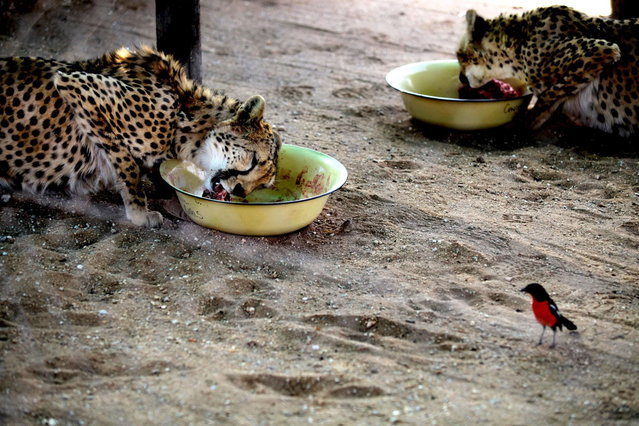
Young cheetahs eat meat at The Cheetah Conservation Fund (CCF) center in Otjiwarongo, Namibia, on August 13, 2013. The CCF started breeding Anatolian livestock dogs to promote cheetah-friendly farming after some 10,000 big cats – the current total worldwide population – were killed or moved off farms in the 1980s.  Up to 1,000 cheetahs were being killed a year, mostly by farmers who saw them as livestock killers. But the use of dogs has slashed losses for sheep and goat farmers and led to less retaliation against the vulnerable cheetah. (Photo by Jennifer Bruce/AFP Photo)

Young cheetahs eat meat at The Cheetah Conservation Fund (CCF) center in Otjiwarongo, Namibia, on August 13, 2013. The CCF started breeding Anatolian livestock dogs to promote cheetah-friendly farming after some 10,000 big cats – the current total worldwide population – were killed or moved off farms in the 1980s. Up to 1,000 cheetahs were being killed a year, mostly by farmers who saw them as livestock killers. But the use of dogs has slashed losses for sheep and goat farmers and led to less retaliation against the vulnerable cheetah. (Photo by Jennifer Bruce/AFP Photo)
Details
29 Aug 2013 10:56:00
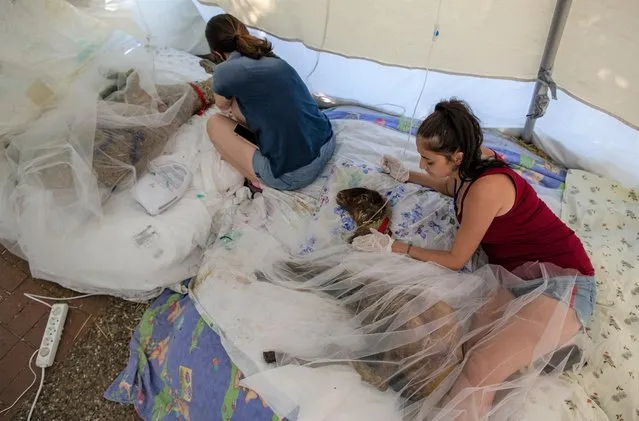
Volunteers care for burned sheeps in a field hospital established by HAYTAP (The Federation of the Animals Rights in Turkey) for animals after a wildfire at the Manavgat district of Antalya, Turkey, 09 August 2021. It is not known how many wild animals living in the forest died in the fires, but about 33,000 farm animals perished. About 30 veterinarians and hundreds of volunteers work around the clock at the field hospital. Sheep, covered in mosquito nets to protect their wounds from flies, lay there in the shade trying to recover, and various animals such as cats, dogs, owls, and cows have been treated or are still being treated there. (Photo by Erdem Sahin/EPA/EFE)

Volunteers care for burned sheeps in a field hospital established by HAYTAP (The Federation of the Animals Rights in Turkey) for animals after a wildfire at the Manavgat district of Antalya, Turkey, 09 August 2021. It is not known how many wild animals living in the forest died in the fires, but about 33,000 farm animals perished. About 30 veterinarians and hundreds of volunteers work around the clock at the field hospital. Sheep, covered in mosquito nets to protect their wounds from flies, lay there in the shade trying to recover, and various animals such as cats, dogs, owls, and cows have been treated or are still being treated there. (Photo by Erdem Sahin/EPA/EFE)
Details
27 Aug 2021 08:30:00
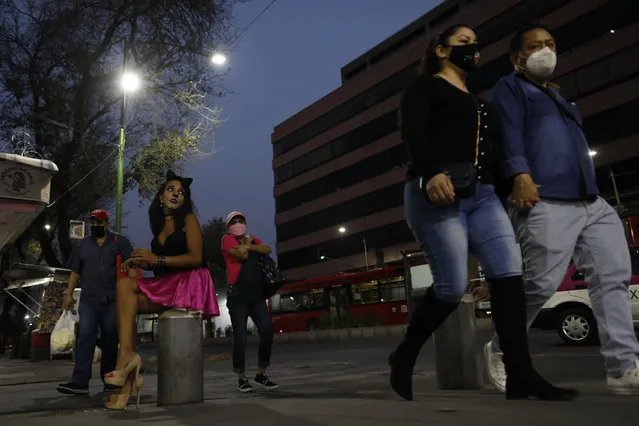
Sеx worker Geraldine wearing cat make-up sits on her usual corner as she waits for clients outside the Revolution subway station, in Mexico City, Saturday, March 13, 2021. Geraldine, 30, a sеx worker since age 15, says many of her regular clients have stopped coming amid the coronavirus pandemic and that seeing new clients presents new health and security risks. She is most concerned about the risk of bringing COVID-19 home to her partner, who has diabetes. (Photo by Rebecca Blackwell/AP Photo)

Sеx worker Geraldine wearing cat make-up sits on her usual corner as she waits for clients outside the Revolution subway station, in Mexico City, Saturday, March 13, 2021. Geraldine, 30, a sеx worker since age 15, says many of her regular clients have stopped coming amid the coronavirus pandemic and that seeing new clients presents new health and security risks. She is most concerned about the risk of bringing COVID-19 home to her partner, who has diabetes. (Photo by Rebecca Blackwell/AP Photo)
Details
24 Jan 2022 05:17:00
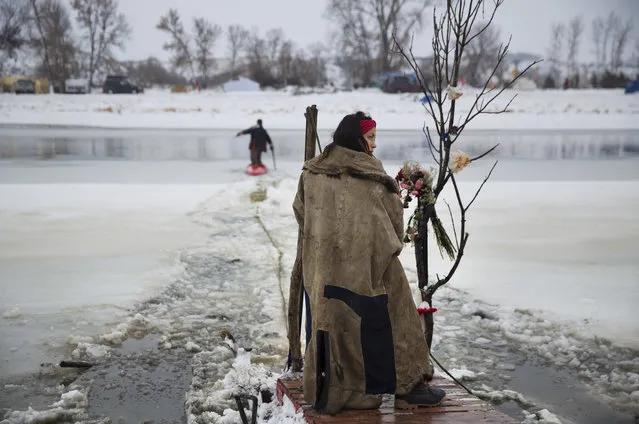
In this Thursday, December 1, 2016 photo, Cat Bigney, part of the Oglala Native American tribe, waits on the shore of the Cannonball river for travelers to arrive by canoe at the Oceti Sakowin camp where people have gathered to protest the Dakota Access oil pipeline in Cannon Ball, N.D. So far, those at the camp have shrugged off the heavy snow, icy winds and frigid temperatures. But if they defy next week's government deadline to abandon the camp, demonstrators know the real deep freeze lies ahead. Life-threatening wind chills and towering snow drifts could mean the greatest challenge is simple survival. (Photo by David Goldman/AP Photo)

In this Thursday, December 1, 2016 photo, Cat Bigney, part of the Oglala Native American tribe, waits on the shore of the Cannonball river for travelers to arrive by canoe at the Oceti Sakowin camp where people have gathered to protest the Dakota Access oil pipeline in Cannon Ball, N.D. So far, those at the camp have shrugged off the heavy snow, icy winds and frigid temperatures. But if they defy next week's government deadline to abandon the camp, demonstrators know the real deep freeze lies ahead. Life-threatening wind chills and towering snow drifts could mean the greatest challenge is simple survival. (Photo by David Goldman/AP Photo)
Details
06 Dec 2016 10:22:00
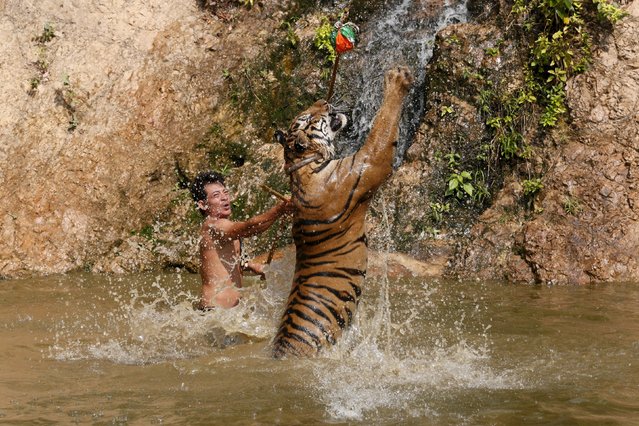
A tiger jumps while being trained at the Tiger Temple in Kanchanaburi province, west of Bangkok, Thailand, February 25, 2016. Thailand's controversial Tiger Temple, dogged for years by talk that it supplies the black market and mistreats its animals, is fighting to keep the big cats after wildlife authorities rejected a bid to extend a zoo licence that expired in 2013. (Photo by Chaiwat Subprasom/Reuters)

A tiger jumps while being trained at the Tiger Temple in Kanchanaburi province, west of Bangkok, Thailand, February 25, 2016. Thailand's controversial Tiger Temple, dogged for years by talk that it supplies the black market and mistreats its animals, is fighting to keep the big cats after wildlife authorities rejected a bid to extend a zoo licence that expired in 2013. The Buddhist temple, home to more than 100 tigers, has been investigated for suspected links to wildlife trafficking and wildlife activists have accused it of illegal breeding of the animals. Thai wildlife authorities have sent ten of the temple's tigers to a wildlife sanctuary. But the temple, which bills itself as a wildlife sanctuary, has denied links to illegal trafficking, and wants to hold on to its tigers. (Photo by Chaiwat Subprasom/Reuters)
Details
29 Feb 2016 11:56:00