Loading...
Done
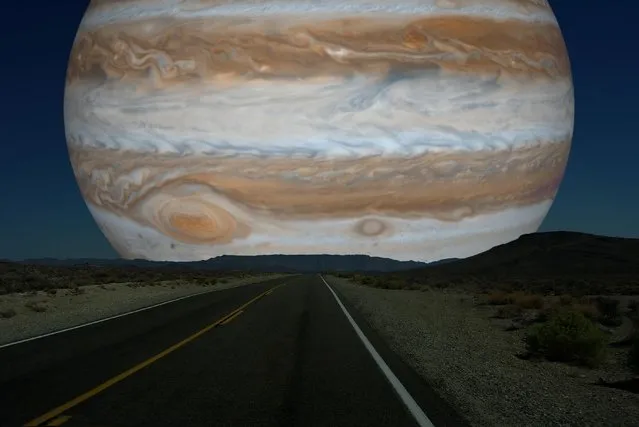
If The Moon Were Replaced With Some Of Our Planets

Our moon is a pretty big object. It's big enough to be a respectable planet in its own right, if it were orbiting the sun instead of the Earth. (Actually, it is orbiting the sun in a nearly perfectly circular orbit, that the Earth only slightly perturbs... but that's a topic for another day.) The Moon is a quarter the diameter of the Earth. Only Pluto has a satellite that is larger, in proportion to the size of the planet it orbits.

Details
29 Mar 2013 10:12:00
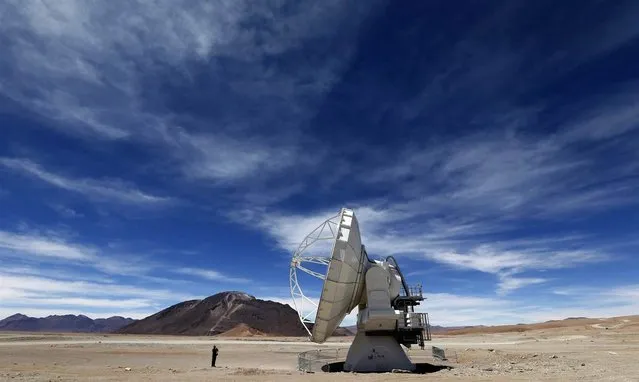
A man takes a photo of a radio antenna that's part of the Atacama Large Milimeter Array Observatory on March 12, 2013 at Llano de Chajnantor, about 43 miles (70 kilometers) from San Pedro de Atacama, Chile. The $1.5 billion ALMA facility, which had its official inauguration on March 13, is considered the world's most expensive ground-based observatory. (Photo by Felipe Trueba/EPA)

A man takes a photo of a radio antenna that's part of the Atacama Large Milimeter Array Observatory on March 12, 2013 at Llano de Chajnantor, about 43 miles (70 kilometers) from San Pedro de Atacama, Chile. The $1.5 billion ALMA facility, which had its official inauguration on March 13, is considered the world's most expensive ground-based observatory. (Photo by Felipe Trueba/EPA)
Details
03 Apr 2013 09:25:00
Student protestors, including one girl with a camera, struggle with soldiers from the Chinese Army, the PLA. Tiananmen Square, 1989. (Photo by Jeff Widener/Associated Press)

Student protestors, including one girl with a camera, struggle with soldiers from the Chinese Army, the PLA. Tiananmen Square, 1989. (Photo by Jeff Widener/Associated Press)
Details
04 Jun 2013 07:57:00
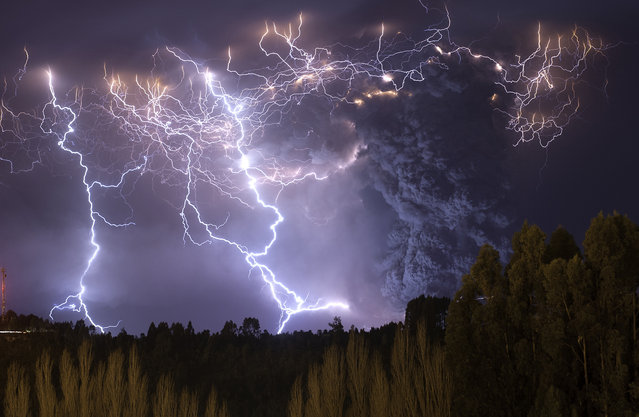
The eruption of Cordon Caulle began on June 4, 2011, located in the Region of Los Rios in Chile. For about 12 months, people and animals became accustomed to living with the daily fall of ash, which also caused problems in the air traffic in South America. The explosions and lightning during first days of the eruption could be seen from hundreds of miles around. This photograph was taken on the second night of eruption from the town of Lago Ranco. (Photo and caption by Francisco Negroni/National Geographic Traveler Photo Contest)

The eruption of Cordon Caulle began on June 4, 2011, located in the Region of Los Rios in Chile. For about 12 months, people and animals became accustomed to living with the daily fall of ash, which also caused problems in the air traffic in South America. The explosions and lightning during first days of the eruption could be seen from hundreds of miles around. This photograph was taken on the second night of eruption from the town of Lago Ranco. (Photo and caption by Francisco Negroni/National Geographic Traveler Photo Contest)

ATTENTION! All pictures are presented in high resolution. To see Hi-Res images – just TWICE click on any picture. In other words, click small picture – opens the BIG picture. Click BIG picture – opens VERY BIG picture.
Details
23 Jun 2013 11:24:00


“BASE jumping, also sometimes written as B.A.S.E jumping, is an activity that employs an initially packed parachute to jump from fixed objects. “B.A.S.E.” is an acronym that stands for four categories of fixed objects from which one can jump: buildings, antennas, spans (bridges), and earth (cliffs)”. – Wikipedia

Photo: Felix Baumgartner, world-renowned B.A.S.E jumper, is pictured in this undated handout photo. Baumgartner will attempt the first unpowered crossing of the strait between England and France. (Photo by Red Bull via Getty Images)
Details
30 Jul 2011 13:06:00
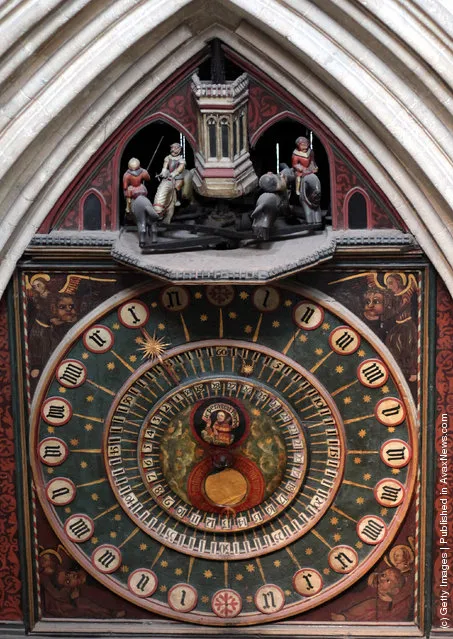
Wells Clock – World's Oldest Mechanical Clock

“Wells Cathedral is a Church of England cathedral in Wells, Somerset, England. Built between 1175 and 1490, Wells Cathedral has been described as “the most poetic of the English Cathedrals”. The Wells clock, an astronomical clock, is located in the north transept. The surviving mechanism, dated to between 1386 and 1392, was replaced in the 19th century, and was eventually moved to the Science Museum in London, where it continues to operate. It is the second-oldest surviving clock in England”. – Wikipedia

Photo: The clock face of world's oldest continually-working mechanical clock is seen as it is hand wound for the very last time on August 21, 2010 in Wells, England. (Photo by Matt Cardy/Getty Images)
Details
10 Aug 2011 11:23:00
Enthusiasts Unveil Their Carts In Bridgewater Ahead Of The World's Largest Illuminated Carnival in Bridgwater, England

Members of the Gremlins Carnival Club, open the doors to their workshop to unveil for the first time their cart, Jungle Drums, which is their entry to this year's Bridgwater Carnival, on November 4, 2011 in Bridgwater, England. (Photo by Matt Cardy/Getty Images)
Details
04 Nov 2011 13:20:00
MV Rena Splits In Two After Large Swells

In this handout provided by Maritime New Zealand, MV Rena is seen in two pieces after overnight bad weather pounded the vessel, on January 8, 2012 in Tauranga, New Zealand. (Photo by Maritime New Zealand via Getty Images)
Details
08 Jan 2012 11:21:00