Loading...
Done
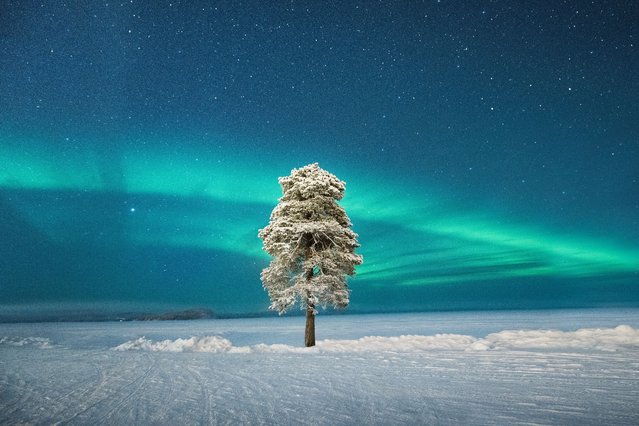
Aurorae category runner-up: Lone Tree under a Scandinavian Aurora by Tom Archer (UK). The photographer decided to explore the area around the hotel on a very crisp -35C evening in Finnish Lapland. When he found this tree, he decided to wait for the misty conditions to change and could not believe his luck when the sky cleared and the aurora came out in the perfect spot. Archer spent about an hour photographing it before his camera started to lock up because of the harsh conditions, but by then he was happy to call it a night. (Photo by Tom Archer/2020 Astronomy Photographer of the Year)

Aurorae category runner-up: Lone Tree under a Scandinavian Aurora by Tom Archer (UK). The photographer decided to explore the area around the hotel on a very crisp -35C evening in Finnish Lapland. When he found this tree, he decided to wait for the misty conditions to change and could not believe his luck when the sky cleared and the aurora came out in the perfect spot. Archer spent about an hour photographing it before his camera started to lock up because of the harsh conditions, but by then he was happy to call it a night. (Photo by Tom Archer/2020 Astronomy Photographer of the Year)
Details
17 Sep 2020 00:03:00
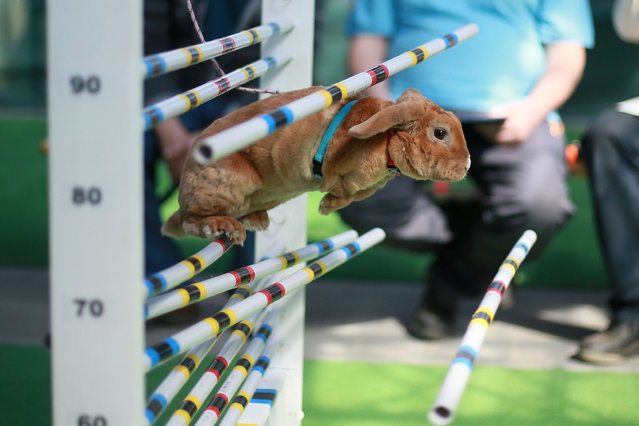
A rabbit fails to jump over an obstacle during a rabbit track and field competition on the sidelines of a hunting exhibition in Kromeriz, about 60 km east of Prague, on April 1, 2017. Circa 100 rabbits took part in the competition, including disciplines as long jump, high jump and running on a flat track. (Photo by  Radek Mica/AFP Photo)

A rabbit fails to jump over an obstacle during a rabbit track and field competition on the sidelines of a hunting exhibition in Kromeriz, about 60 km east of Prague, on April 1, 2017. Circa 100 rabbits took part in the competition, including disciplines as long jump, high jump and running on a flat track. (Photo by Radek Mica/AFP Photo)
Details
09 Apr 2017 09:49:00
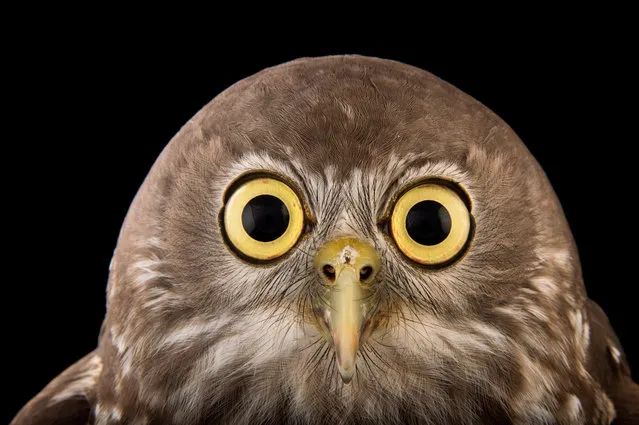
The National Geographic Photo Ark is a travelling exhibition of photographer Joel Sartore’s quest to create a photo archive of biodiversity around the world. So far, Sartore has captured studio portraits of more than 6,000 species – a number that he hopes to double. On 1 July, the ark will open at Melbourne zoo – the first time it has been exhibited in the southern hemisphere. More than 50 portraits will be on display, including many of Australian endangered animals being protected by programs at the zoo itself. These captions have been edited from text supplied by Melbourne zoo. Here: Barking owl. So-named because its call sounds like a barking dog, these birds are native to Australia, Indonesia and Papua New Guinea. In Victoria they are listed as an endangered species, and in 2003 there were estimated to be fewer than 50 breeding pairs. The main threat to the species in Victoria is loss of habitat, especially large trees with hollows in which they can nest and on which many of their prey depend. Apart from a bark, they may utter a chilling scream when they feel threatened. (Photo by Joel Sartore/National Geographic Photo Ark/The Guardian)

The National Geographic Photo Ark is a travelling exhibition of photographer Joel Sartore’s quest to create a photo archive of biodiversity around the world. So far, Sartore has captured studio portraits of more than 6,000 species – a number that he hopes to double. On 1 July, the ark will open at Melbourne zoo – the first time it has been exhibited in the southern hemisphere. More than 50 portraits will be on display, including many of Australian endangered animals being protected by programs at the zoo itself. These captions have been edited from text supplied by Melbourne zoo. Here: Barking owl. (Photo by Joel Sartore/National Geographic Photo Ark/The Guardian)
Details
01 Jul 2017 07:45:00
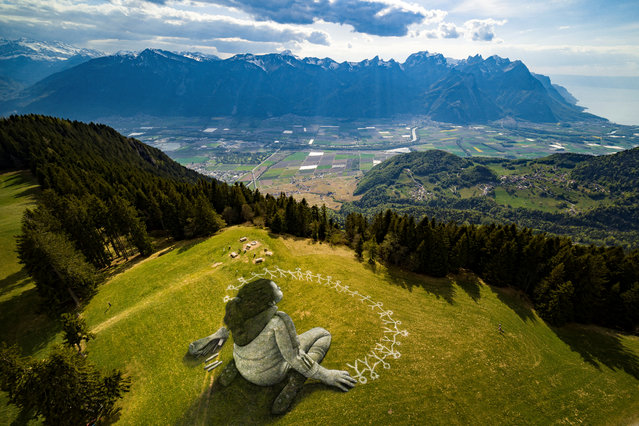
An artwork called “Beyond Crisis” by French artist Guillaume Legros aka Saype and created with an eco paint made out of chalk and coal over a 3000 sqm field is pictured during the coronavirus disease (COVID-19) outbreak in Leysin, Switzerland, April 24, 2020 in this picture obtained by Reuters April 26, 2020. (Photo by Valentin Flauraud/SAYPE/Handout via Reuters)

An artwork called “Beyond Crisis” by French artist Guillaume Legros aka Saype and created with an eco paint made out of chalk and coal over a 3000 sqm field is pictured during the coronavirus disease (COVID-19) outbreak in Leysin, Switzerland, April 24, 2020 in this picture obtained by Reuters April 26, 2020. (Photo by Valentin Flauraud/SAYPE/Handout via Reuters)
Details
27 May 2020 00:05:00
A tamed hawk sits on a chair next to a participant during a traditional hunting contest in Almaty, Kazakhstan December 1, 2018. (Photo by Pavel Mikheyev/Reuters)

A tamed hawk sits on a chair next to a participant during a traditional hunting contest in Almaty, Kazakhstan on December 1, 2018. (Photo by Pavel Mikheyev/Reuters)
Details
09 Dec 2018 00:03:00
Revellers out in Blackpool, Lancashire, UK on New Year's Eve, December 31, 2018. (Photo by Lorne Campbell/Guzelian)

Revellers out in Blackpool, Lancashire, United Kingdom on New Year's Eve, December 31, 2018. (Photo by Lorne Campbell/Guzelian)
Details
17 Mar 2019 00:05:00
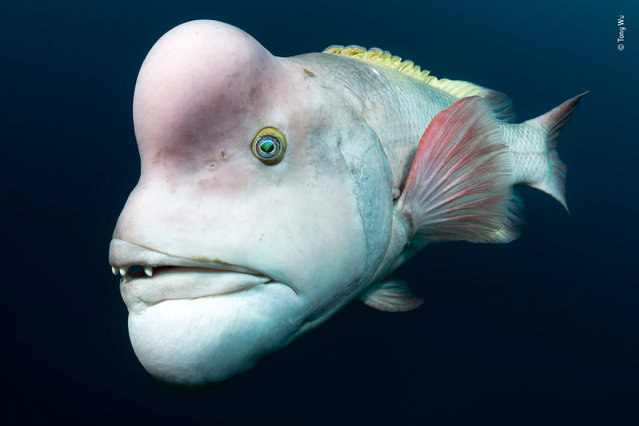
Looking for love by Tony Wu, USA. Highly commended, Animal Portraits. “Accentuating his mature appearance with pastel colours, protruding lips and an outstanding pink forehead, this Asian sheepshead wrasse sets out to impress females and see off rivals, which he will head-butt and bite, near Japan’s remote Sado Island. Individuals start out as females, and when they reach a certain age and size – up to a metre (more than 3 feet) long – can transform into males. Long-lived and slow-growing, the species is intrinsically vulnerable to overfishing”. (Photo by Tony Wu/2018 Wildlife Photographer of the Year)

Looking for love by Tony Wu, USA. Highly commended, Animal Portraits. “Accentuating his mature appearance with pastel colours, protruding lips and an outstanding pink forehead, this Asian sheepshead wrasse sets out to impress females and see off rivals, which he will head-butt and bite, near Japan’s remote Sado Island. Individuals start out as females, and when they reach a certain age and size – up to a metre (more than 3 feet) long – can transform into males. Long-lived and slow-growing, the species is intrinsically vulnerable to overfishing”. (Photo by Tony Wu/2018 Wildlife Photographer of the Year)
Details
03 Sep 2018 08:17:00
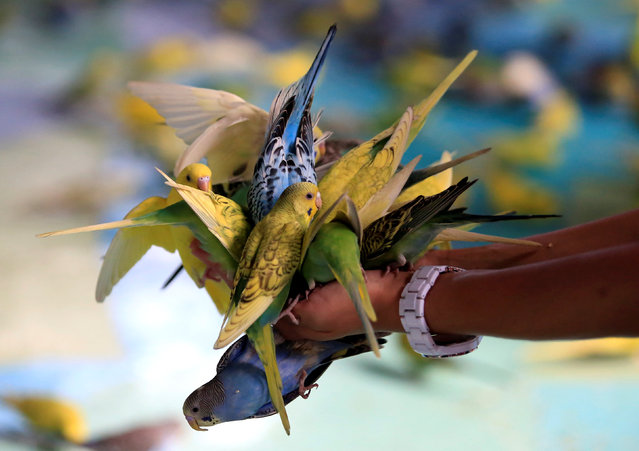
Budgies feed on seeds from a local visitor's hands at Ocean Park in metro Manila, Philippines September 10, 2016. (Photo by Romeo Ranoco/Reuters)

Budgies feed on seeds from a local visitor's hands at Ocean Park in metro Manila, Philippines September 10, 2016. (Photo by Romeo Ranoco/Reuters)
Details
11 Sep 2016 09:47:00