Loading...
Done


#Resistiré 2020 (# I will resist 2020), the hymn recorded by more than 30 Spanish artists to beat the coronavirus together. Participating in the hymn: Alex Ubago, Andrés Suárez, Álvaro Soler, Blas Cantó, Carlos Baute, Conchita, David Bisbal, David Otero, David Summers, Despistaos, Diana Navarro, Dvicio, Mariposa Effect, Hall Effect, Ele, Georgina, India, Jose Mercé, Josemi Carmona, Manuel Carrasco, Melendi, Mikel Erentxun, Nil Moliner, Pastora Soler, Pedro Guerra, Pitingo, Rosana, Rozalén, Rulo, Sofía Ellar and Vanesa Martín. Promoted by Cadena 100, all these musicians and artists come together under the production of Pablo Cebrián to get this Resistiré, with which all funds will be for the benefit of Cáritas (Caritas Internationalis is a confederation of 165 Catholic relief, development and social service organizations operating in over 200 countries and territories worldwide. Collectively and individually, their claimed missions are to work to build a better world, especially for the poor and oppressed).
Details
14 Apr 2020 00:03:00
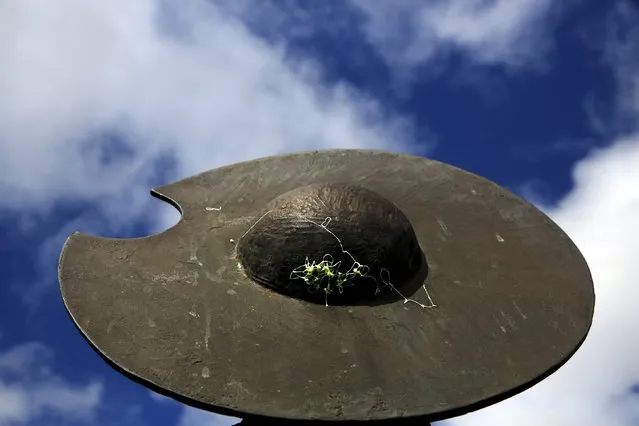
A sculpture of Don Quixote shows him wearing the basin he mistook for the enchanted helmet of the fictional Moorish king Mambrino in Alcazar de San Juan, Spain, April 5, 2016. (Photo by Susana Vera/Reuters)

A sculpture of Don Quixote shows him wearing the basin he mistook for the enchanted helmet of the fictional Moorish king Mambrino in Alcazar de San Juan, Spain, April 5, 2016. The arid central Spanish region of La Mancha is the setting for “Don Quixote”, the seventeenth-century novel by Miguel de Cervantes. Four hundred years after his death, references to the characters of Don Quixote, his loyal squire Sancho Panza and his beautiful lady Dulcinea abound in the surrounding villages from sweet treats to theatre productions involving livestock. Cervantes did not give away the name of the birthplace of Don Quixote, a middle-aged gentleman who becomes obsessed with chivalrous ideals. But many identify the village of Argamasilla de Alba as his hometown. The anniversary of Cervantes’ death is marked on the 23 April. (Photo by Susana Vera/Reuters)
Details
21 Apr 2016 12:32:00
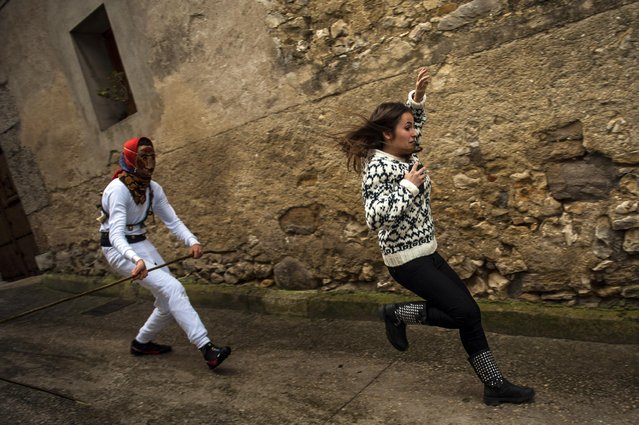
In this photo taken on Sunday, February 15, 2015 a girl runs away from a “Mamuxarro” during the carnival, in the small town of Unanu, northern Spain. While Rio de Janeiro may boast the world’s most famous carnival, the festive period of masquerades and wild and colorful costumes that precedes the Christian religious season of Lent is also a permanent and popular fixture for celebration in Spain and Portugal, with each country having its own strange and unique way of doing it. (Photo by Alvaro Barrientos/AP Photo)

In this photo taken on Sunday, February 15, 2015 a girl runs away from a “Mamuxarro” during the carnival, in the small town of Unanu, northern Spain. In the northern Spanish ancient village of Unamu, people dress up as “Mamuxarro”, folkloric figures in white with a red sash and a metal mask to cover their faces as they pursue townsfolk with sticks. According to custom, their “victims” (usually young women) must kneel and kiss the mamuxarro’s knee after he makes the sign of the cross on their forehead. (Photo by Alvaro Barrientos/AP Photo)
Details
22 Feb 2015 10:51:00
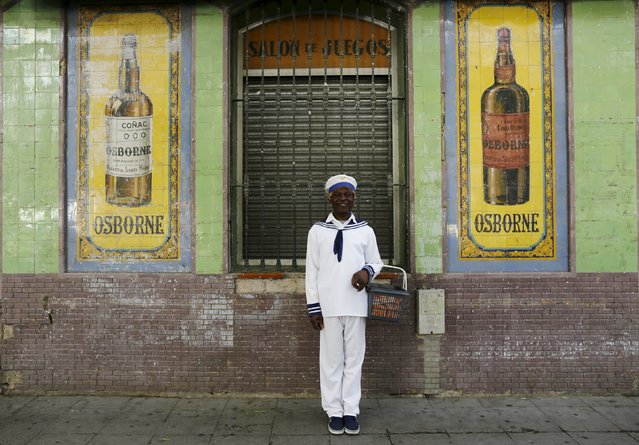
Howard Jackson, a Liberian migrant, poses for a portrait in the Andalusian capital of Seville, southern Spain March 7, 2016. (Photo by Marcelo del Pozo/Reuters)

Howard Jackson, a Liberian migrant, poses for a portrait in the Andalusian capital of Seville, southern Spain March 7, 2016. Jackson escaped civil war and spent three years crossing Africa before reaching Spain. Dressed up in one of his more than 200 costumes, from Peter Pan to Little Red Riding Hood, he is a well-known figure at an intersection entering the Spanish city of Seville where he has sold tissues to motorists for over a decade. Jackson is studying law and wants to become a judge. (Photo by Marcelo del Pozo/Reuters)
Details
24 Mar 2016 12:14:00
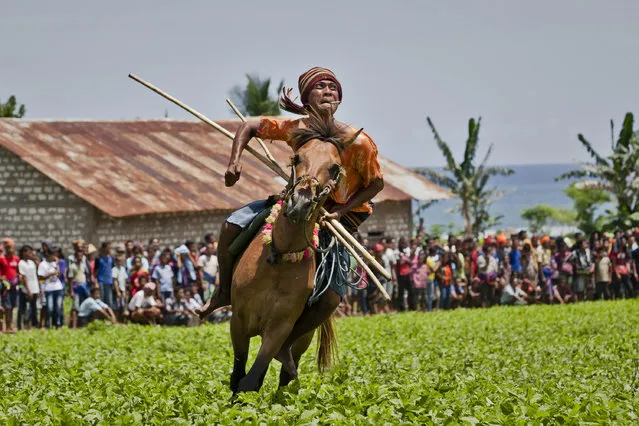
A Pasola rider reacts after throwing his spear during the Pasola war festival at Ratenggaro village on March 22, 2014 in Sumba Island, Indonesia. The Pasola Festival is an important annual event to welcome the new harvest season, which coincides with the arrival of  “Nyale” sea worms during February or March each year. Pasola, an ancient ritual fighting game, involves two teams of men on horseback charging towards each other while trying to hit their rivals with “pasol” javelins and avoid being hit themselves. (Photo by Ulet Ifansasti/Getty Images)

A Pasola rider reacts after throwing his spear during the Pasola war festival at Ratenggaro village on March 22, 2014 in Sumba Island, Indonesia. The Pasola Festival is an important annual event to welcome the new harvest season, which coincides with the arrival of “Nyale” sea worms during February or March each year. Pasola, an ancient ritual fighting game, involves two teams of men on horseback charging towards each other while trying to hit their rivals with “pasol” javelins and avoid being hit themselves. (Photo by Ulet Ifansasti/Getty Images)
Details
25 Mar 2014 07:54:00
Juri Mitomi, 20, holds a cigarette after a Coming of Age Day celebration ceremony at an amusement park in Tokyo January 12, 2015. According to a government announcement, more than 1.2 million men and women who were born in 1994 marked the coming of age this year, an increase of approximately 50,000 from last year. The increase is also the first since 1995. (Photo by Yuya Shino/Reuters)

Juri Mitomi, 20, holds a cigarette after a Coming of Age Day celebration ceremony at an amusement park in Tokyo January 12, 2015. According to a government announcement, more than 1.2 million men and women who were born in 1994 marked the coming of age this year, an increase of approximately 50,000 from last year. The increase is also the first since 1995. (Photo by Yuya Shino/Reuters)
Details
13 Jan 2015 14:05:00
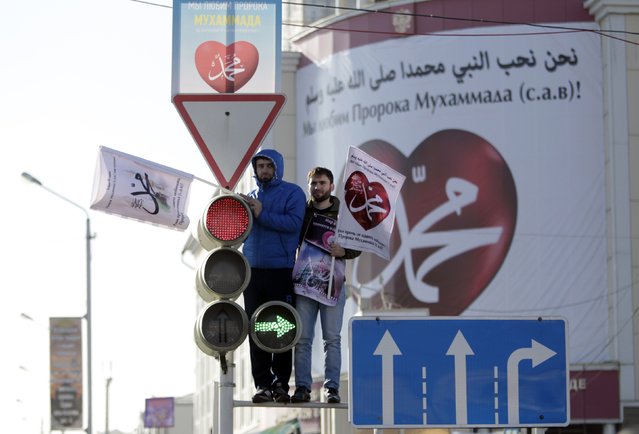
Men stand at the top of a traffic lights post as they attend a rally to protest against satirical cartoons of prophet Mohammad, in Grozny, Chechnya January 19, 2015. Tens of thousands of people staged the rally on Monday in Chechnya against French magazine Charlie Hebdo's cartoons of the prophet, which the predominantly Muslim region's leader denounced as “vulgar and immoral”. The posters read, “Mohammad”. (Photo by Eduard Korniyenko/Reuters)

Men stand at the top of a traffic lights post as they attend a rally to protest against satirical cartoons of prophet Mohammad, in Grozny, Chechnya January 19, 2015. Tens of thousands of people staged the rally on Monday in Chechnya against French magazine Charlie Hebdo's cartoons of the prophet, which the predominantly Muslim region's leader denounced as “vulgar and immoral”. The posters read, “Mohammad”. (Photo by Eduard Korniyenko/Reuters)
Details
20 Jan 2015 12:48:00
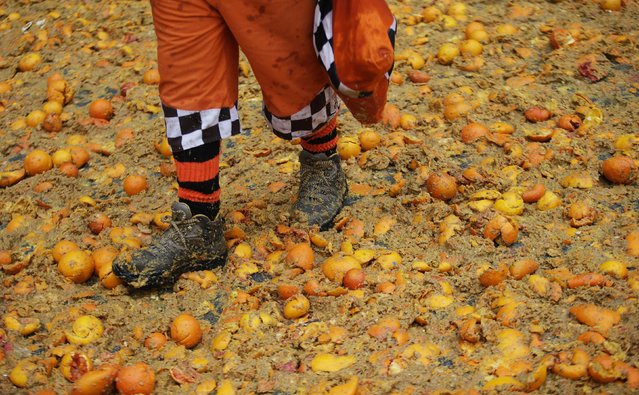
A member of a rival team walks during an annual carnival battle with oranges in the northern Italian town of Ivrea February 15, 2015. Dressed up as Middle Age kings' guards, a group of men ride in a horse-drawn carriage and pelt “foot soldiers” with oranges as thousands of people gather to re-enact a Middle Age battle when the townsfolk of Ivrea overthrew an evil king. (Photo by Max Rossi/Reuters)

A member of a rival team walks during an annual carnival battle with oranges in the northern Italian town of Ivrea February 15, 2015. Dressed up as Middle Age kings' guards, a group of men ride in a horse-drawn carriage and pelt “foot soldiers” with oranges as thousands of people gather to re-enact a Middle Age battle when the townsfolk of Ivrea overthrew an evil king. In a strange twist, instead of swords and cross bows, these days the weapons of choice are oranges. (Photo by Max Rossi/Reuters)
Details
16 Feb 2015 13:06:00