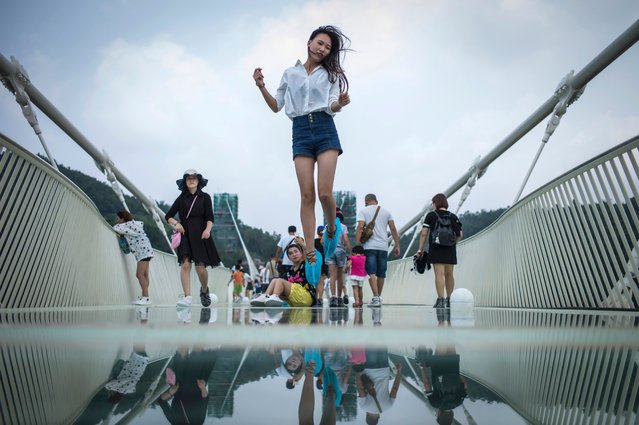
A visitor jumps for a photograph on the world's highest and longest glass-bottomed bridge above a valley in Zhangjiajie in China's Hunan Province on August 21, 2016. The bridge, which opened to the public on a trial basis on Saturday, spans 430 meters (1,410 feet) and rises about 300 meters (984 feet) above a valley in a scenic zone, making it the world's highest and longest glass-bottomed bridge according to Chinese state media. (Photo by Fred Dufour/AFP Photo)
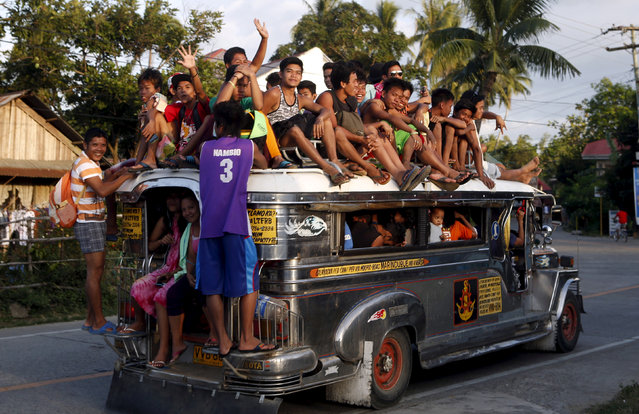
Residents ride on top of an overcrowded “Jeepney”, a locally manufactured public transport, along a highway in Mogpog town on Marinduque island in central Philippines April 8, 2015. (Photo by Erik De Castro/Reuters)
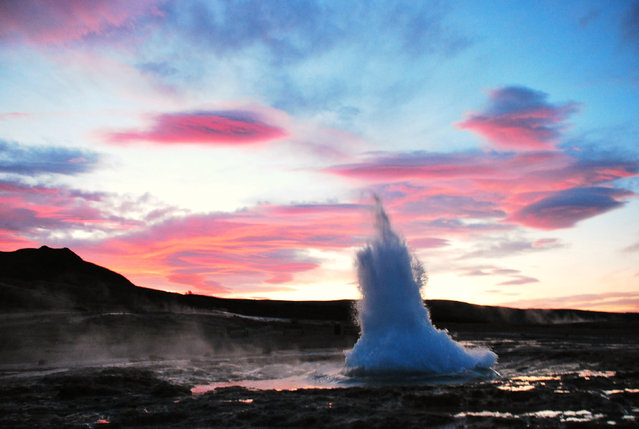
Strokkur geyser against cloudy sky at sunset. Strokkur is a fountain geyser located in a geothermal area beside the Hvítá River in Iceland in the southwest part of the country, east of Reykjavík. It is one of Iceland's most famous geysers, erupting once every 6–10 minutes. Its usual height is 15–20 m, although it can sometimes erupt up to 40 m high. (Photo by Teatsche Dijkhuis/Getty Images/EyeEm)
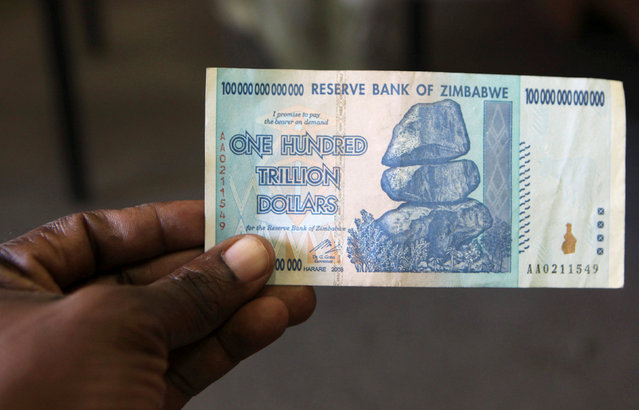
A man holds up for a picture a one hundred trillion Zimbabwean dollars note inside a shop in Harare, Zimbawe, June 12, 2015. Hyperinflation in Zimbabwe was a period of currency instability that began in the late 1990s shortly after the confiscation of private farms from landowners, towards the end of Zimbabwean involvement in the Second Congo War. During the height of inflation from 2008 to 2009, it was difficult to measure Zimbabwe's hyperinflation because the government of Zimbabwe stopped filing official inflation statistics. However, Zimbabwe's peak month of inflation is estimated at 79.6 billion percent in mid-November 2008. (Photo by Philimon Bulawayo/Reuters)
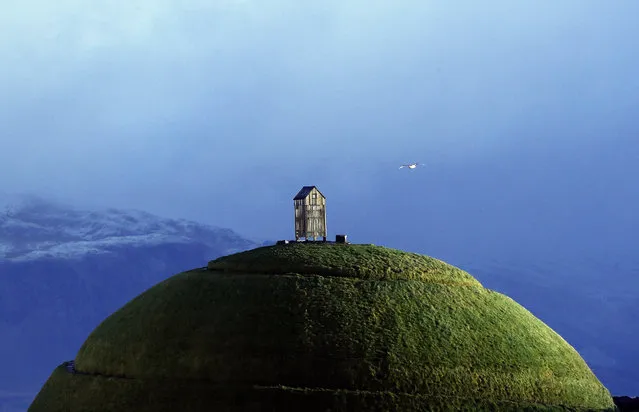
The Thufa hill in Reykjavik, Friday, October 28, 2016. Parliamentary elections will be held in Iceland on October 29, 2016, more than 250,000 voters are called to elect the new parliament, 63 members of the Althing parliament. (Photo by Frank Augstein/AP Photo)
For her series “Japanese Whispers”, Belgian photographer Zaza Bertrand headed inside the intimate world of rabuhos – Japanese love hotels. Love hotels became popular in Japan from the 1960s onwards, due to a lack of privacy in many family homes. There are now around 37,000 of these hotels in Japan, allowing short daytime “rests” or overnight stays. (Photo by Zaza Bertrand/The Guardian)