Loading...
Done
Second Place Winner: “Thunderstorm at False Kiva”. I hiked out to these ruins at night hoping to photograph them with the Milky Way, but instead a thunderstorm rolled through, creating this dramatic image. – Max Seigal. (Photo and caption by Max Seigal/National Geographic Traveler Photo Contest)

Second Place Winner: “Thunderstorm at False Kiva”. I hiked out to these ruins at night hoping to photograph them with the Milky Way, but instead a thunderstorm rolled through, creating this dramatic image. – Max Seigal. National Geographic Traveler Director of Photography Dan Westergren, one of this year's judges, shares his thoughts on the second place winner: “This photo combines two different scenes into one: the small kiva in a cliff dwelling and the grand vista of Canyonlands National Park across the valley. I really like the two different color palettes – warm inside and purple outside. This two-for-one scene was caused by the lightning storm outside the dwelling, which lit up the landscape like it was a huge electronic flash. Looking at this picture I can imagine what a wonderful sight it must have been for the ancient people who lived here. It doesn't seem too amazing now in our modern world, but might have been mind-blowing for the prehistoric residents”. Location: Utah. (Photo and caption by Max Seigal/National Geographic Traveler Photo Contest)
Details
02 Aug 2013 06:16:00
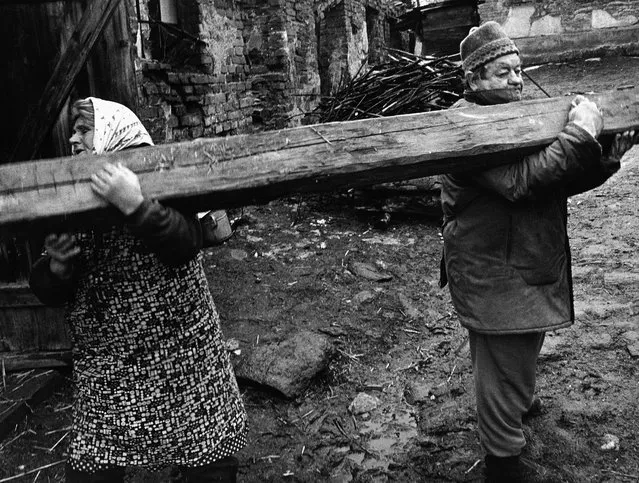
A love story with two log choppers. “In 1993, I was working on a project about life in the Olomouc region of Czechoslovakia. One day, I came to the village of Dlouhá Loučka-Křivá and went into a courtyard where I saw two old people, a husband and wife, sawing firewood for winter. They were working quietly, concentrating. I watched them fetch a beam from a wrecked barn, but they didn’t discuss how they planned to carry it to the saw. The woman faced one way, the man the other. When they realised, the woman eventually turned and followed her husband. The picture I took is the picture of many relationships – when each partner wants something different, but they have to come to an agreement, pull together eventually”. (Photo by Jindrich Streit)

A love story with two log choppers. “In 1993, I was working on a project about life in the Olomouc region of Czechoslovakia. One day, I came to the village of Dlouhá Loučka-Křivá and went into a courtyard where I saw two old people, a husband and wife, sawing firewood for winter. They were working quietly, concentrating. I watched them fetch a beam from a wrecked barn, but they didn’t discuss how they planned to carry it to the saw. The woman faced one way, the man the other. When they realised, the woman eventually turned and followed her husband. The picture I took is the picture of many relationships – when each partner wants something different, but they have to come to an agreement, pull together eventually”. (Photo by Jindrich Streit)
Details
04 Aug 2016 12:34:00
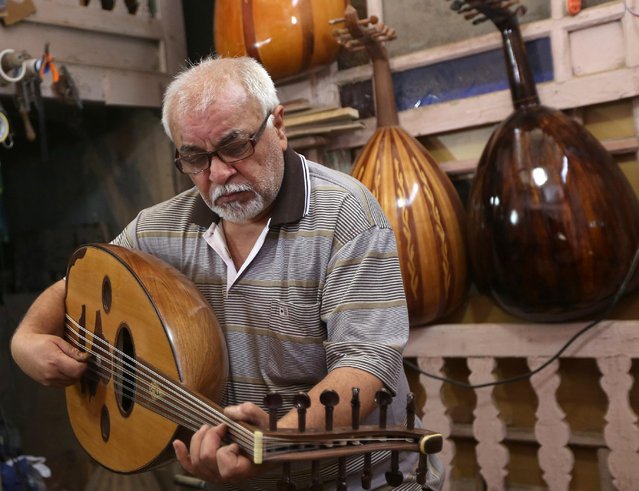
In this photo taken Saturday, June 20, 2015, Mahmoud Abdulnabi tries out an oud, an Arabic instrument related to the lute, at his workshop in Baghdad, Iraq. “The oud is different than other musical instruments”, said Abdulnabi, who has crafted ouds played by some of Iraq's best known musicians, many of whom look down from headshots on the walls. “If you feel joyful, it can play your joy. If the circumstances are sad it can play your sorrow and... help to empty whatever is in your chest”. (Photo by Hadi Mizban/AP Photo)

In this photo taken Saturday, June 20, 2015, Mahmoud Abdulnabi tries out an oud, an Arabic instrument related to the lute, at his workshop in Baghdad, Iraq. “The oud is different than other musical instruments”, said Abdulnabi, who has crafted ouds played by some of Iraq's best known musicians, many of whom look down from headshots on the walls. “If you feel joyful, it can play your joy. If the circumstances are sad it can play your sorrow and... help to empty whatever is in your chest”. (Photo by Hadi Mizban/AP Photo)
Details
05 Jul 2015 10:32:00
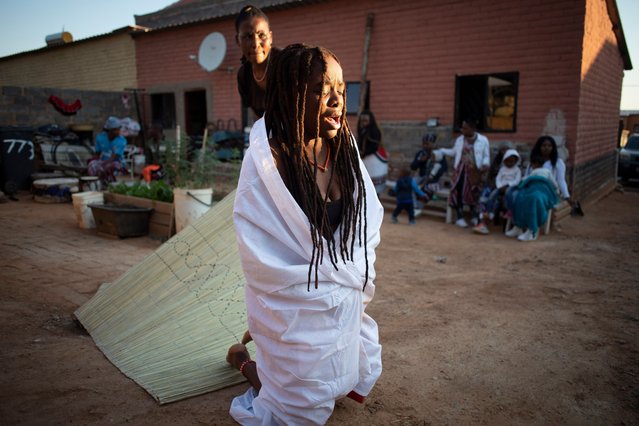
“Sangoma” initiate Dipuo Banda (C) is led out of her teachers shack while she remains in a trance like state prior to dancing during her 3 day initiation ceremony with her teacher, family, friends and students in the Alexandra Township in Johannesburg, South Africa, 14 May 2021. Sangomas, the Zulu term for Medicine Women or traditional healers, fulfill different social and political roles in the community, including divination, physical healing, emotional and spiritual illnesses, directing birth or death rituals and finding lost cattle. (Photo by Kim Ludbrook/EPA/EFE)

“Sangoma” initiate Dipuo Banda (C) is led out of her teachers shack while she remains in a trance like state prior to dancing during her 3 day initiation ceremony with her teacher, family, friends and students in the Alexandra Township in Johannesburg, South Africa, 14 May 2021. Sangomas, the Zulu term for Medicine Women or traditional healers, fulfill different social and political roles in the community, including divination, physical healing, emotional and spiritual illnesses, directing birth or death rituals and finding lost cattle. (Photo by Kim Ludbrook/EPA/EFE)
Details
28 May 2021 08:13:00
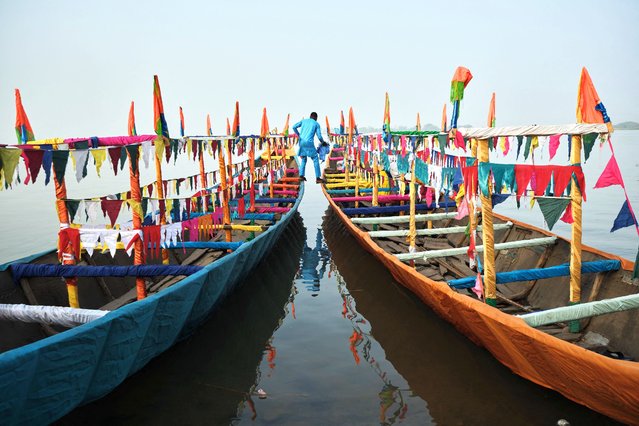
A man crosses from a pirogue to another pirogue during the annual boat regatta in Yauri, Kebbi State, on February 15, 2025. The regatta festival started about 200 years ago as a display of naval strength of the Gungu people, where the Gungu warriors annually attacked dangerous hippopotamus that were destroying farmlands. Warriors would board various sizes of canoes with different types of weapons to attack the animal on the River Niger. This required expertise in canoe paddling and naval warfare. It also served as training exercise for upcoming Gungu warriors. (Photo by Toyin Adedokun/AFP Photo)

A man crosses from a pirogue to another pirogue during the annual boat regatta in Yauri, Kebbi State, on February 15, 2025. The regatta festival started about 200 years ago as a display of naval strength of the Gungu people, where the Gungu warriors annually attacked dangerous hippopotamus that were destroying farmlands. Warriors would board various sizes of canoes with different types of weapons to attack the animal on the River Niger. This required expertise in canoe paddling and naval warfare. It also served as training exercise for upcoming Gungu warriors. (Photo by Toyin Adedokun/AFP Photo)
Details
25 Feb 2025 01:59:00
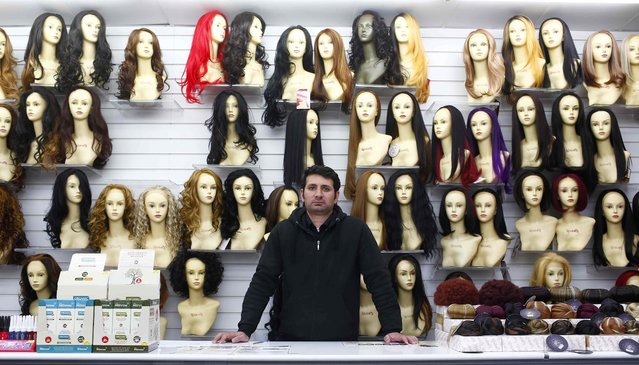
Kashir Mir, 34, poses for a photograph at his workplace, Juliet Wig Shop, in the London constituency of Brent Central, Britain, April 13, 2015. Mir, who was born in Pakistan, said: “I will vote but it's a secret. I also hope they can manage immigration better as I have been stopped and interviewed for hours returning from Pakistan. I'm an honest man, working here and paying my tax”. (Photo by Eddie Keogh/Reuters)

Kashir Mir, 34, poses for a photograph at his workplace, Juliet Wig Shop, in the London constituency of Brent Central, Britain, April 13, 2015. Mir, who was born in Pakistan, said: “I will vote but it's a secret. I also hope they can manage immigration better as I have been stopped and interviewed for hours returning from Pakistan. I'm an honest man, working here and paying my tax”. Brent, a northwest London neighbourhood that's home to Wembley football stadium, is among the most ethnically diverse areas in the United Kingdom. As the country approaches a closely fought election on May 7, Reuters photographer Eddie Keogh visited shopkeepers to get their views on the poll. (Photo by Eddie Keogh/Reuters)
Details
29 Apr 2015 06:30:00
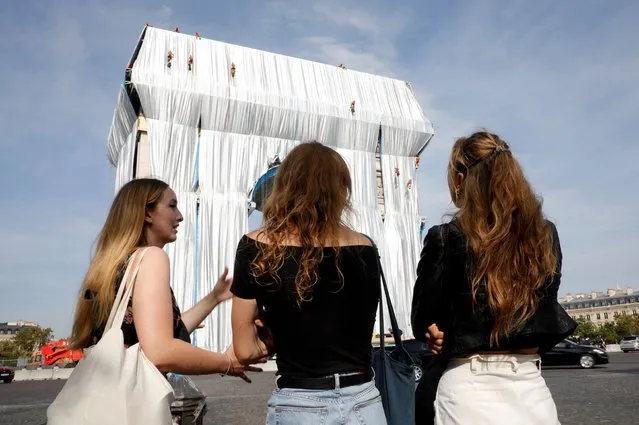
Bystanders look on as workers arrange silver blue fabric, part of the process of wrapping L'Arc de Triomphe in Paris on September 13, 2021, designed by the late artist Christo. Work has begun on wrapping the Arc de Triomphe in Paris in silvery-blue fabric as a posthumous tribute to the artist Christo, who had dreamt of the project for decades. Bulgarian-born Christo, a longtime Paris resident, had plans for sheathing the imposing war memorial at the top of the Champs-Elysees while renting an apartment near it in the 1960s (Photo by Geoffroy Van der Hasselt/AFP Photo)

Bystanders look on as workers arrange silver blue fabric, part of the process of wrapping L'Arc de Triomphe in Paris on September 13, 2021, designed by the late artist Christo. Work has begun on wrapping the Arc de Triomphe in Paris in silvery-blue fabric as a posthumous tribute to the artist Christo, who had dreamt of the project for decades. Bulgarian-born Christo, a longtime Paris resident, had plans for sheathing the imposing war memorial at the top of the Champs-Elysees while renting an apartment near it in the 1960s (Photo by Geoffroy Van der Hasselt/AFP Photo)
Details
01 May 2022 04:48:00
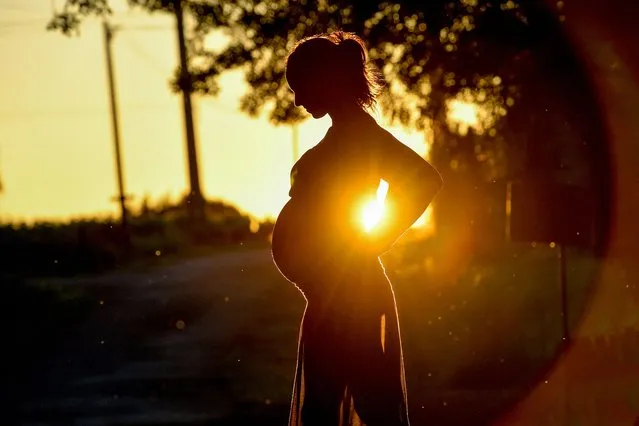
A pregnant woman poses on June 19, 2018 in Vertou, western France. France had an estimated population of 68.4 million by January 1, 2024, representing a further year-on-year increase of 0.3 percent, limited by a marked drop in the birth rate, the INSEE national statistics bureau of France reported on January 16, 2024. In 2023, 678,000 babies were born in France, 6.6 percent fewer than the previous year, the lowest number of births in any year since 1946. Over the same period, there were 631,000 deaths, down 6.5 percent on 2022, a year marked by the consequences of the Covid-19 pandemic and episodes of extreme heat. (Photo by Loic Venance/AFP Photo)

A pregnant woman poses on June 19, 2018 in Vertou, western France. France had an estimated population of 68.4 million by January 1, 2024, representing a further year-on-year increase of 0.3 percent, limited by a marked drop in the birth rate, the INSEE national statistics bureau of France reported on January 16, 2024. In 2023, 678,000 babies were born in France, 6.6 percent fewer than the previous year, the lowest number of births in any year since 1946. Over the same period, there were 631,000 deaths, down 6.5 percent on 2022, a year marked by the consequences of the Covid-19 pandemic and episodes of extreme heat. (Photo by Loic Venance/AFP Photo)
Details
27 Feb 2024 07:29:00