Loading...
Done
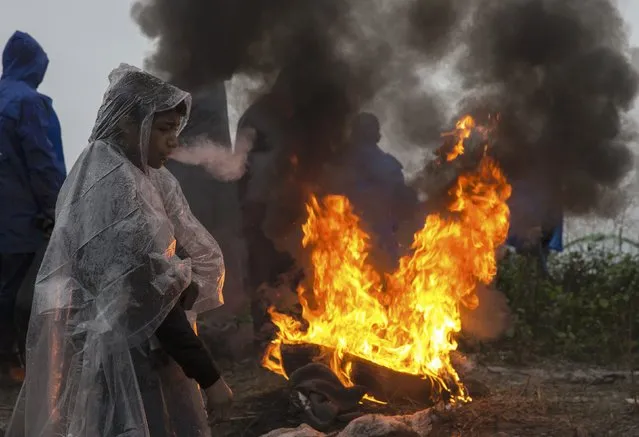
A migrant smokes a cigarette as he waits among others to cross the Croatian border near the village of Berkasovo, Serbia October 19, 2015. (Photo by Marko Djurica/Reuters)

A migrant smokes a cigarette as he waits among others to cross the Croatian border near the village of Berkasovo, Serbia October 19, 2015. Thousands of migrants clamoured to enter European Union member Croatia from Serbia on Monday after a night spent in the cold and mud of no-man's land, their passage west slowed by a Slovenian effort to impose limits on the flow to western Europe. (Photo by Marko Djurica/Reuters)
Details
22 Oct 2015 08:00:00
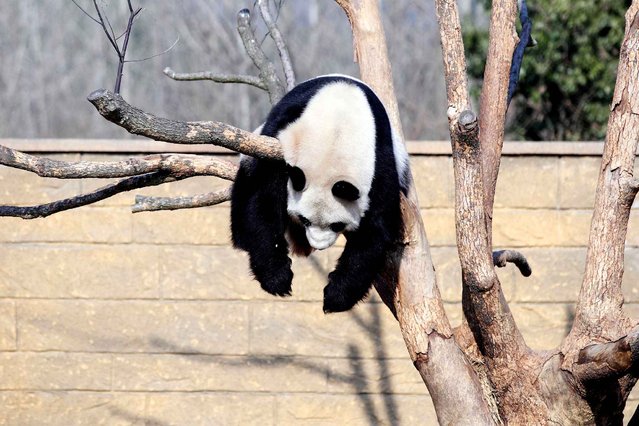
This picture taken on January 1, 2014 shows giant panda “Li Li” sleeping on a tree in Hangzhou Wild Animal World in Hangzhou, east China's Zhejiang province. Giant pandas, notorious for their low s*x drive, are among the world's most endangered animals. Fewer than 1,600 pandas remain in the wild, mainly in China's Sichuan province, with a further 300 in captivity around the world. (Photo by AFP Photo)

This picture taken on January 1, 2014 shows giant panda “Li Li” sleeping on a tree in Hangzhou Wild Animal World in Hangzhou, east China's Zhejiang province. Giant pandas, notorious for their low s*x drive, are among the world's most endangered animals. Fewer than 1,600 pandas remain in the wild, mainly in China's Sichuan province, with a further 300 in captivity around the world. (Photo by AFP Photo)
Details
04 Jan 2014 14:58:00
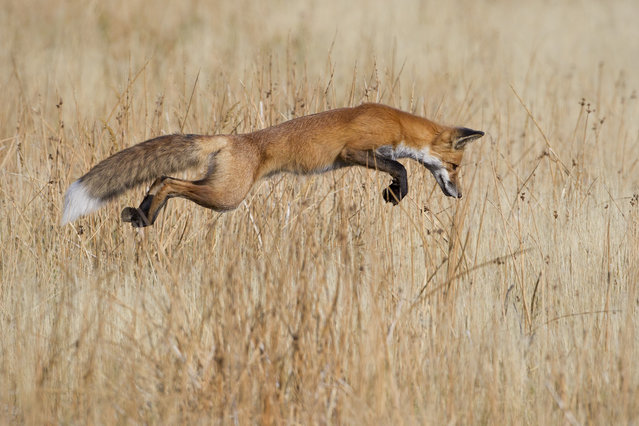
Canada: “Lucky pounce”. (Photo by Connor Stefanison/Wildlife Photographer of the Year 2013)

The winners of The London’s Natural History Museum's prestigious Wildlife Photographer of the Year for 2013 have finally been unveiled. Selected from almost 43,000 entries from 96 countries, the winners offer a glimpse of the stunning array of natural beauty on our planet. Photo: Canada: “Lucky pounce”. “Anticipating the pounce – that was the hardest part”, says Connor, who had come to Yellowstone National Park, Wyoming, USA, in search of wildlife as much as the spectacular landscape. He had found this fox, his first ever, on his last day in the park. It was so absorbed in hunting that Connor had plenty of time to get out of the car and settle behind a rock. It quartered the grassland, back and forth, and then started staring intently at a patch of ground, giving Connor just enough warning of the action to come. When it sprung up, Connor got his shot. And when it landed, the fox got his mouse. (Photo by Connor Stefanison/Wildlife Photographer of the Year 2013)

Details
17 Oct 2013 08:12:00
Ocean voyage

Do you think that history is a science? Well, not exactly. First, and foremost, history is the state's “legend of wars”, it’s official regalia. Of course, public historians are not interested in scientific truth – quite the opposite. In this respect, any attempt to present a state’s history as altruistic and benevolent as possible is welcomed and encouraged – as opposed to any revisionism attempts that may be more accurate. In this matter, Chinese have surpassed us all – they revised in highly creative manner (but rather shamelessly) the technology already invented by Europeans, a process that resulted in oldest state on the planet. Here is an interesting paradox: ask any sinologist about the Middle Kingdom during second century B.C., and he will describe it to you in such a vivid manner as if he has been living there all his life – but as soon as you will ask him to describe Chinese history in the 19-20th centuries… let's say, his eagerness will be greatly diminished. However, we will discuss China in a different article, and in the meantime we will try to understand how exactly historic “legend of wars” is formed and functions – based on a specific and well-known example. A great example is Ferdinand Magellan's first voyage around the world.
Details
14 Nov 2011 09:11:00
Takeoka Chisaka, Hiroshima, Japan. “One morning in August 1945, I was walking home from the night shift at a factory in Hiroshima. As I reached my door, there was a huge explosion. When I came to, my head was bleeding and I had been blasted 30m away”. (Photo and caption by Sasha Maslov)

Takeoka Chisaka, Hiroshima, Japan. “One morning in August 1945, I was walking home from the night shift at a factory in Hiroshima. As I reached my door, there was a huge explosion. When I came to, my head was bleeding and I had been blasted 30m away. The atomic bomb had detonated. When I found my mother, her eyes were badly burned. A doctor said they had to come out, but he didn’t have the proper tools so used a knife instead. It was hellish. I became a peace-worker after the war. In the 1960s, at a meeting at the UN, I met one of the people who created the atomic bomb. He apologised”. (Photo and caption by Sasha Maslov)
Details
11 May 2015 11:56:00
People visit an art installation “Alley of Flying Umbrellas” in central St. Petersburg, Russia, May 15, 2015. Art installation inspired by “Umbrella Sky Project” of Portuguese town of Agueda and was made of 500 colored umbrellas. (Photo by Anatoly Maltsev/EPA)

People visit an art installation “Alley of Flying Umbrellas” in central St. Petersburg, Russia, May 15, 2015. Art installation inspired by “Umbrella Sky Project” of Portuguese town of Agueda and was made of 500 colored umbrellas. (Photo by Anatoly Maltsev/EPA)
Details
19 May 2015 12:13:00
An animal rights protester demonstrates for the abolition of bull runs and bullfights, three days before the start of the famous running of the bulls San Fermin festival in Pamplona, northern Spain, July 4, 2015. (Photo by Eloy Alonso/Reuters)

An animal rights protester demonstrates for the abolition of bull runs and bullfights, three days before the start of the famous running of the bulls San Fermin festival in Pamplona, northern Spain, July 4, 2015. (Photo by Eloy Alonso/Reuters)
Details
05 Jul 2015 10:45:00
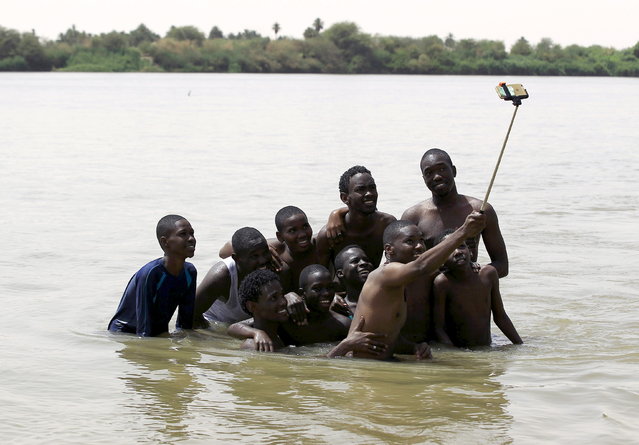
A group of young men use a selfie stick to take a picture of themselves in shallow waters known as the first cataract of the River Nile outside Khartoum, Sudan, May 22, 2015. In Sudan, which faces insurgences in the western region of Darfur and along its border with breakaway South Sudan, as well as double-digit inflation and high unemployment, life goes on for young people in the capital Khartoum. (Photo by Mohamed Nureldin Abdallah/Reuters)

A group of young men use a selfie stick to take a picture of themselves in shallow waters known as the first cataract of the River Nile outside Khartoum, Sudan, May 22, 2015. In Sudan, which faces insurgences in the western region of Darfur and along its border with breakaway South Sudan, as well as double-digit inflation and high unemployment, life goes on for young people in the capital Khartoum. (Photo by Mohamed Nureldin Abdallah/Reuters)
Details
09 Jul 2015 12:20:00