A woman plays billiards during a local championship at a sports hall in Yemen's capital Sanaa on December 16, 2019. (Photo by Mohammed Huwais/AFP Photo)
Revellers brave the rain as they make the most of New Year's Eve in Liverpool city centre, United Kingdom on December 31, 2023. (Photo by Ioannis Alexopoulos/London News Pictures)
A person reacts on the “Swiftie Steps” ahead of a Taylor Swift concert, following the cancellation of three Taylor Swift concerts in Vienna because of a planned attack, at Wembley Stadium in London, Britain on August 15, 2024. (Photo by Toby Melville/Reuters)
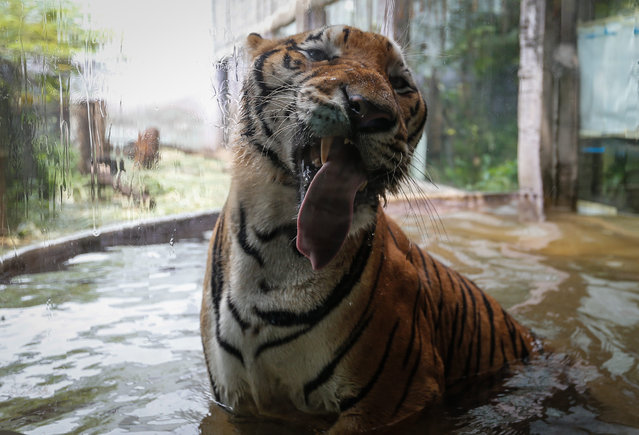
A Bengal tiger licks a glass enclosure during a presentation of Bengial tiger cubs at the Malabon Zoo in Malabon City, north of Manila, Philippines, 14 July 2016. The Bengal tiger cubs, which were born at the zoo, are two months old and named “Tiger Duterte” and “Tiger Leni”. The Malabon Zoo has one of the largest private collections of exotic and endemic animals in the Philippines. (Photo by Mark R. Cristino/EPA)
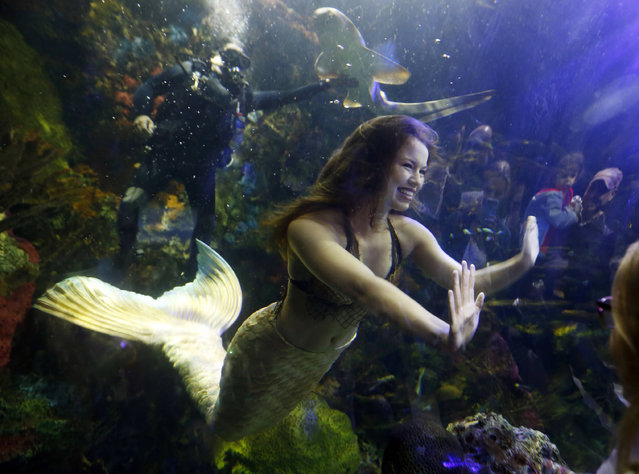
Mermaid Hales Parcells geets children as she performs at the Virginia Aquarium in Virginia Beach, Va., Monday, April 3, 2017. The Aquarium presents a mermaid show one night each week during the month of April. (Photo by Steve Helber/AP Photo)
In this June 16, 2017 photo, Batel Delciner, 23, removes wood from a furnace to lower the heat cooking sugar juice at the Ti Jean distillery, which produces clairin, a sugar-based alcoholic drink, in Leogane, Haiti. The broth is cooked for about four hours after a fermentation period of four to eight days. (Photo by Dieu Nalio Chery/AP Photo)
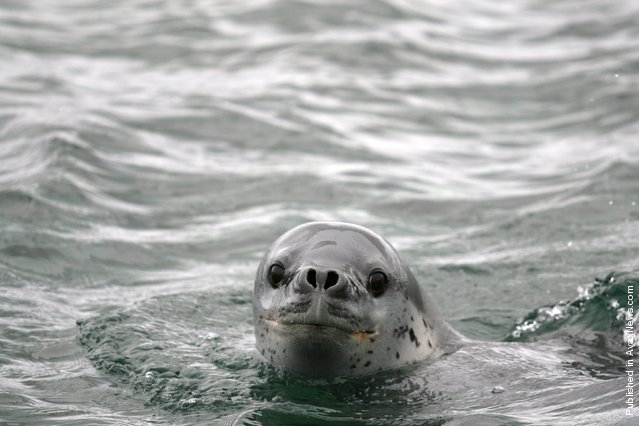
“The leopard seal (Hydrurga leptonyx), also referred to as the sea leopard, is the second largest species of seal in the Antarctic (after the southern elephant seal). It is most common in the southern hemisphere along the coast of Antarctica and on most sub-Antarctic islands, but can also be found on the coasts of southern Australia, Tasmania, South Africa, New Zealand, Lord Howe Island, Tierra del Fuego, the Cook Islands, and the Atlantic coast of South America. It can live twenty-six years, possibly more. Orcas and large sharks are the only natural predators of leopard seals”. – Wikipedia