Loading...
Done
Nuclear Football

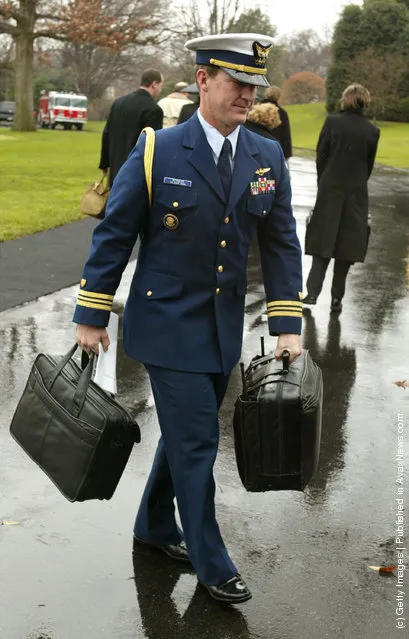
“The nuclear football (also known as the atomic football, the president's emergency satchel, the button, the black box, or just the football) is a briefcase, the contents of which are to be used by the President of the United States of America to authorize a nuclear attack while away from fixed command centers, such as the White House Situation Room. It functions as a mobile hub in the strategic defense system of the United States. It is a metallic Zero Halliburton briefcase carried in a black leather “jacket”. The package weighs around 45 pounds (20 kilograms). A small antenna protrudes from the bag near the handle”. – Wikipedia

Photo: A U.S. Military officer carries the “football”, which carries nuclear launch codes, on South Lawn after returning with U.S. President George W. Bush to the White House January 7, 2002 in Washington, DC. (Photo by Mark Wilson/Getty Images)
Details
06 Aug 2011 12:53:00
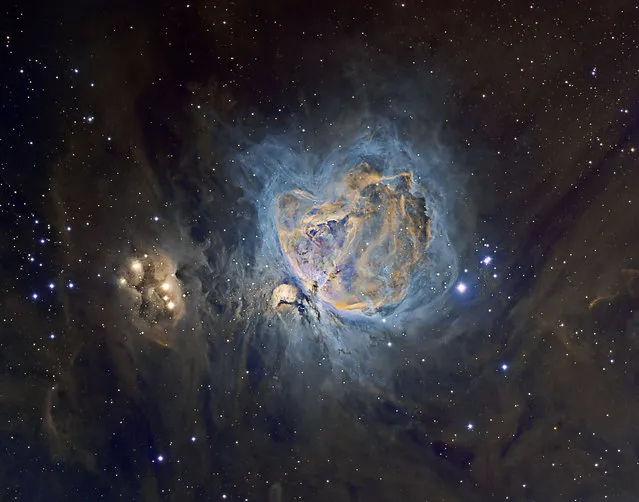
M42 Subtle V1 cropped. One of the most well-known astronomical objects in our universe is the Orion Nebula and this image depicts the wider region of the Orion Molecular Cloud Complex that is its home. This complex also includes another popular target for astrophotographers, the Horsehead Nebula, as well as Barnard’s Loop and the Running Man Nebula, which can be seen to the left of this photograph. (Photo by Patrick Gilliland)

M42 Subtle V1 cropped. One of the most well-known astronomical objects in our universe is the Orion Nebula and this image depicts the wider region of the Orion Molecular Cloud Complex that is its home. This complex also includes another popular target for astrophotographers, the Horsehead Nebula, as well as Barnard’s Loop and the Running Man Nebula, which can be seen to the left of this photograph. (Photo by Patrick Gilliland)
Details
17 Nov 2015 08:05:00
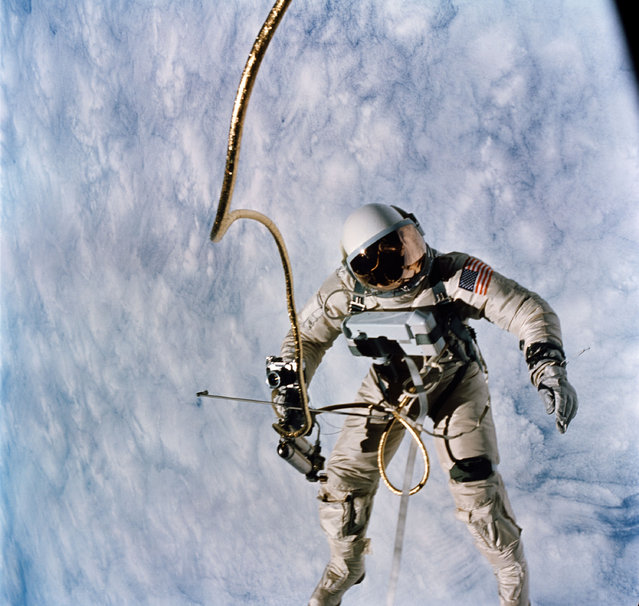
Astronaut Edward H. White II, pilot for the Gemini-Titan 4 (GT-4) spaceflight, floats in the zero-gravity of space during the third revolution of the GT-4 spacecraft on June 3, 1965. White wears a specially designed spacesuit. His face is shaded by a gold-plated visor to protect him from unfiltered rays of the sun. (Photo by NASA)

Astronaut Edward H. White II, pilot for the Gemini-Titan 4 (GT-4) spaceflight, floats in the zero-gravity of space during the third revolution of the GT-4 spacecraft on June 3, 1965. White wears a specially designed spacesuit. His face is shaded by a gold-plated visor to protect him from unfiltered rays of the sun. In his right hand he carries a Hand-Held Self-Maneuvering Unit (HHSMU) that gives him control over his movements in space. White also wears an emergency oxygen chest pack; and he carries a camera mounted on the HHSMU for taking pictures of the sky, Earth and the GT-4 spacecraft. He is secured to the spacecraft by a 25-feet umbilical line and a 23-feet tether line. Both lines are wrapped together in gold tape to form one cord. Astronaut James A. McDivitt, command pilot, remained inside the spacecraft during the extravehicular activity (EVA). Astronaut White died in the Apollo/Saturn 204 fire at Cape Kennedy on January 27, 1967. (Photo by NASA)
Details
22 Jul 2014 12:05:00
Soap Bubble Structures by Kym Cox. Bubbles optimise space and minimise their surface area for a given volume of air. This phenomenon makes them a useful tool in many areas of research, in particular, materials science and ‘packing’ – how things fit together. Bubble walls drain under gravity, thin at the top, thick at the bottom, which interferes with travelling lightwaves to create bands of colour. Black spots show the wall is too thin for interference colours, indicating the bubble is about to burst. (Photo by Kym Cox/2019 Science Photographer of the Year/RPS)

Soap Bubble Structures by Kym Cox. Bubbles optimise space and minimise their surface area for a given volume of air. This phenomenon makes them a useful tool in many areas of research, in particular, materials science and “packing” – how things fit together. Bubble walls drain under gravity, thin at the top, thick at the bottom, which interferes with travelling lightwaves to create bands of colour. Black spots show the wall is too thin for interference colours, indicating the bubble is about to burst. (Photo by Kym Cox/2019 Science Photographer of the Year/RPS)
Details
15 Aug 2019 00:03:00
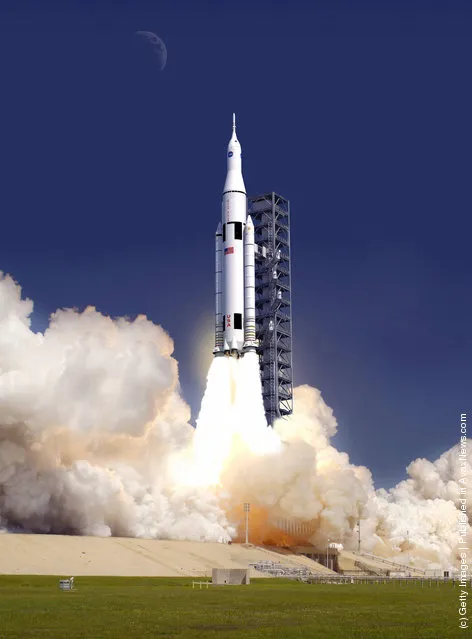
NASA's New Space Launch System

“The Space Launch System, or SLS, is a Shuttle-Derived heavy launch vehicle being designed by NASA, following the cancellation of the Constellation Program, to replace the Space Shuttle after its retirement. The NASA Authorization Act of 2010 envisions the transformation of the Ares I and Ares V vehicle designs into a single launch vehicle usable for both crew and cargo. It is to be upgraded over time with more powerful versions. The proposed SLS is visually similar to the legacy Saturn V booster and in particular the proposed, two-stage, Saturn INT-20”. – Wikipedia

Photo: In this illustration provided by NASA, the design for a new space rocket system, the Space Launch System, is seen. NASA's new rocket design will reportedly cost about $35 billion and be ready to for test launch in 2017. According to NASA, the rocket will be used to carry Orion Multi-Purpose Crew Vehicle as well as cargo and science experiments to earth's orbit, as a backup for the space station and possibly destinations beyond that. (Illustration by NASA via Getty Images)
Details
15 Sep 2011 10:50:00
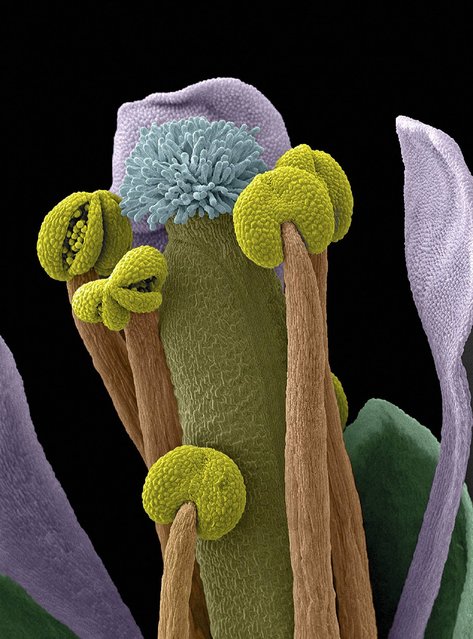
Scanning electron micrograph (SEM) of an Arabidopsis thaliana flower, also commonly known as thale cress. Some of the anthers are open, revealing pollen grains ready for dispersal. Arabidopsis was the first plant to have its entire genome sequenced and is widely used as a model organism in molecular and plant biology. Horizontal width of image is 1200 microns. Magnification 100x. (Photo by Stefan Eberhard/Wellcome Images)

Beautiful, strange and occasionally alarming pictures from the shortlist for this year’s Wellcome image awards – which celebrate the very best in science photography and imaging – from an x-ray of a bat to a micrograph of a kidney stone. The exhibition opens on 12 March at three science centres and the Museum of Science and Industry in Manchester. Photo: Scanning electron micrograph (SEM) of an Arabidopsis thaliana flower, also commonly known as thale cress. Some of the anthers are open, revealing pollen grains ready for dispersal. Arabidopsis was the first plant to have its entire genome sequenced and is widely used as a model organism in molecular and plant biology. Horizontal width of image is 1200 microns. Magnification 100x. (Photo by Stefan Eberhard/Wellcome Images)
Details
11 Mar 2014 05:58:00
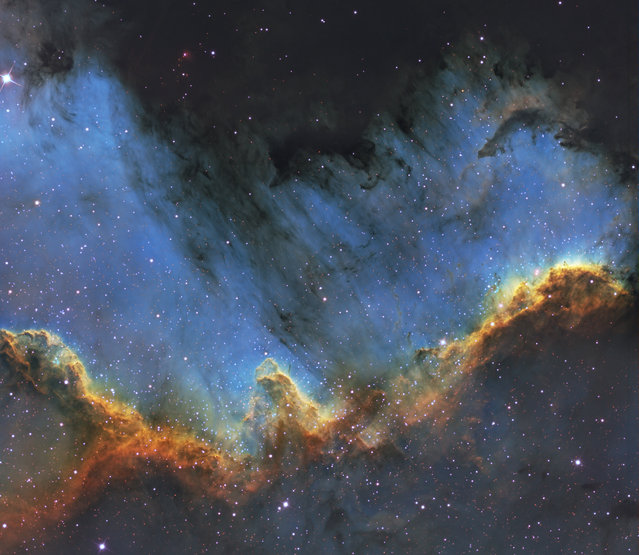
The Cygnus Wall is in the southern  area of NGC7000 also known as the North America Nebula. It is approximately 1800 light years from Earth, and is in the constellation Cygnus. The Wall is an energized shock front and contains the most concentrated star formations in the nebula. The size of the North America Nebula is about 4 full moons. (Bill Snyder)

Amateur astronomer Bill Snyder has been involved with astrophotography since 2007. Photo: The Cygnus Wall is in the southern area of NGC7000 also known as the North America Nebula. It is approximately 1800 light years from Earth, and is in the constellation Cygnus. The Wall is an energized shock front and contains the most concentrated star formations in the nebula. The size of the North America Nebula is about 4 full moons. (Photo and caption by Bill Snyder)
Details
30 Oct 2013 09:15:00
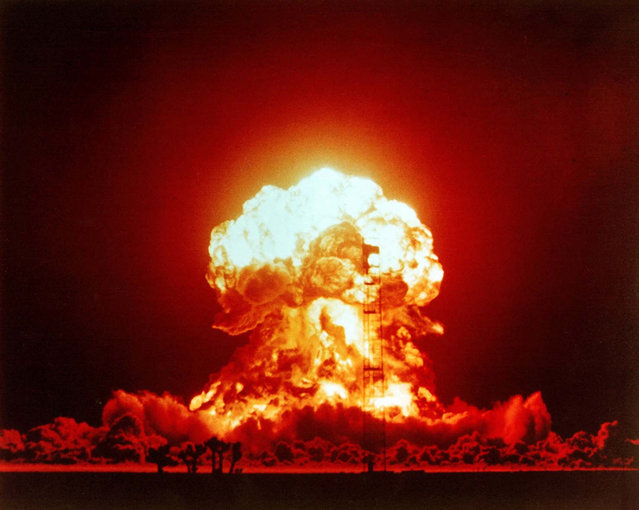
The BADGER shot was a 23 kiloton nuclear bomb. Over 2,000 US soldiers were within 3.7 kilometers of the explosion. (Photo by Alamy Stock Photo)

The BADGER shot was a 23 kiloton nuclear bomb. Over 2,000 US soldiers were within 3.7 kilometers of the explosion. (Photo by Alamy Stock Photo)
Details
12 Aug 2017 05:38:00