Loading...
Done
Watercolor Painting By Shin Jong Sik

Watercolorist Shin Jong Sik is famous for expressing clean, transparent colors and his still life paintings express colorful, dignified and deep feeling. Taking flowers, dishes and hemp cloth as materials, he does not compose as they are seen but recomposes with new ideas.
Details
02 Apr 2014 12:58:00
A demonstrator with a Palestinian flag painted on her face takes part in a march to express solidarity with Palestinians in Gaza, in Beirut, Lebanon on October 13, 2023. (Photo by Mohamed Azakir/Reuters)

A demonstrator with a Palestinian flag painted on her face takes part in a march to express solidarity with Palestinians in Gaza, in Beirut, Lebanon on October 13, 2023. (Photo by Mohamed Azakir/Reuters)
Details
23 Oct 2023 05:20:00
Prince Philip, Duke of Edinburgh practicing his bicycle polo technique, Windsor Great Park, Berkshire, 1964. (Photo by Norman Potter/Daily Express/Hulton Archive/Getty Images)

Prince Philip, Duke of Edinburgh practicing his bicycle polo technique, Windsor Great Park, Berkshire, 1964. (Photo by Norman Potter/Daily Express/Hulton Archive/Getty Images)
Details
25 Jun 2018 00:01:00
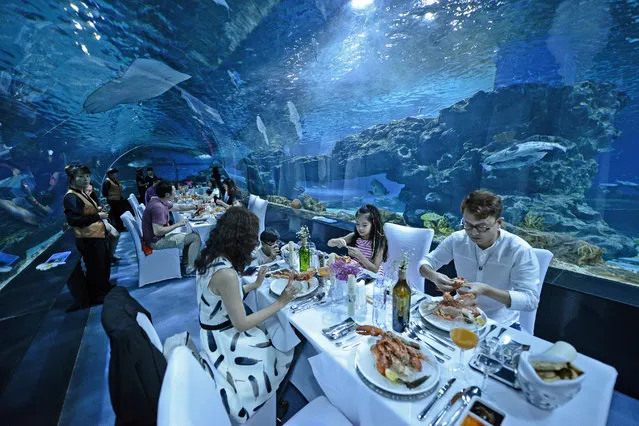
Aquarium visitors attend a dinner party in an underwater tunnel in Tianjin, China on September 15, 2016. (Photo by Feature China/Barcroft Images)

Aquarium visitors attend a dinner party in an underwater tunnel in Tianjin, China on September 15, 2016. Tianjin Haichang Polar Ocean World opened in the city of Tianjin, southeast of Beijing, in 2010. It gives visitors a chance to see more than 150 large animals from the Arctic and Antarctic regions, including polar bears. (Photo by Feature China/Barcroft Images)
Details
16 Sep 2016 11:18:00
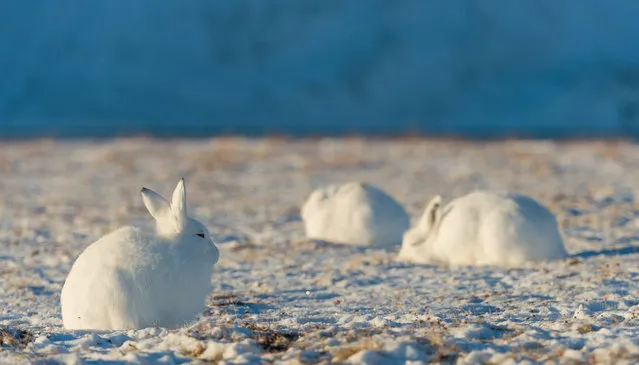
Arctic Hare

The arctic hare, or polar rabbit, is a species of hare which is adapted largely to polar and mountainous habitats. The arctic hare survives with a thick coat of fur and usually digs holes in the ground or under snow to keep warm and sleep. Arctic hares look like rabbits but have shorter ears, are taller when standing, and, unlike rabbits, can thrive in cold climates. They can travel together with many other hares, sometimes huddling with dozens or more, but are usually found alone, taking, in some cases, more than one partner. The arctic hare can run up to 60 kilometres per hour (40 mph). Its predators include the arctic wolf, arctic fox, and ermine.
Details
17 Mar 2014 13:56:00
Models blow kisses backstage at the Red Beard show during MBFWI presented by American Express Fall/Winter 2014 on March 13, 2014 in Istanbul, Turkey. (Photo by S. Alemdar/Getty Images for IMG)

Models blow kisses backstage at the Red Beard show during MBFWI presented by American Express Fall/Winter 2014 on March 13, 2014 in Istanbul, Turkey. (Photo by S. Alemdar/Getty Images for IMG)
Details
15 Mar 2014 10:30:00
No Face Day In Chine

Employees wear "No-Face" masks during working hours at a service company in Handan, Hebei Province of China. As a service company, staff must smile to customers every day. On “No-Face Day”, staff wore masks to hide their facial expressions and allow them to relax. No-Face is a character in the 2001 animated movie “Spirited Away”, a silent masked creature who has no facial expressions.
Details
02 Aug 2015 20:49:00
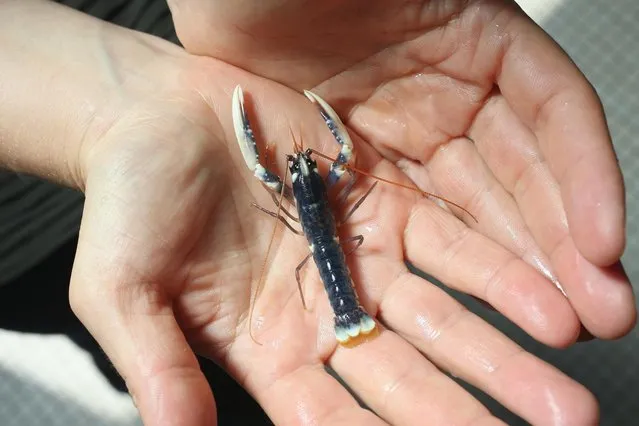
Isabel Schmalenbach, an environmental scientist with the Helgoland Biological Institute (Biologische Anstalt Helgoland), part of the Alfred Wegener Institute for Polar and Marine Research, holds a one-year old baby European lobster (Homarus gammarus) raised at the institute on August 3, 2013 on Helgoland Island, Germany. (Photo by Sean Gallup/Getty Images)

Isabel Schmalenbach, an environmental scientist with the Helgoland Biological Institute (Biologische Anstalt Helgoland), part of the Alfred Wegener Institute for Polar and Marine Research, holds a one-year old baby European lobster (Homarus gammarus) raised at the institute on August 3, 2013 on Helgoland Island, Germany. Later in the day Schmalenbach and her colleagues released a total of 415 one-year old lobsters into the North Sea as part of an effort to repopulate the lobster population around Helgoland (also called Heligoland). In the 19th century local fishermen caught up to 80,000 lobsters a year in the surrounding waters, combined with the heavy allied bombing of the island during and after World War II, as well as other environmental factors, decimated the lobster population. (Photo by Sean Gallup)

Details
05 Aug 2013 08:39:00