Loading...
Done
«Underwater». Laurie Simmons discovered this silicone s*x doll in a shop while on holiday in Japan and was immediately interested in the type of generic beauty their looks could add to her work. She went on to create the Love Doll series, in which she places silicone s*x dolls in positions that explore a woman’s interior life. (Photo by Laurie Simmons/Salon 94/The Guardian)

«Underwater». Laurie Simmons discovered this silicone sеx doll in a shop while on holiday in Japan and was immediately interested in the type of generic beauty their looks could add to her work. She went on to create the Love Doll series, in which she places silicone sеx dolls in positions that explore a woman’s interior life. (Photo by Laurie Simmons/Salon 94/The Guardian)
Details
28 Sep 2017 07:38:00
Two storks sit in their nest as the sun rises in Wehrheim near Frankfurt, Germany, Thursday, August 29, 2024. (Photo by Michael Probst/AP Photo)

Two storks sit in their nest as the sun rises in Wehrheim near Frankfurt, Germany, Thursday, August 29, 2024. (Photo by Michael Probst/AP Photo)
Details
30 Nov 2024 03:35:00
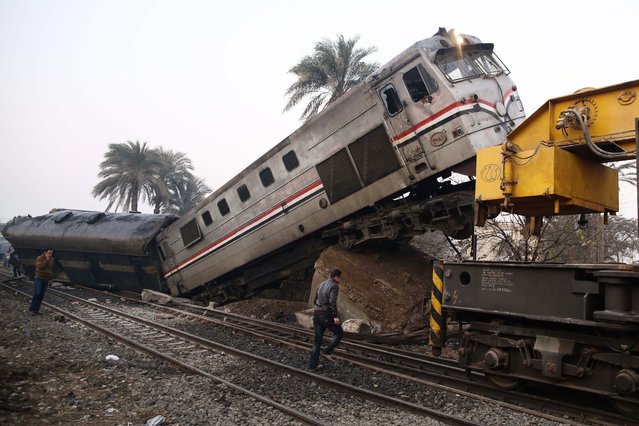
People gather at the site of a train derailment near Beni Suef, Egypt, Thursday, February 11, 2016 that  injured dozens of people were injured as it was traveling north toward Cairo. Railroad accidents due to negligence are common in Egypt. Egyptians have long complained that the government has failed to deal with the country's chronic transport problems. (Photo by Samer Abdallah/AP Photo)

People gather at the site of a train derailment near Beni Suef, Egypt, Thursday, February 11, 2016 that injured dozens of people were injured as it was traveling north toward Cairo. Railroad accidents due to negligence are common in Egypt. Egyptians have long complained that the government has failed to deal with the country's chronic transport problems. (Photo by Samer Abdallah/AP Photo)
Details
12 Feb 2016 13:08:00
It is said that Torajans are people who “live to die”. For this Indonesian ethnic group, funerals are such extravagant events that they sometimes attract tourists. Families can postpone burials years (and the deceased are considered sick and hosted at home until the funeral) until the family can raise enough money and gather as many relatives as possible. And then it’s a jubilant multiday social event with a parade, dances and animal sacrifices. Agung Parameswara photographed these funerary practices when he traveled to South Sulawesi province, where the Torajans live. But often, their funeral isn’t the last time the dead are seen. In August, crypts are opened, coffins are slid back out and bodies delicately unsheathed. This tender ritual is known as Ma’Nene, which is customarily performed every few years. (Photo by Agung Parameswara/The Washington Post)

It is said that Torajans are people who “live to die”. For this Indonesian ethnic group, funerals are such extravagant events that they sometimes attract tourists. Families can postpone burials years (and the deceased are considered sick and hosted at home until the funeral) until the family can raise enough money and gather as many relatives as possible. And then it’s a jubilant multiday social event with a parade, dances and animal sacrifices. Agung Parameswara photographed these funerary practices when he traveled to South Sulawesi province, where the Torajans live. (Photo by Agung Parameswara/The Washington Post)
Details
06 Oct 2016 09:15:00
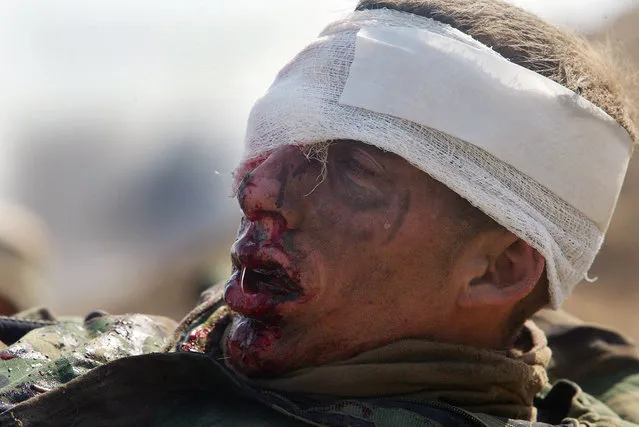
U.S. Marine Lt. Ben Reid from 1/2 Charlie Company of Task Force Tarawa waits to be medivaced after being hit with shrapnel and a machine gun round, in the southern Iraqi city of Nasiriyah, on March 23, 2003. The Marines suffered a number of deaths and casualties during gun battles throughout the city. (Photo by Joe Raedle/The Atlantic)

U.S. Marine Lt. Ben Reid from 1/2 Charlie Company of Task Force Tarawa waits to be medivaced after being hit with shrapnel and a machine gun round, in the southern Iraqi city of Nasiriyah, on March 23, 2003. The Marines suffered a number of deaths and casualties during gun battles throughout the city. (Photo by Joe Raedle via The Atlantic)
Details
20 Mar 2013 08:50:00
A man walks on a bridge crossing over the Besor stream on a rainy day, near Kibbutz Tze'elim in Israel's southern Negev desert February 16, 2017. (Photo by Amir Cohen/Reuters)

A man walks on a bridge crossing over the Besor stream on a rainy day, near Kibbutz Tze'elim in Israel's southern Negev desert February 16, 2017. (Photo by Amir Cohen/Reuters)
Details
22 May 2017 07:29:00
People take photos of blooming cherry blossoms in Washington, DC, on Tuesday, March 25, 2025. (Photo by Matt McClain/The Washington Post via Getty Images)

People take photos of blooming cherry blossoms in Washington, DC, on Tuesday, March 25, 2025. (Photo by Matt McClain/The Washington Post via Getty Images)
Details
21 Apr 2025 03:25:00
A dog sits in the shade of a mangrove tree as a woman uses a fork to dig for shellfish on the reef-mud flats of a lagoon located at South Tarawa in the central Pacific island nation of Kiribati May 23, 2013. (Photo by David Gray/Reuters)

A dog sits in the shade of a mangrove tree as a woman uses a fork to dig for shellfish on the reef-mud flats of a lagoon located at South Tarawa in the central Pacific island nation of Kiribati May 23, 2013. Kiribati consists of a chain of 33 atolls and islands that stand just metres above sea level, spread over a huge expanse of otherwise empty ocean. With surrounding sea levels rising, Kiribati President Anote Tong has predicted his country will likely become uninhabitable in 30-60 years because of inundation and contamination of its freshwater supplies. (Photo by David Gray/Reuters)
Details
13 Jun 2013 09:23:00