Loading...
Done
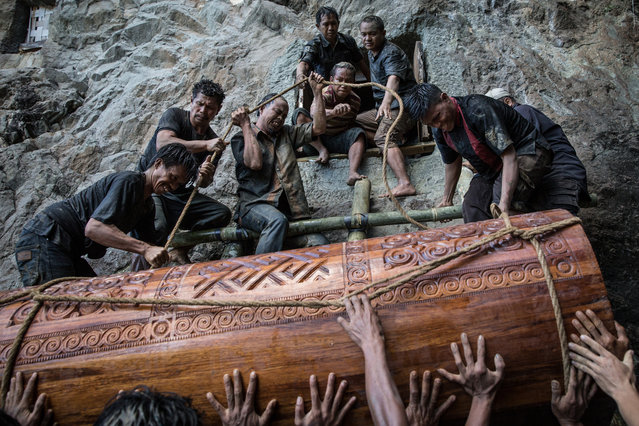
It is said that Torajans are people who “live to die”. For this Indonesian ethnic group, funerals are such extravagant events that they sometimes attract tourists. Families can postpone burials years (and the deceased are considered sick and hosted at home until the funeral) until the family can raise enough money and gather as many relatives as possible. And then it’s a jubilant multiday social event with a parade, dances and animal sacrifices. Agung Parameswara photographed these funerary practices when he traveled to South Sulawesi province, where the Torajans live. But often, their funeral isn’t the last time the dead are seen. In August, crypts are opened, coffins are slid back out and bodies delicately unsheathed. This tender ritual is known as Ma’Nene, which is customarily performed every few years. (Photo by Agung Parameswara/The Washington Post)

It is said that Torajans are people who “live to die”. For this Indonesian ethnic group, funerals are such extravagant events that they sometimes attract tourists. Families can postpone burials years (and the deceased are considered sick and hosted at home until the funeral) until the family can raise enough money and gather as many relatives as possible. And then it’s a jubilant multiday social event with a parade, dances and animal sacrifices. Agung Parameswara photographed these funerary practices when he traveled to South Sulawesi province, where the Torajans live. (Photo by Agung Parameswara/The Washington Post)
Details
06 Oct 2016 09:15:00
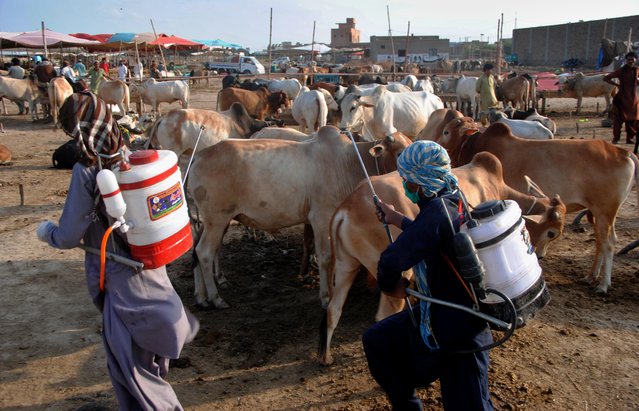
Health workers wearing face masks spray disinfectant liquid on sacrificial animals amid concerns over the spread of the SARS-CoV-2 coronavirus that causes the pandemic COVID-19 disease ahead of the Muslim festival of Eid al-Adha at an animal market in Hyderabad, southern Pakistan, 21 July 2020. Eid al-Adha, also known as the Festival of the Sacrifice, is the second and holiest of the two main Islamic holidays celebrated each year (the other one being Eid al-Fitr). Every year, on the 10th day of the Islamic lunar month of Dhu al-Hijjah, Muslims around the world ritually slaughter a sacrificial animal and split the meat into three parts: one is reserved for the family, another for friends and relatives, and the third is given to the poor and needy. The Saudi Supreme Court has declared that the first day of Eid al-Adha this year falls on 31 July. (Photo by Nadeem Khawar/EPA/EFE)

Health workers wearing face masks spray disinfectant liquid on sacrificial animals amid concerns over the spread of the SARS-CoV-2 coronavirus that causes the pandemic COVID-19 disease ahead of the Muslim festival of Eid al-Adha at an animal market in Hyderabad, southern Pakistan, 21 July 2020. (Photo by Nadeem Khawar/EPA/EFE)
Details
23 Jul 2020 00:07:00
This time exposure photo provided by the Santa Barbara County Fire Department shows a series of lightning strikes over Santa Barbara, Calif., seen from Stearns Wharf in the city's harbor, Tuesday evening, March 5, 2019. A storm soaking California on Wednesday could trigger mudslides in wildfire burn areas where thousands of residents are under evacuation orders, authorities warned. (Photo by Mike Eliason/Santa Barbara County Fire Department via AP Photo)

This time exposure photo provided by the Santa Barbara County Fire Department shows a series of lightning strikes over Santa Barbara, Calif., seen from Stearns Wharf in the city's harbor, Tuesday evening, March 5, 2019. A storm soaking California on Wednesday could trigger mudslides in wildfire burn areas where thousands of residents are under evacuation orders, authorities warned. (Photo by Mike Eliason/Santa Barbara County Fire Department via AP Photo)
Details
22 Mar 2019 00:03:00
Dinosaur robots acting as receptionist greet a hotel employee demonstrating how to check-in to the hotel during a press preview for the newly-opening Henn na Hotel Maihama Tokyo Bay in Urayasu, east of Tokyo, Japan March 15, 2017. The reception desk is handled by robots that speak Japanese, English, Chinese and Korean, as well as porter robots that help guests carry luggage to their rooms. Tasks such as window-cleaning and vacuuming are also handled by robots. Japan's second robot-run hotel Henn na Hotel (“strange hotel” in Japanese) opened on March 15, 2017 as the robot-staffed hotel near Tokyo, operating company H.I.S. Co. said. (Photo by Issei Kato/Reuters)

Dinosaur robots acting as receptionist greet a hotel employee demonstrating how to check-in to the hotel during a press preview for the newly-opening Henn na Hotel Maihama Tokyo Bay in Urayasu, east of Tokyo, Japan March 15, 2017. The reception desk is handled by robots that speak Japanese, English, Chinese and Korean, as well as porter robots that help guests carry luggage to their rooms. Tasks such as window-cleaning and vacuuming are also handled by robots. Japan's second robot-run hotel Henn na Hotel (“strange hotel” in Japanese) opened on March 15, 2017 as the robot-staffed hotel near Tokyo, operating company H.I.S. Co. said. (Photo by Issei Kato/Reuters)
Details
16 Mar 2017 09:54:00
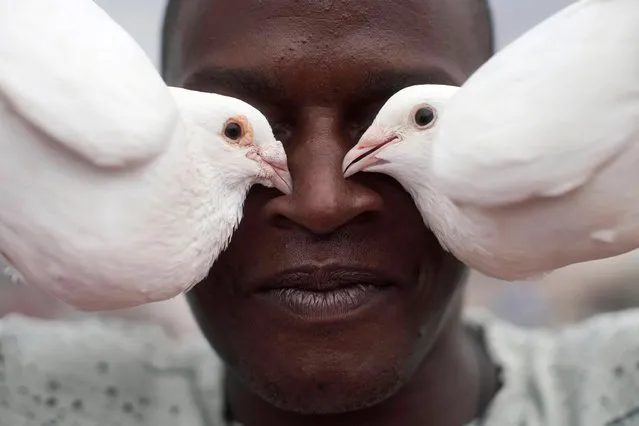
Pigeon fancier Yonisbel Santana poses for a photo at his rooftop in Havana, Cuba, May 18, 2021. Havana's pigeon keepers crane out of a window, intently watching the grey birds take flight. Mostly staying indoors due to the country's worst outbreak of COVID-19 since the coronavirus pandemic began in March last year, Cubans are increasingly breeding pigeons as a form of escape. (Photo by Alexandre Meneghini/Reuters)

Pigeon fancier Yonisbel Santana poses for a photo at his rooftop in Havana, Cuba, May 18, 2021. Havana's pigeon keepers crane out of a window, intently watching the grey birds take flight. Mostly staying indoors due to the country's worst outbreak of COVID-19 since the coronavirus pandemic began in March last year, Cubans are increasingly breeding pigeons as a form of escape. (Photo by Alexandre Meneghini/Reuters)
Details
13 Jul 2021 11:09:00
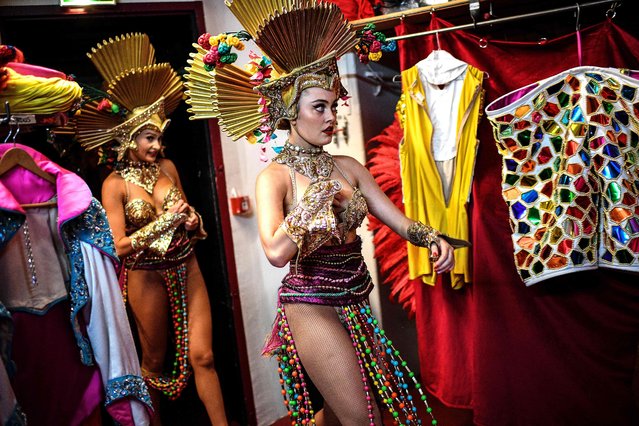
Dancers wait in the wings before performing in a full-dress rehearsal at the Moulin Rouge in Paris on September 8, 2021, two days ahead of the reopening of the cabaret following an 18-month closure amid the COVID-19 pandemic. Closed for a year and a half due to the pandemic, the Moulin Rouge and Le Lido, emblems of the crazy Parisian nights since 1889, are finally reopening. (Photo by Christophe Archambault/AFP Photo)

Dancers wait in the wings before performing in a full-dress rehearsal at the Moulin Rouge in Paris on September 8, 2021, two days ahead of the reopening of the cabaret following an 18-month closure amid the COVID-19 pandemic. Closed for a year and a half due to the pandemic, the Moulin Rouge and Le Lido, emblems of the crazy Parisian nights since 1889, are finally reopening. (Photo by Christophe Archambault/AFP Photo)
Details
10 Sep 2021 10:07:00
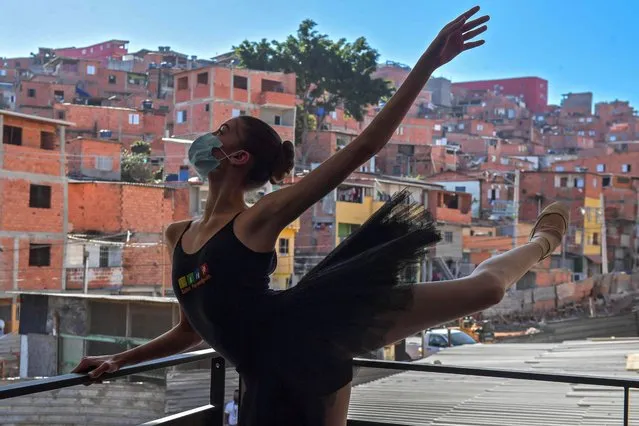
Mariana Sousa, student of the Ballet Paraisopolis, warms up during a rehearse in Paraisopolis favela, outskirts of Sao Paulo, Brazil on August 27, 2020, amid the new coronavirus COVID-19 pandemic. The 200 ballet students of Paraisopolis, the second largest favela in Sao Paulo, restarted rehearsals after five months with a coreography about a police operation that put their community in mourning last year. (Photo by Nelson Almeida/AFP Photo)

Mariana Sousa, student of the Ballet Paraisopolis, warms up during a rehearse in Paraisopolis favela, outskirts of Sao Paulo, Brazil on August 27, 2020, amid the new coronavirus COVID-19 pandemic. The 200 ballet students of Paraisopolis, the second largest favela in Sao Paulo, restarted rehearsals after five months with a coreography about a police operation that put their community in mourning last year. (Photo by Nelson Almeida/AFP Photo)
Details
11 Sep 2020 00:03:00
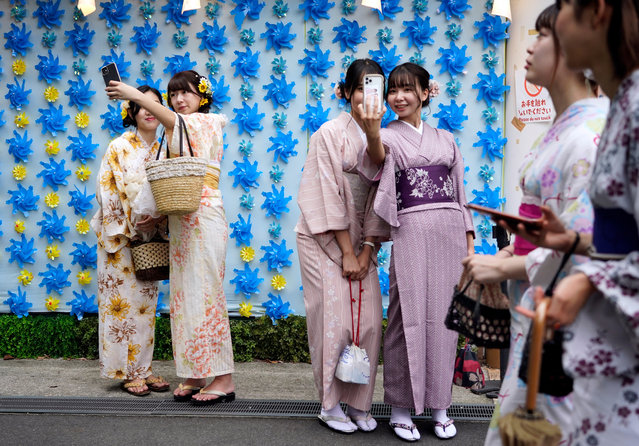
Japanese women wearing “yukata” casual summer kimono take selfies at Asakusa district in Tokyo, Japan, 13 September 2020. Asakusa is one of Tokyo's most-visited areas and is usually crowded with tourists. In Japan, the numbers of visitors from abroad fell by 99.9 percent from a year earlier in July due to the ban for entries of foreign visitors amid the coronavirus pandemic. (Photo by Franck Robichon/EPA/EFE)

Japanese women wearing “yukata” casual summer kimono take selfies at Asakusa district in Tokyo, Japan, 13 September 2020. Asakusa is one of Tokyo's most-visited areas and is usually crowded with tourists. In Japan, the numbers of visitors from abroad fell by 99.9 percent from a year earlier in July due to the ban for entries of foreign visitors amid the coronavirus pandemic. (Photo by Franck Robichon/EPA/EFE)
Details
24 Sep 2020 00:01:00