Loading...
Done
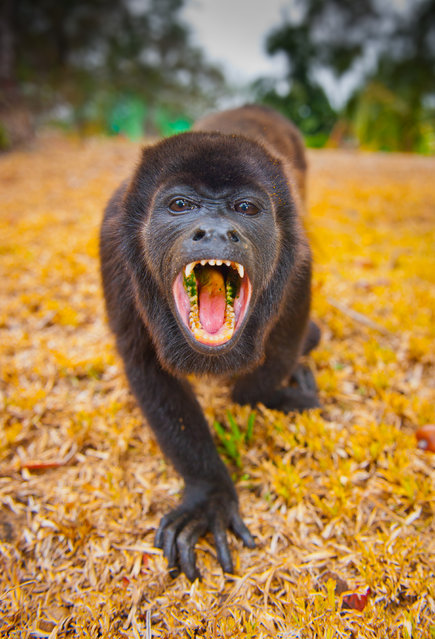
“Attacking Howler Monkey”. Due to a major tropical rainstorm my wife and I were forced to stay overnight in a Howler Monkey Rescue center in Panama. I used the time to explore the area and to take photos of the monkeys. Just after the rain finally stopped, I ran into this monkey that tried to mock attack me. I quickly took a couple of photos before retreating to a (more) safe distance. (Photo and caption by Christian Mueller-Planitz/National Geographic Traveler Photo Contest)

“Attacking Howler Monkey”. Due to a major tropical rainstorm my wife and I were forced to stay overnight in a Howler Monkey Rescue center in Panama. I used the time to explore the area and to take photos of the monkeys. Just after the rain finally stopped, I ran into this monkey that tried to mock attack me. I quickly took a couple of photos before retreating to a (more) safe distance. (Photo and caption by Christian Mueller-Planitz/National Geographic Traveler Photo Contest)

ATTENTION! All pictures are presented in high resolution. To see Hi-Res images – just TWICE click on any picture. In other words, click small picture – opens the BIG picture. Click BIG picture – opens VERY BIG picture.
Details
30 Jun 2013 12:25:00
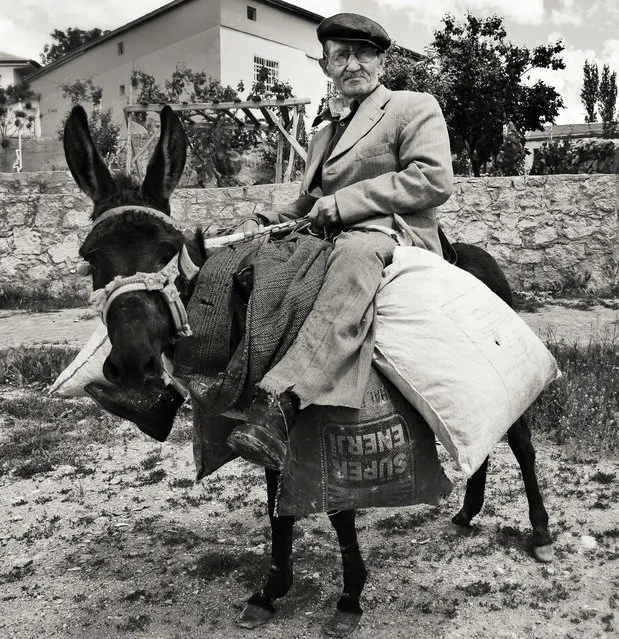
“Super Enerji”. Taken on my road trip through Turkey. (Photo and caption by Michelle Brandemuehl/National Geographic Traveler Photo Contest)

“Super Enerji”. Taken on my road trip through Turkey. (Photo and caption by Michelle Brandemuehl/National Geographic Traveler Photo Contest)

ATTENTION! All pictures are presented in high resolution. To see Hi-Res images – just TWICE click on any picture. In other words, click small picture – opens the BIG picture. Click BIG picture – opens VERY BIG picture.
Details
05 Jul 2013 11:17:00
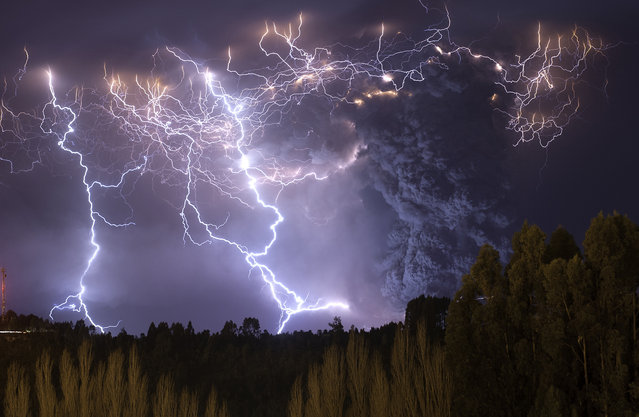
The eruption of Cordon Caulle began on June 4, 2011, located in the Region of Los Rios in Chile. For about 12 months, people and animals became accustomed to living with the daily fall of ash, which also caused problems in the air traffic in South America. The explosions and lightning during first days of the eruption could be seen from hundreds of miles around. This photograph was taken on the second night of eruption from the town of Lago Ranco. (Photo and caption by Francisco Negroni/National Geographic Traveler Photo Contest)

The eruption of Cordon Caulle began on June 4, 2011, located in the Region of Los Rios in Chile. For about 12 months, people and animals became accustomed to living with the daily fall of ash, which also caused problems in the air traffic in South America. The explosions and lightning during first days of the eruption could be seen from hundreds of miles around. This photograph was taken on the second night of eruption from the town of Lago Ranco. (Photo and caption by Francisco Negroni/National Geographic Traveler Photo Contest)

ATTENTION! All pictures are presented in high resolution. To see Hi-Res images – just TWICE click on any picture. In other words, click small picture – opens the BIG picture. Click BIG picture – opens VERY BIG picture.
Details
23 Jun 2013 11:24:00


Interesting (音阙诗听) – Zhao Fangjing (赵方婧) – Mang Zhong (芒种) (Official Music Video)
Details
22 May 2020 00:03:00
The Radio City Rockettes perform during a rehearsal for their Christmas show in New York City, on October 13, 2021. The 2021 production will run from November 5, 2021, to January 2, 2022, at Radio City Music Hall. (Photo by Timothy A. Clary/AFP Photo)

The Radio City Rockettes perform during a rehearsal for their Christmas show in New York City, on October 13, 2021. The 2021 production will run from November 5, 2021, to January 2, 2022, at Radio City Music Hall. (Photo by Timothy A. Clary/AFP Photo)
Details
19 Oct 2021 08:00:00
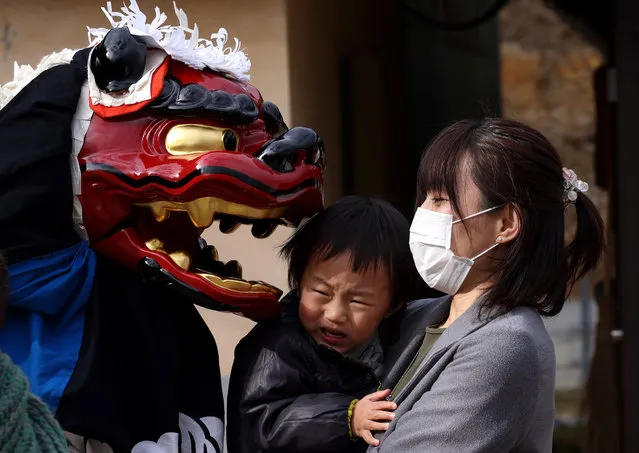
A performer wearing a lion mask performs the Ise Daikagura lion dance at the remote village of Yamanawa on February 08, 2021 in Ryuo, Japan. Ise Daikagura is a group of traditional Lion Dance performers who pray in front of farmers houses and businesses for good grain harvests and disease-free lives. Performers play sacred music using drums and flutes with two lion mask dancers. A lion mask is considered a symbol of God, who enters the house and performs in front of the Shinto God, a statue placed inside the house, mostly in the kitchen. These prayers are called “Kamodo Barai”. After the prayers, they are gifted with money, rice, sake and Japanese sweets from the householders. A group can travel for more than one hundred days to thousands of households and businesses throughout rural-villages in western Japan, and pray to those who are unable to visit the country’s most sacred shrine, the Grand Ise Shrine in Mie Prefecture. The group started its performance in the Edo era between 1603 to 1868 according to Japanese history. The Japanese government designated it as an important folk cultural national property in 1981. (Photo by Buddhika Weerasinghe/Getty Images)

A performer wearing a lion mask performs the Ise Daikagura lion dance at the remote village of Yamanawa on February 08, 2021 in Ryuo, Japan. Ise Daikagura is a group of traditional Lion Dance performers who pray in front of farmers houses and businesses for good grain harvests and disease-free lives. (Photo by Buddhika Weerasinghe/Getty Images)
Details
18 Feb 2021 09:27:00
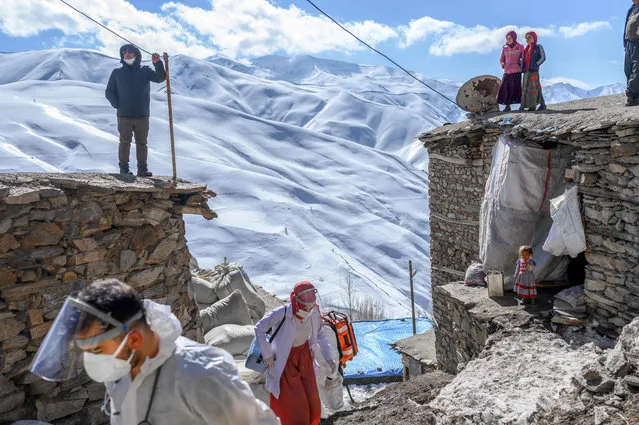
In this photograph taken on February 15, 2021, doctor Sergen Saracoglu (L) and nurse Yilzdiz Ayten (C) from the Bahcesaray public hospital vaccination team, arrive at the village of Guneyyamac in eastern Turkey, as part of an expedition to vaccinate residents of 65 years old or above with Sinovac's CoronaVac Covid-19 vaccine. Turkey's population of more than 83 million is spread out across Europe and Asia and covers some seemingly impregnable terrain. The vaccination effort with China's CoronaVac jab kicked off with a bang in mid-January when Turkey inoculated more than half a million people in the first few days. But it slowed down considerably when doctors left the big cities and tried to reach remote places such as Imamli and Ozbeyli – two ethnically Kurdish hamlets of a few hundred herders and farmers each. (Photo by Bulent Kilic/AFP Photo)

In this photograph taken on February 15, 2021, doctor Sergen Saracoglu (L) and nurse Yilzdiz Ayten (C) from the Bahcesaray public hospital vaccination team, arrive at the village of Guneyyamac in eastern Turkey, as part of an expedition to vaccinate residents of 65 years old or above with Sinovac's CoronaVac Covid-19 vaccine. (Photo by Bulent Kilic/AFP Photo)
Details
18 Mar 2021 09:32:00
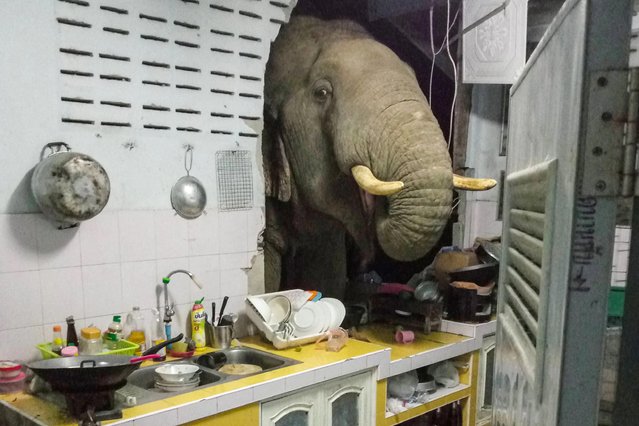
This photograph taken on June 20, 2021 and received courtesy of Radchadawan Peungprasopporn via her Facebook account on June 22, 2021 shows an elephant searching for food in the kitchen of her home in Pa La-U, Hua Hin. (Photo by Radchadawan Peungprasopporn/Facebook via AFP Photo)

This photograph taken on June 20, 2021 and received courtesy of Radchadawan Peungprasopporn via her Facebook account on June 22, 2021 shows an elephant searching for food in the kitchen of her home in Pa La-U, Hua Hin. (Photo by Radchadawan Peungprasopporn/Facebook via AFP Photo)
Details
06 Jul 2021 10:27:00