Loading...
Done
Police detain demonstrators during an action against Russia's attack on Ukraine in St. Petersburg, Russia, Monday, February 28, 2022. Protests against the Russian invasion of Ukraine resumed on Monday, with people taking to the streets of Moscow and St. Petersburg and other Russian towns despite mass arrests. (Photo by Dmitri Lovetsky/AP Photo)

Police detain demonstrators during an action against Russia's attack on Ukraine in St. Petersburg, Russia, Monday, February 28, 2022. Protests against the Russian invasion of Ukraine resumed on Monday, with people taking to the streets of Moscow and St. Petersburg and other Russian towns despite mass arrests. (Photo by Dmitri Lovetsky/AP Photo)
Details
01 Mar 2022 07:15:00
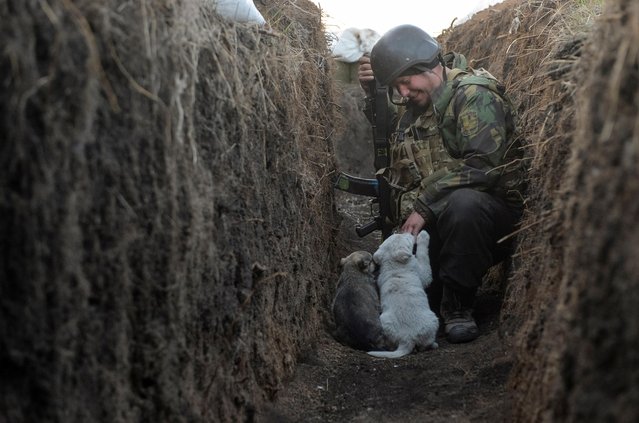
Volodymyr, a service member of the Ukrainian armed forces, plays with puppies at fighting positions on the line of separation from pro-Russian rebels in Donetsk region, Ukraine on April 10, 2021. The two unnamed puppies living on frontline positions will be taken home and named by soldiers departing on troops rotation. (Photo by Oleksandr Klymenko/Reuters)

Volodymyr, a service member of the Ukrainian armed forces, plays with puppies at fighting positions on the line of separation from pro-Russian rebels in Donetsk region, Ukraine on April 10, 2021. The two unnamed puppies living on frontline positions will be taken home and named by soldiers departing on troops rotation. (Photo by Oleksandr Klymenko/Reuters)
Details
24 Apr 2021 08:42:00
The eruption of Cordon Caulle began on June 4, 2011, located in the Region of Los Rios in Chile. For about 12 months, people and animals became accustomed to living with the daily fall of ash, which also caused problems in the air traffic in South America. The explosions and lightning during first days of the eruption could be seen from hundreds of miles around. This photograph was taken on the second night of eruption from the town of Lago Ranco. (Photo and caption by Francisco Negroni/National Geographic Traveler Photo Contest)

The eruption of Cordon Caulle began on June 4, 2011, located in the Region of Los Rios in Chile. For about 12 months, people and animals became accustomed to living with the daily fall of ash, which also caused problems in the air traffic in South America. The explosions and lightning during first days of the eruption could be seen from hundreds of miles around. This photograph was taken on the second night of eruption from the town of Lago Ranco. (Photo and caption by Francisco Negroni/National Geographic Traveler Photo Contest)

ATTENTION! All pictures are presented in high resolution. To see Hi-Res images – just TWICE click on any picture. In other words, click small picture – opens the BIG picture. Click BIG picture – opens VERY BIG picture.
Details
23 Jun 2013 11:24:00
The view at night from the Shanghai Tower in Shanghai, China on August 7, 2015. The tower is technically smaller than the Burj Khalifa in Dubai but, while the observation deck of Dubai’s mega-structure is at 556m, the Shanghai Tower’s is at 561m, meaning the view is a little higher. (Photo by Paul Reiffer/REX Shutterstock)

The view at night from the Shanghai Tower in Shanghai, China on August 7, 2015. The tower is technically smaller than the Burj Khalifa in Dubai but, while the observation deck of Dubai’s mega-structure is at 556m, the Shanghai Tower’s is at 561m, meaning the view is a little higher. (Photo by Paul Reiffer/REX Shutterstock)
Details
21 Jan 2016 08:02:00
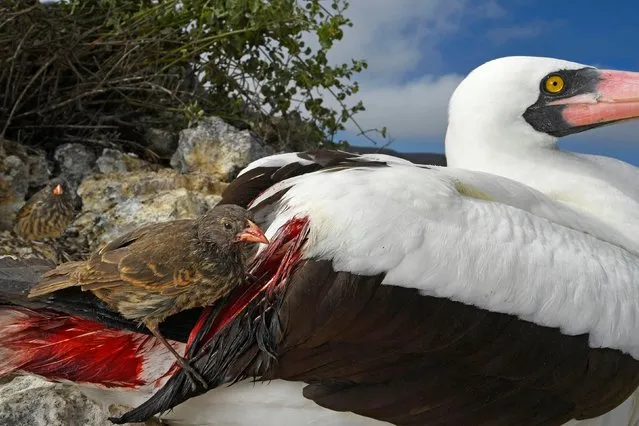
Bloodthirsty by Thomas P Peschak, Germany/South Africa — winner, Behaviour: birds. When rations run short on Wolf Island, in the remote northern Galápagos, the sharp-beaked ground finches become vampires. Their sitting targets are Nazca boobies and other large birds. The finches rely on a scant diet of seeds and insects, which regularly dries up, so they drink blood to survive. ‘I’ve seen more than half a dozen finches drinking from a single Nazca booby,’ says Tom. Rather than leave their nests the boobies tolerate the vampires, and the blood loss doesn’t seem to cause permanent harm. (Photo by Thomas P Peschak/2018 Wildlife Photographer of the Year)

Bloodthirsty by Thomas P. Peschak, Germany/South Africa — winner, Behaviour: birds. When rations run short on Wolf Island, in the remote northern Galápagos, the sharp-beaked ground finches become vampires. Their sitting targets are Nazca boobies and other large birds. The finches rely on a scant diet of seeds and insects, which regularly dries up, so they drink blood to survive. ‘I’ve seen more than half a dozen finches drinking from a single Nazca booby,’ says Tom. Rather than leave their nests the boobies tolerate the vampires, and the blood loss doesn’t seem to cause permanent harm. (Photo by Thomas P. Peschak/2018 Wildlife Photographer of the Year)
Details
19 Oct 2018 00:05:00
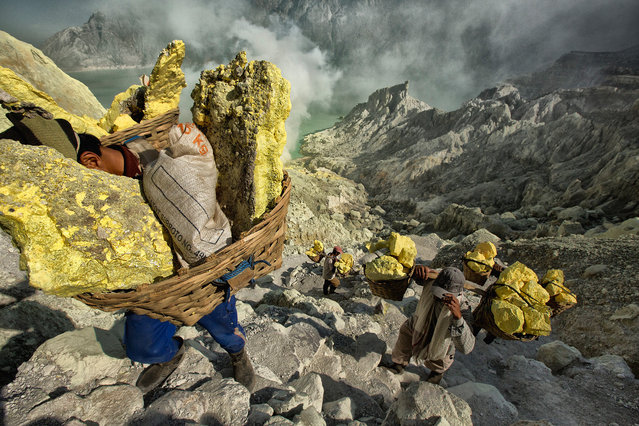
Sulphur miners haul sulphur up an arduous path out of Indonesia’s Ijen volcano. The average carry out of the volcano is 70 kilograms per load per miner.  The all-time record carry was 120 kilograms in one load.  Extraordinary numbers given most of the miners only weigh around 55 kilograms.  Ijen volcano, Indonesia, 2012. (Photo by Hugh Brown/South West News Service)

Sulphur miners haul sulphur up an arduous path out of Indonesia’s Ijen volcano. The average carry out of the volcano is 70 kilograms per load per miner. The all-time record carry was 120 kilograms in one load. Extraordinary numbers given most of the miners only weigh around 55 kilograms. Ijen volcano, Indonesia, 2012. (Photo by Hugh Brown/South West News Service)
Details
30 Jul 2018 00:05:00
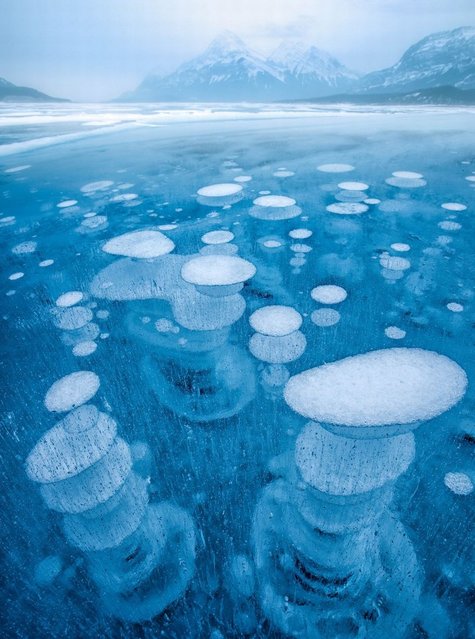
Ice bubbles in Abraham Lake, located at the foot of the Rocky Mountains in Canada. (Photo by Chip Phillips/Rex Features)

Located at the foot of the Rocky Mountains on the North Saskatchewan River, the rare phenomenon occurs each winter in the man-made lake. Photo: Ice bubbles in Abraham Lake. (Photo by Chip Phillips/Rex Features)
Details
27 Jun 2013 07:19:00


Japan's electronics equipment maker MuRata Manufacturing Co., Ltd's showcased their bicycle-riding robot “MuRata Boy” during the CEATEC Japan 2006 exhibition on October 3, 2006 in Chiba, Japan. The “MuRata Boy” robot can ride up a 25-degree slope, stop without losing its balance and make an S-curve without falling. (Photo by Koichi Kamoshida/Getty Images)
Details
14 May 2011 13:41:00