Loading...
Done
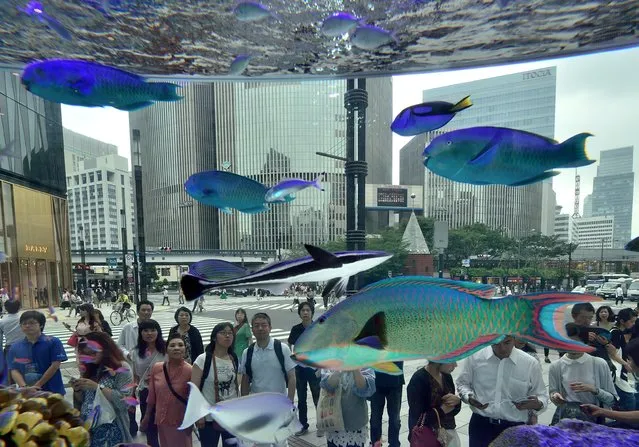
Visitors look at tropical fish transported from Japan's southern island of Okinawa displayed in a giant 14-ton fish tank at the Sony Square event space in Tokyo on July 17, 2016. The 45-day-long summer exhibition will be held through August 28 to display sea creatures common to the waters around Okinawa. (Photo by Kazuhiro Nogi/AFP Photo)

Visitors look at tropical fish transported from Japan's southern island of Okinawa displayed in a giant 14-ton fish tank at the Sony Square event space in Tokyo on July 17, 2016. The 45-day-long summer exhibition will be held through August 28 to display sea creatures common to the waters around Okinawa. (Photo by Kazuhiro Nogi/AFP Photo)
Details
18 Jul 2016 13:05:00
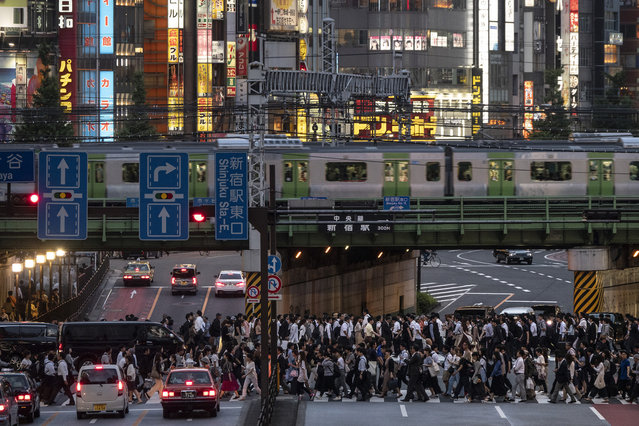
In this Tuesday, June 4, 2019, photo, a Yamanote Line train travels above commuters walking across the crossing during evening rush hours in the Shinjuku district of Tokyo. Operated by the East Japan Railway Co., the Yamanote Line in Tokyo makes a loop around the center of the city, connecting 29 stations that include key stops such as Shinjuku, Shibuya and Ikebukuro. A complete loop of about an hour offers scenes of Japanese daily lives. (Photo by Jae C. Hong/AP Photo)

In this Tuesday, June 4, 2019, photo, a Yamanote Line train travels above commuters walking across the crossing during evening rush hours in the Shinjuku district of Tokyo. Operated by the East Japan Railway Co., the Yamanote Line in Tokyo makes a loop around the center of the city, connecting 29 stations that include key stops such as Shinjuku, Shibuya and Ikebukuro. A complete loop of about an hour offers scenes of Japanese daily lives. (Photo by Jae C. Hong/AP Photo)
Details
27 Jun 2019 00:03:00


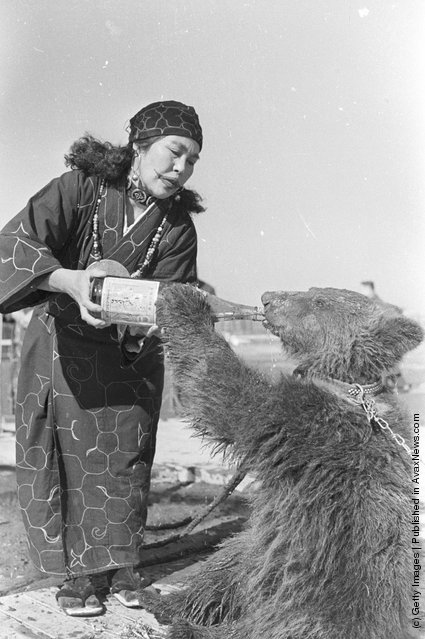
“The Ainu (アイヌ?), also called Aynu, Aino (アイノ), and in historical texts Ezo (蝦夷), are indigenous people or groups in Japan and Russia. Historically they spoke the Ainu language and related varieties and lived in Hokkaidō, the Kuril Islands, and much of Sakhalin. Most of those who identify themselves as Ainu still live in this same region, though the exact number of living Ainu is unknown. This is due to ethnic issues in Japan resulting in those with Ainu backgrounds hiding their identities and confusion over mixed heritages. In Japan, because of intermarriage over many years with Japanese, the concept of a 'pure Ainu' ethnic group is no longer feasible. Official estimates of the population are of around 25,000, while the unofficial number is upwards of 200,000 people”. – Wkipedia

Photo: A captive bear drinking from a large bottle held by an Ainu tribeswoman. (Photo by Evans/Three Lions/Getty Images). Circa 1955

Details
24 Mar 2011 14:01:00
Cormorant Fishing

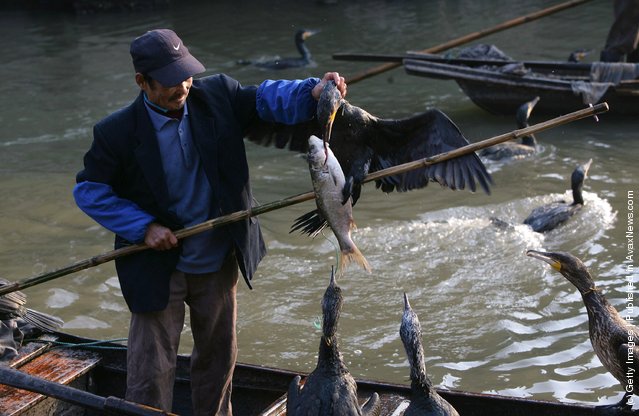
“Cormorant fishing is a traditional fishing method in which fishermen use trained cormorants to fish in rivers. Historically, cormorant fishing has taken place in Japan and China from around 960 AD. and recorded from other places throughout the world”. – Wikipedia

Photo: A cormorant raised by a fisherman catches a fish on a canal on November 27, 2007 in Xitang Town of Jiashan County, Zhejiang Province, China. (Photo by China Photos/Getty Images)
Details
07 Oct 2011 09:34:00
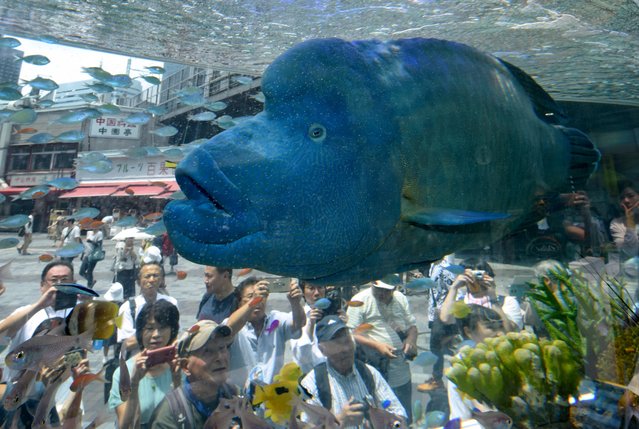
A humpead wrasse, transported from Japan's southern island of Okinawa, swims with other tropical saltwater fish on display in a tank for the Sony Aquarium 2017 exhibition in Tokyo on July 31, 2017. The Sony Aquarium 2017 exhibition, featuring marine life common to the waters around Okinawa, runs until August 13. (Photo by Kazuhiro Nogi/AFP Photo)

A humpead wrasse, transported from Japan's southern island of Okinawa, swims with other tropical saltwater fish on display in a tank for the Sony Aquarium 2017 exhibition in Tokyo on July 31, 2017. The Sony Aquarium 2017 exhibition, featuring marine life common to the waters around Okinawa, runs until August 13. (Photo by Kazuhiro Nogi/AFP Photo)
Details
01 Aug 2017 07:50:00
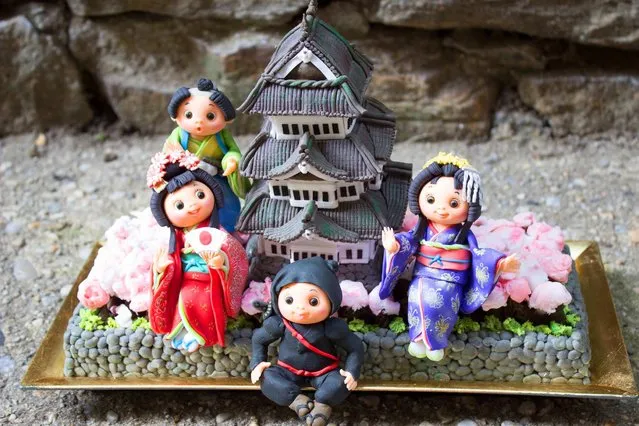
Sweet-toothed jet setters don't even need their passports for this worldwide tour, as they can travel around the world in 40 cakes. Some of the world's most famous landmarks and cultures have been created by some of the best bakers, as featured in this month's edition of Cake Masters magazine. Pictured here is “Japan”. (Photo by Mimi Cafe Union/Mercury Press/Caters News)

Sweet-toothed jet setters don't even need their passports for this worldwide tour, as they can travel around the world in 40 cakes. Some of the world's most famous landmarks and cultures have been created by some of the best bakers, as featured in this month's edition of Cake Masters magazine. Pictured here is “Japan”. (Photo by Mimi Cafe Union/Mercury Press/Caters News)
Details
17 Sep 2014 12:52:00
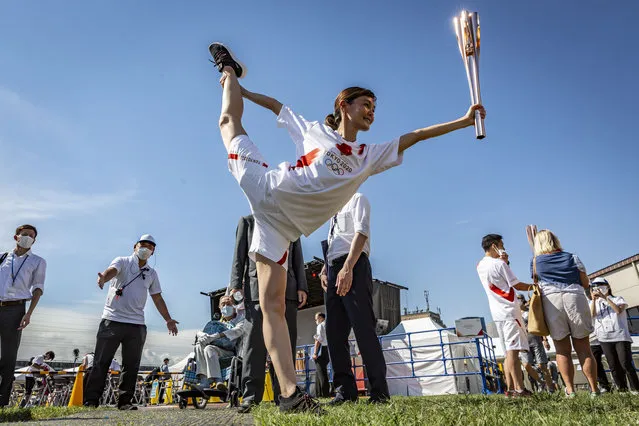
A torch bearer poses for photographs during the Olympic Torch Relay Celebration event on July 21, 2021 in Tokyo, Japan. As the Olympic torch relay makes its way around Tokyo, public relays have been cancelled in favour of daily ceremonies held behind closed doors, as authorities act to avoid large gatherings while the country endures a fourth wave of coronavirus. (Photo by Yuichi Yamazaki/Getty Images)

A torch bearer poses for photographs during the Olympic Torch Relay Celebration event on July 21, 2021 in Tokyo, Japan. As the Olympic torch relay makes its way around Tokyo, public relays have been cancelled in favour of daily ceremonies held behind closed doors, as authorities act to avoid large gatherings while the country endures a fourth wave of coronavirus. (Photo by Yuichi Yamazaki/Getty Images)
Details
24 Mar 2022 05:32:00
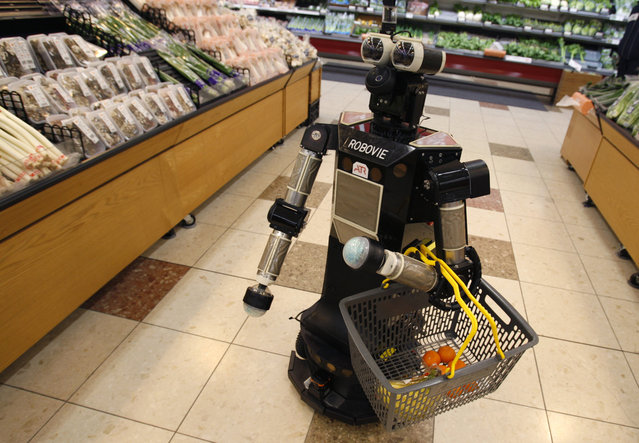
A robot named “Robovie-II”, developed by Japanese robotics research institution ATR, moves around at a grocery store during a shopping assisting experiment by utilizing the robot in an ubiquitous network technology platform in Kyoto, western Japan January 6, 2010. The robot greets the shopper at the entrance of the store, follows him to the shelves while holding a grocery basket and reminds him of the items on a shopping list, which the shopper would have entered beforehand in a specialized mobile device. The experiment is aimed to gather data in order to provide livelihood support for the elderly by using robots and network technologies, ATR's researcher Satoshi Koizumi said. (Photo by Yuriko Nakao/Reuters)

A robot named “Robovie-II”, developed by Japanese robotics research institution ATR, moves around at a grocery store during a shopping assisting experiment by utilizing the robot in an ubiquitous network technology platform in Kyoto, western Japan January 6, 2010. (Photo by Yuriko Nakao/Reuters)
Details
02 Feb 2018 06:54:00