Masked Guggen music bands parade through the streets on the occasion of the beginning of the Fasnacht Carnival of Lucerne, Switzerland, early 23 February 2017. (Photo by Urs Flueeler/EPA)
A man wears a sweater covered in Irish themed pins as he stands with thousands of spectators to watch the 254th New York City St. Patrick's Day parade up 5th Avenue in the Manhattan Borough of New York, March 17, 2015. (Photo by Mike Segar/Reuters)
Actress Olga Kurylenko poses for a photograph at the British Academy of Film and Arts (BAFTA) awards ceremony at the Royal Opera House in London February 16, 2014. (Photo by Suzanne Plunkett/Reuters)
An Indian boy dressed as Hindu god Shiva to attract alms from devotees chats with tourists as they sit on benches partially submerged in flood waters on the banks of the River Ganges in Allahabad, India, Thursday, July 30, 2015. The Ganges, one of India's largest rivers is flooded following monsoon rains. (Photo by Rajesh Kumar Singh/AP Photo)
A submerged statue of the Hindu Lord Shiva stands amid the flooded waters of river Ganges at Rishikesh in the Himalayan state of Uttarakhand June 17, 2013. Early monsoon rains have swollen the Ganges, India's longest river, swept away houses, killed at least 60 people and left tens of thousands stranded, officials said on June 18, 2013. (Photo by Reuters/Stringer)
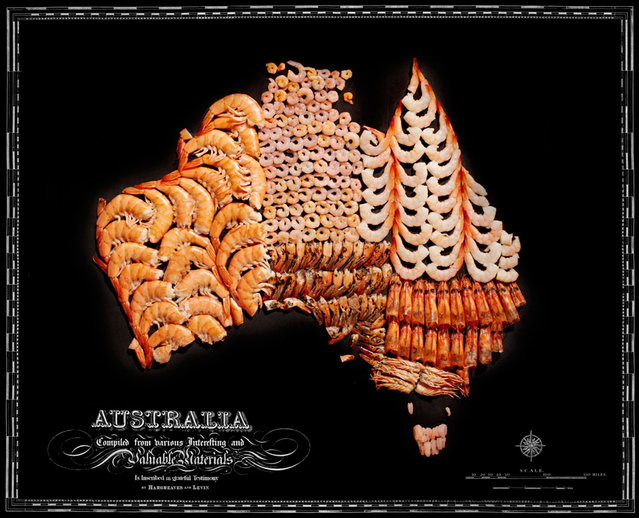
Photographer Henry Hargreaves and artist Caitlin Levin have been working together for about decade. Their shared love for “food, photography, travel, and art” has found an outlet in a series of maps that they have illustrated with food.
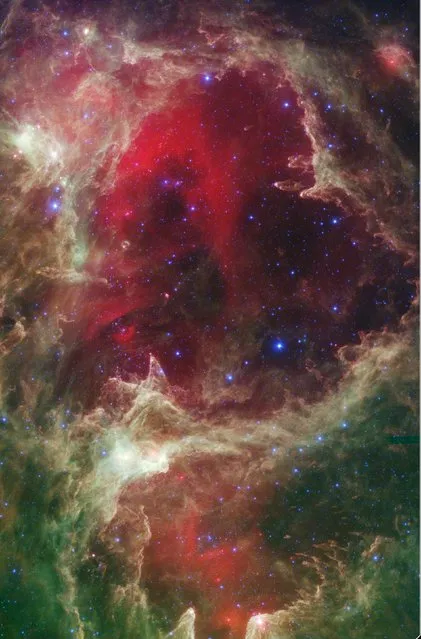
An infrared portrait from NASA's Spitzer Space Telescope which shows generations of stars is seen in this undated NASA handout image released February 14, 2013. In this wispy star-forming region, called W5, the oldest stars can be seen as blue dots in the centers of the two hollow cavities (other blue dots are background and foreground stars not associated with the region). Red shows heated dust that pervades the region's cavities, while green highlights dense clouds. (Photo by NASA/Reuters/JPL-Caltech/Harvard-Smithsonian/Handout)
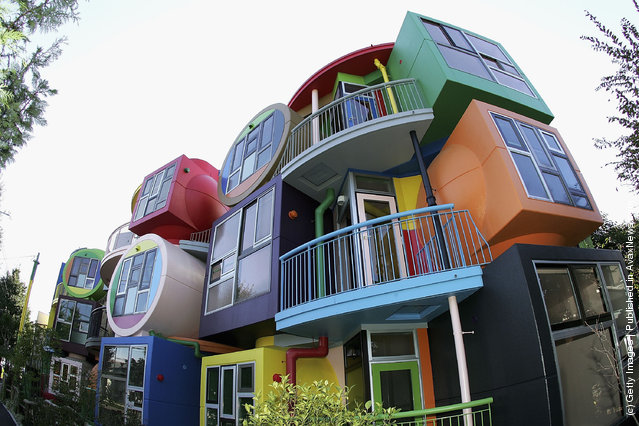
“The Reversible Destiny Lofts – Mitaka (In Memory of Helen Keller) is a nine-unit multiple dwelling. It was first completed example of procedural architecture put to residential use. These lofts reflexively articulate the residents’ operative tendencies and coordinating skills essential to and determinative of human thought and behavior; which means to say, the lofts manage, by virtue of how they are constructed, to reveal to their residents the ins and outs of what makes a person, in this case the resident. This is the same set of tendencies and skills to which Arakawa and Madeline Gins gave diagrammatic form in their decades-long research project The Mechanism of Meaning”. – Wikipedia
Photo: The exterior of the concept design home “Reversible Destiny Lofts MITAKA: In Memory of Helen Keller” is seen on October 27, 2005 in Tokyo, Japan. (Photo by Koichi Kamoshida/Getty Images)