Loading...
Done
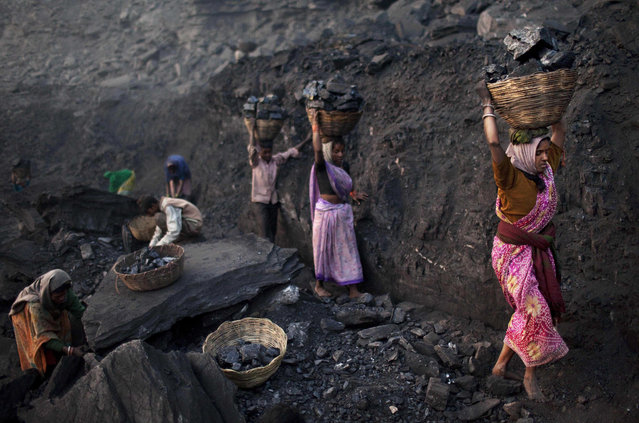
In this Friday, January 7, 2011 photo, people carry baskets of coal scavenged illegally at an open-cast mine in the village of Bokapahari in the eastern Indian state of Jharkhand where a community of coal scavengers live and work. The world's biggest coal users – China, the United States and India – have boosted coal mining in 2017, in an abrupt departure from last year's record global decline for the heavily polluting fuel and a setback to efforts to rein in climate change emissions. (Photo by Kevin Frayer/AP Photo)

In this Friday, January 7, 2011 photo, people carry baskets of coal scavenged illegally at an open-cast mine in the village of Bokapahari in the eastern Indian state of Jharkhand where a community of coal scavengers live and work. The world's biggest coal users – China, the United States and India – have boosted coal mining in 2017, in an abrupt departure from last year's record global decline for the heavily polluting fuel and a setback to efforts to rein in climate change emissions. (Photo by Kevin Frayer/AP Photo)
Details
28 Jun 2017 08:08:00
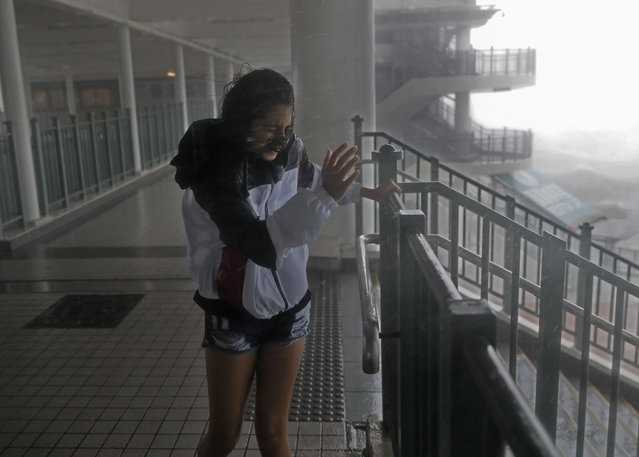
A girl stands against strong wind caused by Typhoon Mangkhut at a pier on the waterfront of Victoria Habour Hong Kong, Sunday, September 16, 2018. Hong Kong and southern China hunkered down as strong winds and heavy rain from Typhoon Mangkhut lash the densely populated coast. The biggest storm of the year left at least 28 dead from landslides and drownings as it sliced through the northern Philippines. (Photo by Vincent Yu/AP Photo)

A girl stands against strong wind caused by Typhoon Mangkhut at a pier on the waterfront of Victoria Habour Hong Kong, Sunday, September 16, 2018. Hong Kong and southern China hunkered down as strong winds and heavy rain from Typhoon Mangkhut lash the densely populated coast. The biggest storm of the year left at least 28 dead from landslides and drownings as it sliced through the northern Philippines. (Photo by Vincent Yu/AP Photo)
Details
18 Sep 2018 00:05:00
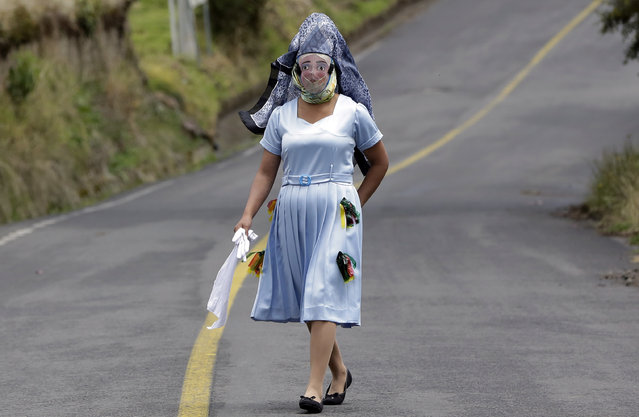
A woman dressed for la “La Diablada” festival walks down a road in Pillaro, Ecuador, Friday, January 6, 2017. Local legend holds that anyone who adopts a costume for the celebration and wears it at the event six years in a row will have good luck. (Photo by Dolores Ochoa/AP Photo)

A woman dressed for la “La Diablada” festival walks down a road in Pillaro, Ecuador, Friday, January 6, 2017. Local legend holds that anyone who adopts a costume for the celebration and wears it at the event six years in a row will have good luck. (Photo by Dolores Ochoa/AP Photo)
Details
21 Dec 2017 06:35:00
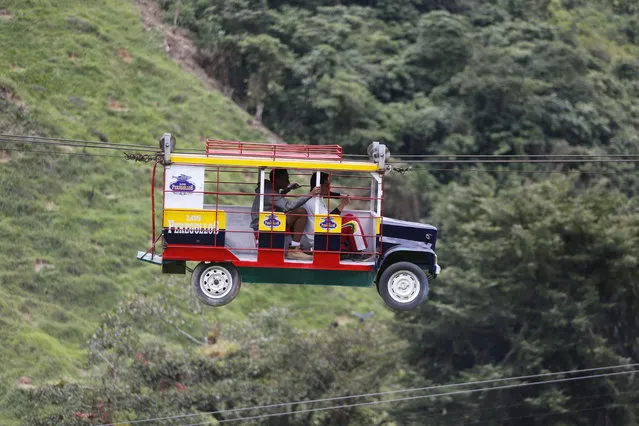
Tourists ride a cable car in the form a of a Chiva, a bus used to serve rural routes, in Pitalito, Colombia, Tuesday, April 5, 2017. The ride called “La Chiva Voladora” costs about $0.70 and you zip along about 800 meters from one side of a hill to another. (Photo by Fernando Vergara/AP Photo)

Tourists ride a cable car in the form a of a Chiva, a bus used to serve rural routes, in Pitalito, Colombia, Tuesday, April 5, 2017. The ride called “La Chiva Voladora” costs about $0.70 and you zip along about 800 meters from one side of a hill to another. (Photo by Fernando Vergara/AP Photo)
Details
21 Dec 2017 06:51:00
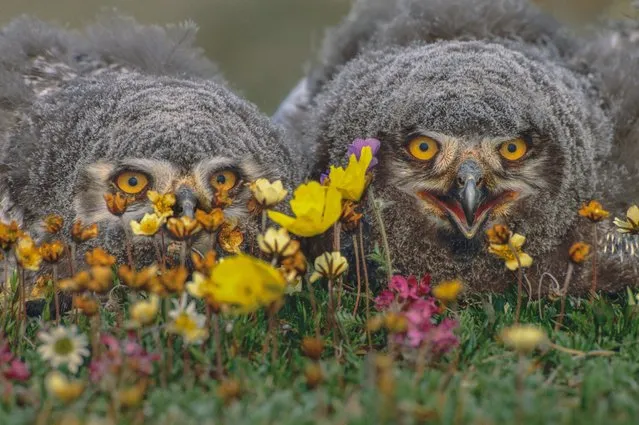
Snowy owlets (Bubo scandiacus), Arctic National Wildlife Refuge, Alaska, USA. “A pair of gray-feathered snowy owlets hunker down in the abundant flowers that flourish in the dropping-enriched soil of their nest mound”. (Photo by Art Wolfe/Art Wolfe Stock)

The photography of Art Wolfe covers the globe, capturing landscapes, wildlife, and cultures from every continent; here he talks through a selection of his favourite images. Art Wolfe is an American photographer and conservationist. His photographs have been noted by environmental advocacy groups for their “stunning” visual impact. Here: Snowy owlets (Bubo scandiacus), Arctic National Wildlife Refuge, Alaska, USA. (Photo by Art Wolfe/Art Wolfe Stock)
Details
19 Mar 2018 00:05:00
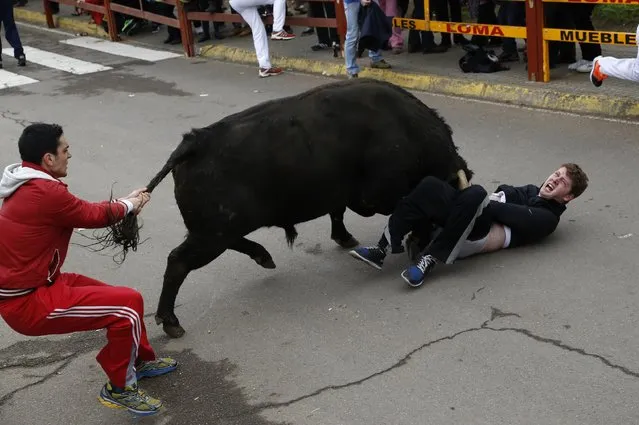
In this photo taken Saturday, February 14, 2015, Benjamin Miller, 20, from Georgia, in the US, is gored by a bull during the “Carnaval del Toro” in Ciudad Rodrigo, Spain. (Photo by Jose Vicente/AP Photo)

In this photo taken Saturday, February 14, 2015, Benjamin Miller, 20, from Georgia, in the US, is gored by a bull during the “Carnaval del Toro” in Ciudad Rodrigo, Spain. An American youth is recovering in the intensive-care unit of a hospital in western Salamanca after being savagely gored during a bullfighting festival celebrating Carnival, officials said Sunday. Surgeon Enrique Crespo said he was called to operate on 20-year-old Benjamin Miller from Georgia, who had been gored and tossed by a large fighting bull on Saturday, the first day of nearby Ciudad Rodrigo's “Carnaval del Toro”. (Photo by Jose Vicente/AP Photo)
Details
21 Feb 2015 11:00:00
This picture taken on November 1, 2014 shows Japanese body-painting artist Hikaru Cho (L) adding the finishing touches to a body painting of fingers sticking out from prison cell bars on the head of Ryonosuke Tanaka during “Tokyo Designers Week” in Tokyo. Cho, 21, was born to Chinese parents in Japan and burst onto Tokyo's art scene when she entered the city's Musashino Art University in 2012. (Photo by Yoshikazu Tsuno/AFP Photo)

This picture taken on November 1, 2014 shows Japanese body-painting artist Hikaru Cho (L) adding the finishing touches to a body painting of fingers sticking out from prison cell bars on the head of Ryonosuke Tanaka during “Tokyo Designers Week” in Tokyo. Cho, 21, was born to Chinese parents in Japan and burst onto Tokyo's art scene when she entered the city's Musashino Art University in 2012. Cho's ultimate ambition is to paint an entire – and naked – body. (Photo by Yoshikazu Tsuno/AFP Photo)
Details
08 Nov 2014 12:59:00
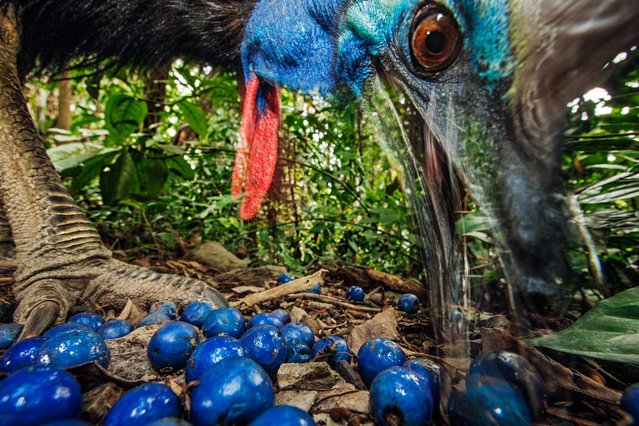
“Cassowaries are large, flightless birds related to emus and (more distantly) to ostriches, rheas, and kiwis”, writes Olivia Judson in the September issue of National Geographic magazine. (Photo by Christian Ziegler/National Geographic)

“Cassowaries are large, flightless birds related to emus and (more distantly) to ostriches, rheas, and kiwis”, writes Olivia Judson in the September issue of National Geographic magazine. How large? People-size: Adult males stand well over five foot five and top 110 pounds. Females are even taller, and can weigh more than 160 pounds. Dangerous when roused, they’re shy and peaceable when left alone. But even birds this big and tough are prey to habitat loss. The dense New Guinea and Australia rain forests where they live have dwindled. Today cassowaries might number 1,500 to 2,000. And because they help shape those same forests – by moving seeds from one place to another – “if they vanish”, Judson writes, “the structure of the forest would gradually change” too. (Photo by Christian Ziegler/National Geographic)
Details
06 Jan 2014 12:21:00