Loading...
Done
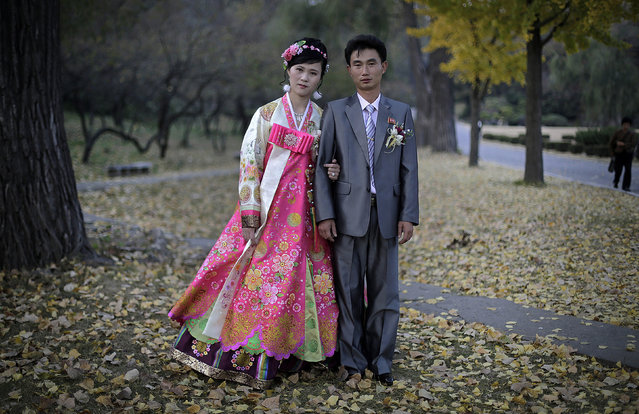
In this October 25, 2014, file photo, North Korean bride Ri Ok Ran, 28, and groom Kang Sung Jin, 32, pose for a portrait at the Moran Hill where they went to take wedding pictures, in Pyongyang, North Korea. The couple were married after dating for about two years. Their motto: “To have many children so that they can serve in the army and defend and uphold our leader and country, for many years into the future”. (Photo by Wong Maye-E/AP Photo)

Associated Press photographer Wong Maye-E tries to get her North Korean subjects to open up as much as is possible in an authoritarian country with no tolerance for dissent and great distrust of foreigners. She has taken dozens of portraits of North Koreans over the past three years, often after breaking the ice by taking photos with an instant camera and sharing them. Her question for everyone she photographs: What is your motto? Their answers reflect both their varied lives and the government that looms incessantly over all of them. (Photo by Wong Maye-E/AP Photo)
Details
16 Jun 2017 06:28:00
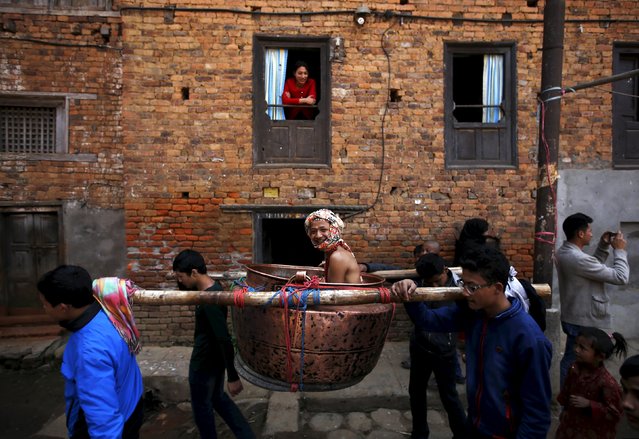
A devotee is carried around town in a vessel as part of rituals during the Swasthani Bratakatha festival at Thecho in Lalitpur, Nepal, February 19, 2016. During the month long festival, devotees recite one chapter of a Hindu tale daily from the 31-chapter sacred Swasthani Brata Katha book that is dedicated to God Madhavnarayan and Goddess Swasthani, alongside various other gods and goddess and the miraculous feats performed by them. (Photo by Navesh Chitrakar/Reuters)

A devotee is carried around town in a vessel as part of rituals during the Swasthani Bratakatha festival at Thecho in Lalitpur, Nepal, February 19, 2016. During the month long festival, devotees recite one chapter of a Hindu tale daily from the 31-chapter sacred Swasthani Brata Katha book that is dedicated to God Madhavnarayan and Goddess Swasthani, alongside various other gods and goddess and the miraculous feats performed by them. (Photo by Navesh Chitrakar/Reuters)
Details
21 Feb 2016 11:32:00
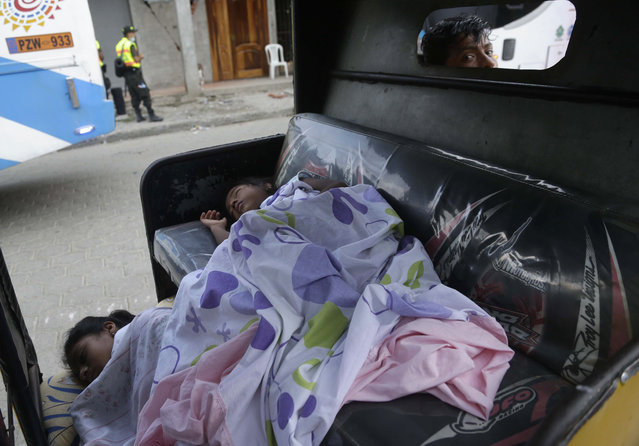
Girls sleep in the back of their father's moto-taxi as he watches them from the front seat, days after an earthquake in Pedernales, Ecuador, Wednesday, April 20, 2016. A fresh tremor rattled Ecuador before dawn Wednesday, a magnitude-6.1 jolt that set babies crying and shaken residents pouring once again into the streets, fearful of yet more damage following a monster earthquake over the weekend. (Photo by Dolores Ochoa/AP Photo)

Girls sleep in the back of their father's moto-taxi as he watches them from the front seat, days after an earthquake in Pedernales, Ecuador, Wednesday, April 20, 2016. A fresh tremor rattled Ecuador before dawn Wednesday, a magnitude-6.1 jolt that set babies crying and shaken residents pouring once again into the streets, fearful of yet more damage following a monster earthquake over the weekend. (Photo by Dolores Ochoa/AP Photo)
Details
21 Apr 2016 12:02:00
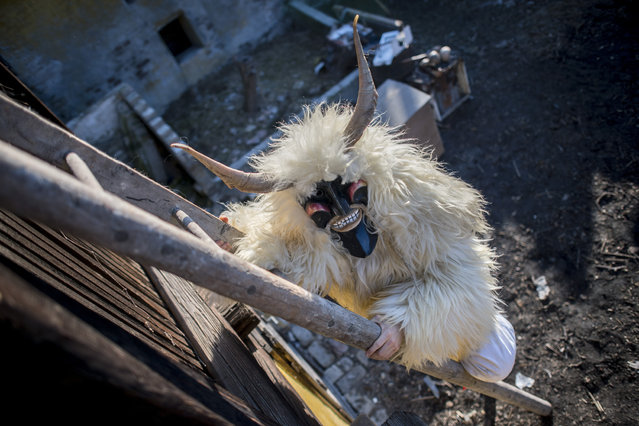
A man wears a busho mask and a costume made of sheep pelt while climbing up a ladder outside a barn in Mohacs, Hungary, 20 February 2020, on the first day of carnival. The traditional Busho carnival, which marks the end of winter, dates back to the 16th century. According to local legend, members of an ethnic South Slavic group living in Mohacs at the time dressed up in similar costumes and wore wooden masks to scare away Ottoman invaders, who mistook them for demons. (Photo by Tamas Soki/EPA/EFE)

A man wears a busho mask and a costume made of sheep pelt while climbing up a ladder outside a barn in Mohacs, Hungary, 20 February 2020, on the first day of carnival. The traditional Busho carnival, which marks the end of winter, dates back to the 16th century. According to local legend, members of an ethnic South Slavic group living in Mohacs at the time dressed up in similar costumes and wore wooden masks to scare away Ottoman invaders, who mistook them for demons. (Photo by Tamas Soki/EPA/EFE)
Details
23 Feb 2020 00:07:00
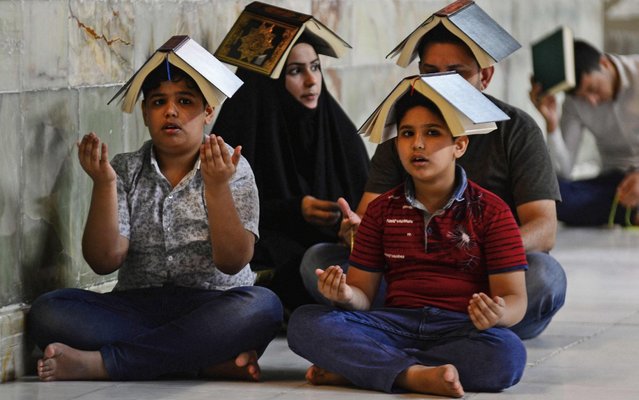
Shiite Muslims gather, albeit in fewer numbers due to the COVID-19 pandemic, at the Imam Ali shrine in the central Iraqi holy city of Najaf late on May 16, 2020, to mark Lailat al-Qadr, a night in the holy month of Ramadan during which the Koran was first revealed to the Prophet Mohammed in the seventh century. Worshippers placed copies of the Koran on their heads to convey veneration during the overnight prayers in a centuries-old ritual, as they pleaded to God to rid them of the ongoing novel coronavirus pandemic. (Photo by Haidar Hamdani/AFP Photo)

Shiite Muslims gather, albeit in fewer numbers due to the COVID-19 pandemic, at the Imam Ali shrine in the central Iraqi holy city of Najaf late on May 16, 2020, to mark Lailat al-Qadr, a night in the holy month of Ramadan during which the Koran was first revealed to the Prophet Mohammed in the seventh century. Worshippers placed copies of the Koran on their heads to convey veneration during the overnight prayers in a centuries-old ritual, as they pleaded to God to rid them of the ongoing novel coronavirus pandemic. (Photo by Haidar Hamdani/AFP Photo)
Details
19 May 2020 00:07:00
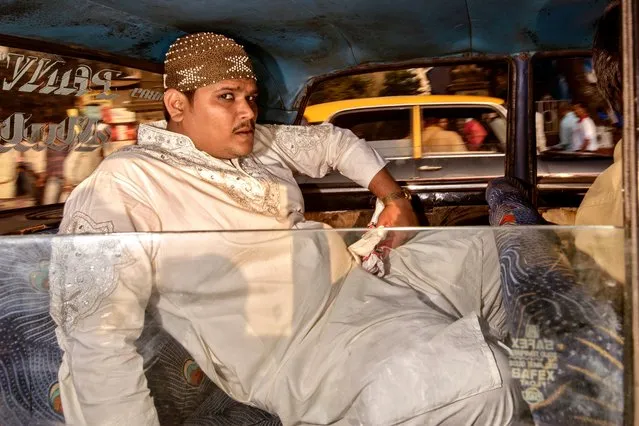
“I’m not scared of breaking the fourth wall”, Wallace has said of the photos where the subject is clearly aware of him taking the shot. “If they are looking at you in a photograph most photographers will think, oh, that’s not a good image. (But) people like to be involved and in the picture. You can see what they are thinking, see them talking”. (Photo by Dougie Wallace/The Guardian)

In Dougie Wallace’s photos of Mumbai taxis, the chatter, yelling, and constant horns of the city are almost audible. A selection of his images is on show at Gayfield Creative Spaces, Edinburgh, as part of the Retina photography festival until 30 July. For four years, the Glasgow-born Wallace focused his photos on one kind of taxi in particular: the Premier Padmini, a 1960s workhorse painted in black and yellow. Locally known as “Kaali-Peeli”, there were once more than 60,000 of them in the Indian city. But thanks to laws restricting pollution, the cars now are fast disappearing from Mumbai’s streets. (Photo by Dougie Wallace/The Guardian)
Details
13 Jul 2016 13:50:00
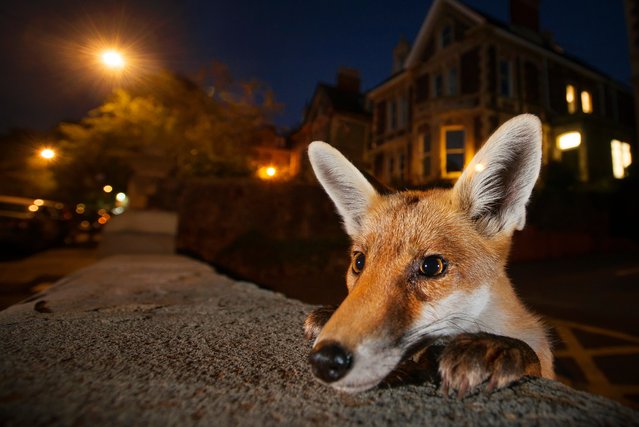
Nosy neighbour by Sam Hobson, UK. Sam knew exactly who to expect when he set his camera on the wall one summer’s evening in a suburban street in Bristol, the UK’s famous fox city. He wanted to capture the inquisitive nature of the urban red fox in a way that would pique the curiosity of its human neighbours about the wildlife around them. (Photo by Sam Hobson/2016 Wildlife Photographer of the Year)

Nosy neighbour by Sam Hobson, UK. Sam knew exactly who to expect when he set his camera on the wall one summer’s evening in a suburban street in Bristol, the UK’s famous fox city. He wanted to capture the inquisitive nature of the urban red fox in a way that would pique the curiosity of its human neighbours about the wildlife around them. (Photo by Sam Hobson/2016 Wildlife Photographer of the Year)
Details
31 Aug 2016 12:05:00
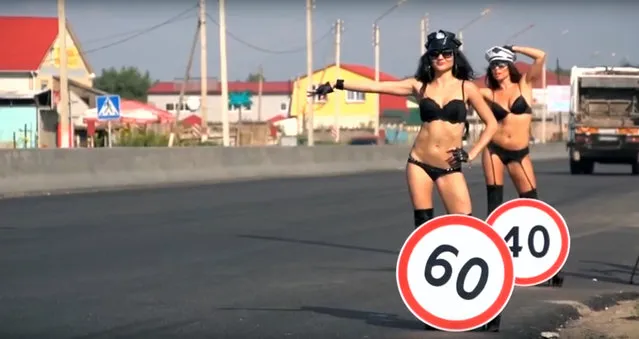
Half-naked girls against speed driving in Nizhny, Novgorod Region, Russia on September 5, 2016. Russian drivers are getting quite an eyeful in a bid to make them slow down thanks to topless women flashing speed limit signs at an accident blackspot. A trial of the road safety campaign demonstrated that it helped lower the speed of traffic near a  pedestrian crossing in Severny village. (Photo by YouTube)

Half-naked girls against speed driving in Nizhny, Novgorod Region, Russia on September 5, 2016. Russian drivers are getting quite an eyeful in a bid to make them slow down thanks to topless women flashing speed limit signs at an accident blackspot. A trial of the road safety campaign demonstrated that it helped lower the speed of traffic near a pedestrian crossing in Severny village. (Photo by YouTube)
Details
06 Sep 2016 10:45:00