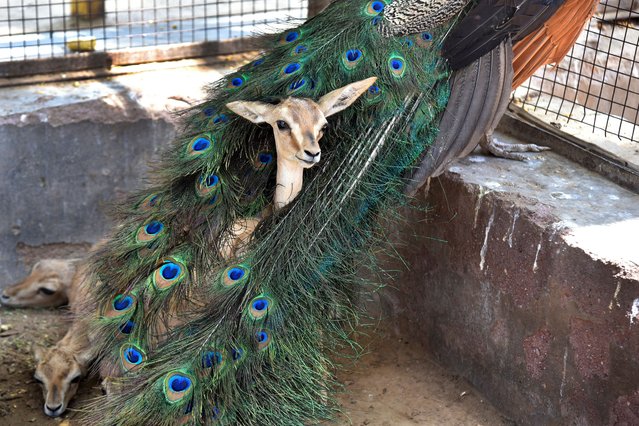
A Chinkara gazelle fawn rests in the plumage of a peacock at an animal rescue center on a hot summer day in Bikaner, Rajasthan, India, Thursday, May 23, 2024. (Photo by Dinesh Gupta/AP Photo)
Model feebee poses as part of art installation “Dazzle room” made by artist Shigeki Matsuyama at Room 32 fashion and design exhibition in Tokyo, Friday, February 19, 2016. Matsuyama's installation features a strong contrast of black and white, which he learned from dazzle camouflage used mainly in World War I, in Tokyo, Friday, Feb. 19, 2016. (Photo by Shuji Kajiyama/AP Photo)
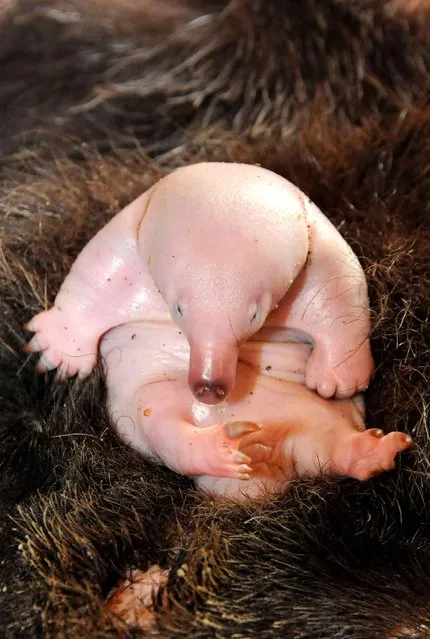
It's a 30-day-old Echidna baby, known as a “puggle” – one of only 24 ever bred in captivity. The proud parents are Tippy and Pickle of Australia Zoo. The tiny baby, whose s*x has not yet been identified, hatched from a soft egg and will continue to develop and nurse inside Tippy's warm pouch. (Photo by Australia Zoo/Rex/Sipa Press)
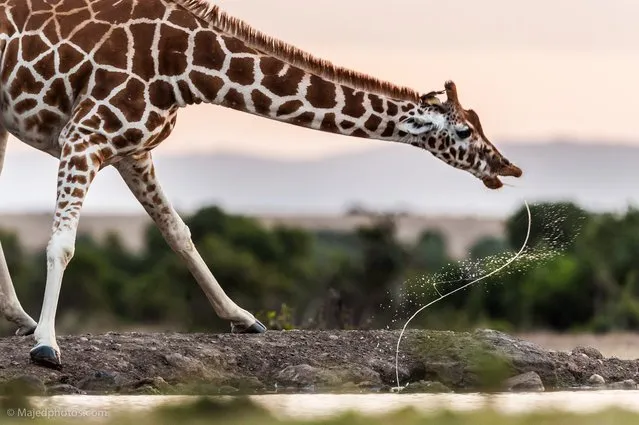
National Geographic invites photographers from around the world to enter the 2013 National Geographic Photography Contest. The grand-prize winner will receive $10,000 (USD) and a trip to National Geographic headquarters in Washington, D.C., to participate in the annual National Geographic Photography Seminar in January 2014. Photo: “We just want to move to search to the Leopard at that morning but we found a group of giraffes come toward a small lake and start drinking it was a nice moment when the Giraffe finish from drinking and leave a letters “S” with motion in the air”. (Photo and caption by Majed Ali/National Geographic Photography Contest)
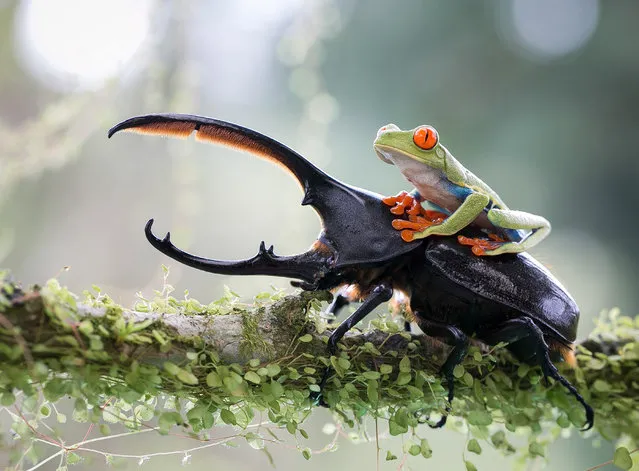
“The knight and his steed”. This picture was taken in a natural but controlled environment. There are pictures that can not be done in nature or that would imply a very high cost of both time and money, thats why photography workshops are run conducted at strategic locations and bringing EVERYONE who is interested, the basic notions (lighting, camera handling, composition, etc...) or the specimens, and afford them the opportunity to take pictures like this. Although controlled, this shot was not prepared at all, I was performing a workshop with the agalychnis callidryas treefrog from Costa Rica when the frog managed to jump to the branch where this huge titan was sleeping... I had my gear ready so I only had to change a few settings and shoot... the rest is history. (Photo and caption by Nicolas Reusens Boden (Sweden)/2014 Sony World Photography Awards)
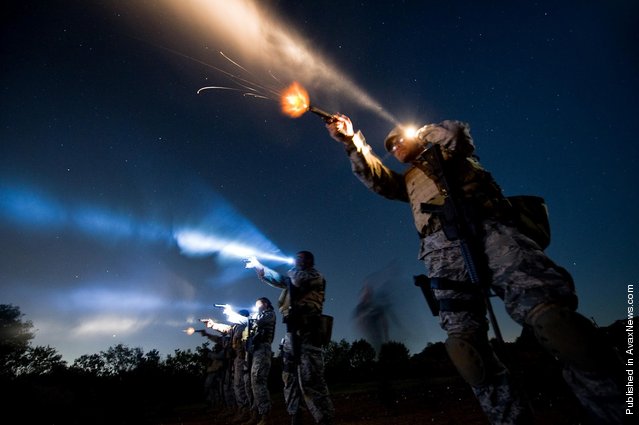
Tech. Sgt. Milo Hinson, 3rd Combat Camera Squadron, uses a flashlight while shooting a Berretta 9mm during the night-fire portion of Advance Weapons, Tactics and Techniques training in San Antonio. During night-fire training, airmen learn how to tactically illuminate targets with flashlights and practice using night vision goggles. (Photo by Staff Sgt. Jonathan Snyder/U.S. Air Force). 2011
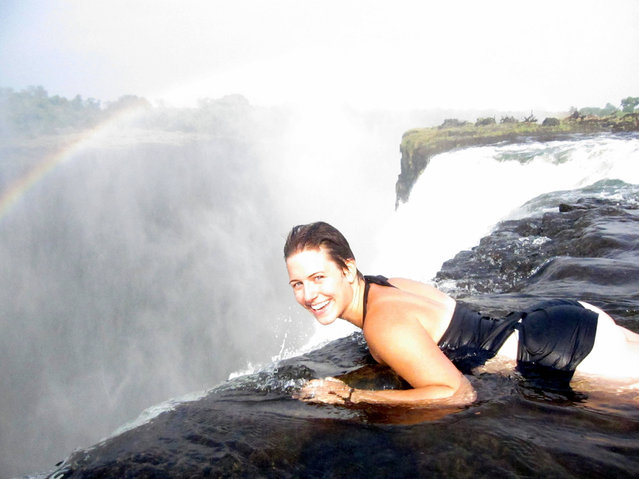
“The Victoria Falls or Mosi-oa-Tunya is a waterfall located in southern Africa on the Zambezi River between the countries of Zambia and Zimbabwe. A famous feature is a naturally formed pool known as the Devil's Pool, near the edge of the falls, accessed via Livingstone Island in Zambia. When the river flow is at a certain level, usually during the months of September to December, a rock barrier forms a pool with little current; some people swim in the pool. Occasional deaths have been reported when people slip over the edge of the rock barrier”. – Wikipedia
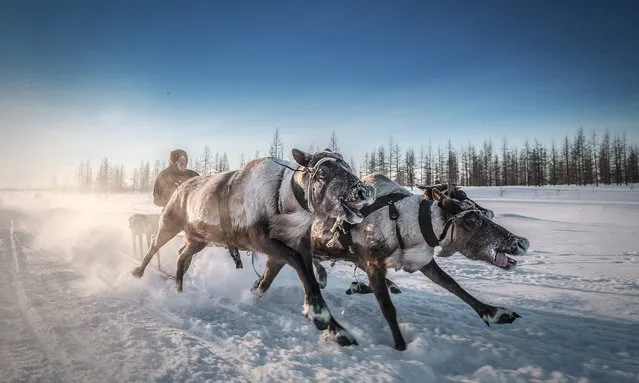
Take me away, deer, Russia. The Nenet people of Arctic Russia use reindeer and sledges as a prime mode of transport. The animals’ navigational ability means that in severe conditions they are sometimes the only hope of survival. (Photo by Kamil Nureev/Smithsonian Photo Contest)