Loading...
Done
Wells Clock – World's Oldest Mechanical Clock

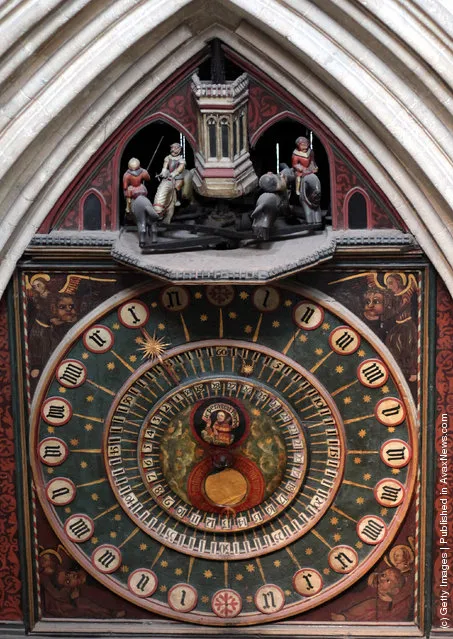
“Wells Cathedral is a Church of England cathedral in Wells, Somerset, England. Built between 1175 and 1490, Wells Cathedral has been described as “the most poetic of the English Cathedrals”. The Wells clock, an astronomical clock, is located in the north transept. The surviving mechanism, dated to between 1386 and 1392, was replaced in the 19th century, and was eventually moved to the Science Museum in London, where it continues to operate. It is the second-oldest surviving clock in England”. – Wikipedia

Photo: The clock face of world's oldest continually-working mechanical clock is seen as it is hand wound for the very last time on August 21, 2010 in Wells, England. (Photo by Matt Cardy/Getty Images)
Details
10 Aug 2011 11:23:00
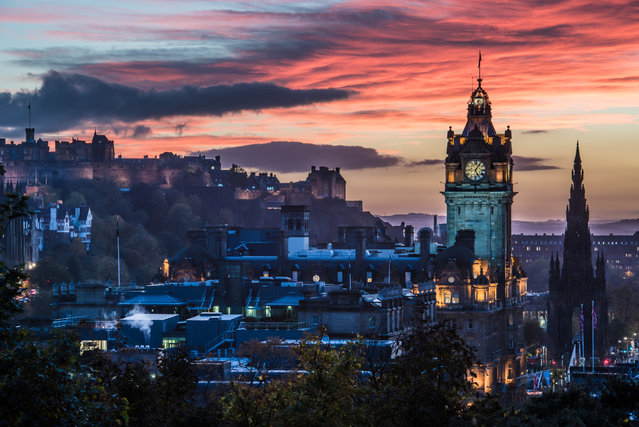
Beautiful red sunset sky over Edinburgh, Scotland. Edinburgh is the capital city of Scotland and a popular tourist destination. It is also a major European financial (fund management) centre. Prominent buildings from left to right are: Edinburgh Castle, The Balmoral Hotel Clock Tower and The Scott Monument. (Photo by John Lawson/Getty Images)

Beautiful red sunset sky over Edinburgh, Scotland. Edinburgh is the capital city of Scotland and a popular tourist destination. It is also a major European financial (fund management) centre. Prominent buildings from left to right are: Edinburgh Castle, The Balmoral Hotel Clock Tower and The Scott Monument. (Photo by John Lawson/Getty Images)
Details
11 Apr 2020 00:03:00
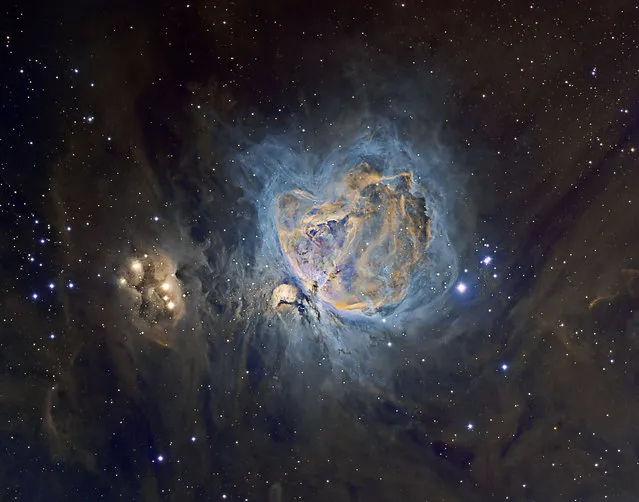
M42 Subtle V1 cropped. One of the most well-known astronomical objects in our universe is the Orion Nebula and this image depicts the wider region of the Orion Molecular Cloud Complex that is its home. This complex also includes another popular target for astrophotographers, the Horsehead Nebula, as well as Barnard’s Loop and the Running Man Nebula, which can be seen to the left of this photograph. (Photo by Patrick Gilliland)

M42 Subtle V1 cropped. One of the most well-known astronomical objects in our universe is the Orion Nebula and this image depicts the wider region of the Orion Molecular Cloud Complex that is its home. This complex also includes another popular target for astrophotographers, the Horsehead Nebula, as well as Barnard’s Loop and the Running Man Nebula, which can be seen to the left of this photograph. (Photo by Patrick Gilliland)
Details
17 Nov 2015 08:05:00
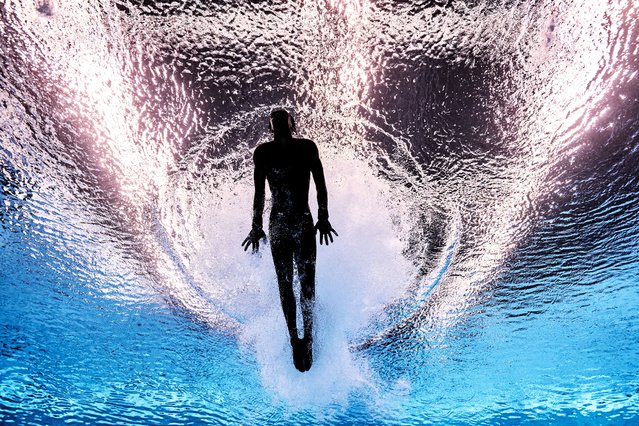
Robbie Lee of Team Great Britain competes in the Men's 10m Platform Preliminaries on day 23 of the Singapore 2025 World Aquatics Championships at OCBC Aquatic Centre on August 02, 2025 in Singapore. (Photo by Adam Pretty/Getty Images)

Robbie Lee of Team Great Britain competes in the Men's 10m Platform Preliminaries on day 23 of the Singapore 2025 World Aquatics Championships at OCBC Aquatic Centre on August 02, 2025 in Singapore. (Photo by Adam Pretty/Getty Images)
Details
03 Sep 2025 04:44:00
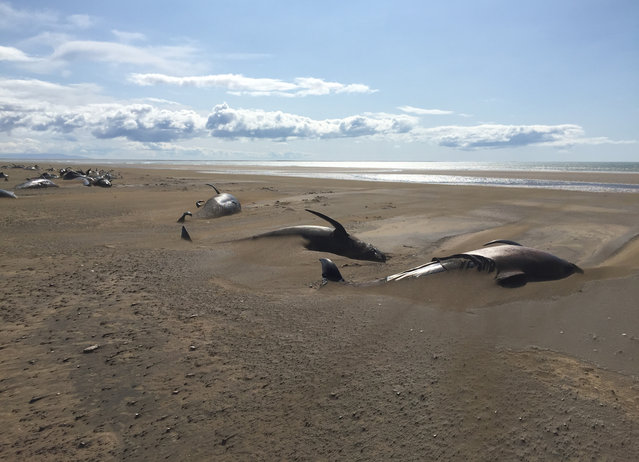
Some dozens of long-finned pilot whales lay dead on a remote beach in Iceland after they were discovered by tourists sightseeing in the Snaefellsnes Peninsula in western Iceland aboard a helicopter, Thursday July 18, 2019. The whales were concentrated in one spot on the beach, many partially covered by sand. (Photo by David Schwarzhans via AP Photo)

Some dozens of long-finned pilot whales lay dead on a remote beach in Iceland after they were discovered by tourists sightseeing in the Snaefellsnes Peninsula in western Iceland aboard a helicopter, Thursday July 18, 2019. The whales were concentrated in one spot on the beach, many partially covered by sand. (Photo by David Schwarzhans via AP Photo)
Details
21 Jul 2019 00:03:00
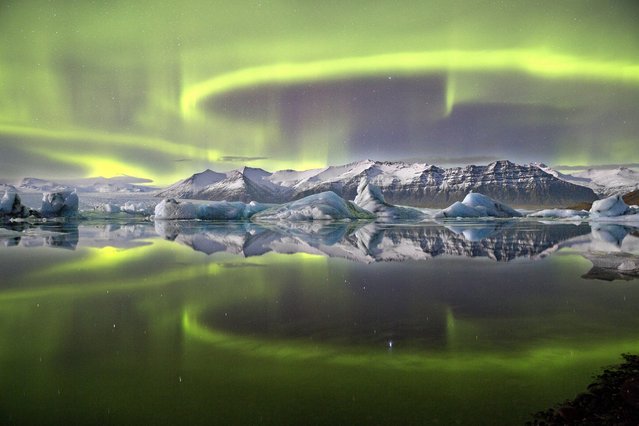
“Aurora over a glacier lagoon”. A vivid green overheaded aurrora pictured in Iceland's Vatnajokull National Park reflected almost symetrically in Jokulsrlon Glacier lagoon. A complete lack of wind and currrent combin in this sheltred lagoon scene to crete an arresting mirror effect giving the image a sensation of utter stillness. Despite theis there is motion on a suprising scale, as the loops and arcs of the aurora are shaped by the shifting forces of the Earth's magnetic field. (Photo by  James Woodend/The Astronomy Photographer of the Year 2014 Contest)

“Aurora over a glacier lagoon”. A vivid green overheaded aurrora pictured in Iceland's Vatnajokull National Park reflected almost symetrically in Jokulsrlon Glacier lagoon. A complete lack of wind and currrent combin in this sheltred lagoon scene to crete an arresting mirror effect giving the image a sensation of utter stillness. Despite theis there is motion on a suprising scale, as the loops and arcs of the aurora are shaped by the shifting forces of the Earth's magnetic field. James Woodend of Great Britain won the grand prize with the image, beating out more than 2,500 other entries. The Astronomy Photographer of the Year 2014 contest is judged by the Royal Observatory Greenwich and BBC Sky at Night magazine. (Photo by James Woodend/The Astronomy Photographer of the Year 2014 Contest)
Details
26 Sep 2014 13:39:00
A receptionist dinosaur robot performs at the new robot hotel, aptly called Henn na Hotel or Weird Hotel, in Sasebo, southwestern Japan, Wednesday, July 15, 2015. From the receptionist that does the check-in and check-out to the porter that’s a stand-on-wheels taking luggage up to the room, the hotel, that is run as part of Huis Ten Bosch amusement park, is “manned” almost totally by robots to save labor costs. (Photo by Shizuo Kambayashi/AP Photo)

A receptionist dinosaur robot performs at the new robot hotel, aptly called Henn na Hotel or Weird Hotel, in Sasebo, southwestern Japan, Wednesday, July 15, 2015. From the receptionist that does the check-in and check-out to the porter that’s a stand-on-wheels taking luggage up to the room, the hotel, that is run as part of Huis Ten Bosch amusement park, is “manned” almost totally by robots to save labor costs. (Photo by Shizuo Kambayashi/AP Photo)
Details
16 Jul 2015 11:18:00
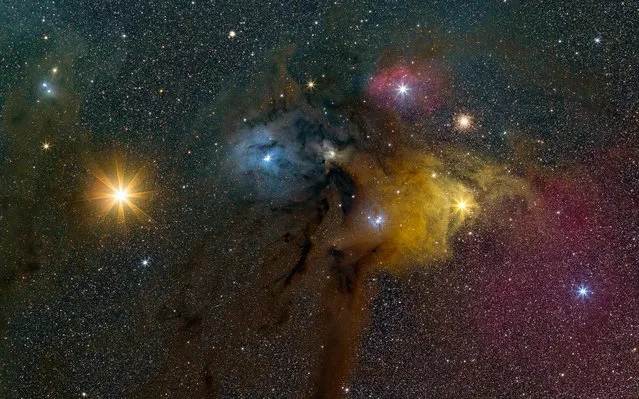
Mars and its Rival Antares and the Rho Ophiuchi cloud complex. (Photo by Phil Hart/CWAS/The Guardian)

These spectacular images of the universe are the finalists in the 2016 CWAS “David Malin” awards. The annual competition, which celebrates the best astronomy images taken by Australian photographers, is part of AstroFest 2016. The winners will be announced on 16 July. An associated exhibition opens the following day at the CSIRO Parkes Observatory visitors centre, and a second exhibition will also travel to selected venues around Australia. Here: Mars and its Rival Antares and the Rho Ophiuchi cloud complex. (Photo by Phil Hart/CWAS/The Guardian)
Details
12 Jul 2016 12:08:00