Loading...
Done
Four pillars of light from the 4 Laser Guide Star Facility on ESO's Very Large Telescope (VLT) are shown reaching into the Chilean night sky in this image from ESO Photo Ambassador Fred Kamphues, on September 2, 2016. The lasers are a key part of the adaptive optics system on the VLT. Adaptive optics allows astronomers to drastically reduce the atmospheric distortion present at even the best sites in the world for astronomy, including Paranal in Chile, the home of the VLT. (Photo by F. Kamphues/ESO)

Four pillars of light from the 4 Laser Guide Star Facility on ESO's Very Large Telescope (VLT) are shown reaching into the Chilean night sky in this image from ESO Photo Ambassador Fred Kamphues, on September 2, 2016. The lasers are a key part of the adaptive optics system on the VLT. Adaptive optics allows astronomers to drastically reduce the atmospheric distortion present at even the best sites in the world for astronomy, including Paranal in Chile, the home of the VLT. (Photo by F. Kamphues/ESO)
Details
23 Feb 2017 00:06:00
The Spanking. (Photo by Vika Valter/Getty Images)

The Spanking. (Photo by Vika Valter/Getty Images)
Details
03 Apr 2017 08:34:00
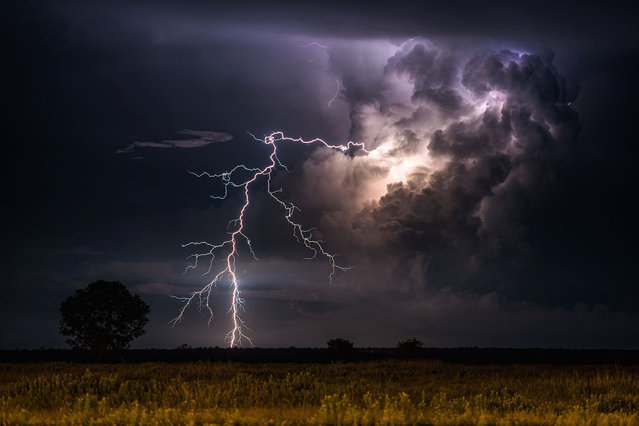
An incredible clear-air lightning display from storms to the east of Noonamah, just outside Darwin on April 6, 2015. (Photo by Jacci Ingham/The Guardian)

An incredible clear-air lightning display from storms to the east of Noonamah, just outside Darwin on April 6, 2015. (Photo by Jacci Ingham/The Guardian)
Details
12 Jun 2017 09:16:00
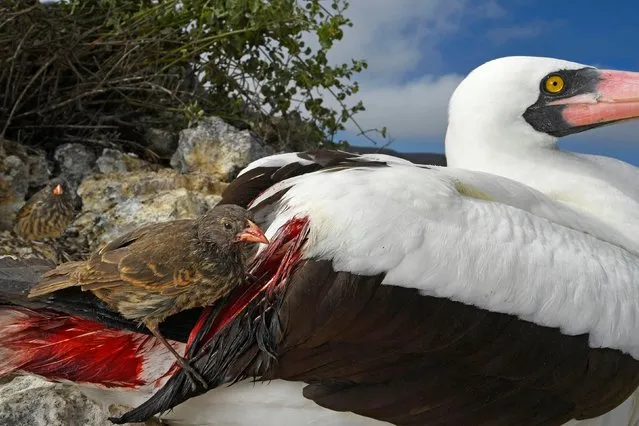
Bloodthirsty by Thomas P Peschak, Germany/South Africa — winner, Behaviour: birds. When rations run short on Wolf Island, in the remote northern Galápagos, the sharp-beaked ground finches become vampires. Their sitting targets are Nazca boobies and other large birds. The finches rely on a scant diet of seeds and insects, which regularly dries up, so they drink blood to survive. ‘I’ve seen more than half a dozen finches drinking from a single Nazca booby,’ says Tom. Rather than leave their nests the boobies tolerate the vampires, and the blood loss doesn’t seem to cause permanent harm. (Photo by Thomas P Peschak/2018 Wildlife Photographer of the Year)

Bloodthirsty by Thomas P. Peschak, Germany/South Africa — winner, Behaviour: birds. When rations run short on Wolf Island, in the remote northern Galápagos, the sharp-beaked ground finches become vampires. Their sitting targets are Nazca boobies and other large birds. The finches rely on a scant diet of seeds and insects, which regularly dries up, so they drink blood to survive. ‘I’ve seen more than half a dozen finches drinking from a single Nazca booby,’ says Tom. Rather than leave their nests the boobies tolerate the vampires, and the blood loss doesn’t seem to cause permanent harm. (Photo by Thomas P. Peschak/2018 Wildlife Photographer of the Year)
Details
19 Oct 2018 00:05:00
Leonhard Nienbling is shown with his 6-month old pet baboon Jackl, who holds a 6-month old kitten, its playmate, June 29, 1952. Niebling has quite an animal collection at his home in Zirndorf, Germany. (Photo by Heinrich Sanden/AP Photo)

Leonhard Nienbling is shown with his 6-month old pet baboon Jackl, who holds a 6-month old kitten, its playmate, June 29, 1952. Niebling has quite an animal collection at his home in Zirndorf, Germany. (Photo by Heinrich Sanden/AP Photo)
Details
26 Sep 2017 09:08:00


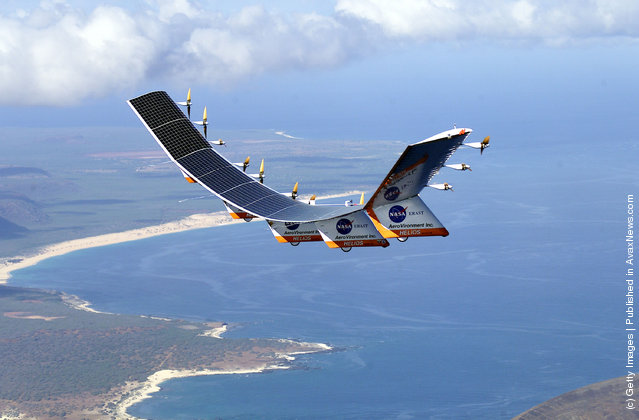
“NASA's Pathfinder, Pathfinder Plus, Centurion and Helios Prototype were an evolutionary series of solar- and fuel-cell-system-powered unmanned aerial vehicles. AeroVironment, Inc. developed the vehicles under NASA's Environmental Research Aircraft and Sensor Technology (ERAST) program. They were built to develop the technologies that would allow long-term, high-altitude aircraft to serve as “atmospheric satellites”, to perform atmospheric research tasks as well as serve as communications platforms”. – Wikipedia

Photo: The solar-electric Helios Prototype flying wing is flies over the Hawaiian islands of Niihau and Lehua during the first solar-powered test flight July 14, 2001 from the U.S. Navy's Pacific Missile Range Facility on Kauai, HI. The 18-hour flight was a functional checkout of the aircraft's systems and performance in preparation for an attempt to reach sustained flight at 100,000 feet altitude later in the summer. (Photo Courtesy of NASA/Getty Images)
Details
14 Jul 2011 09:24:00
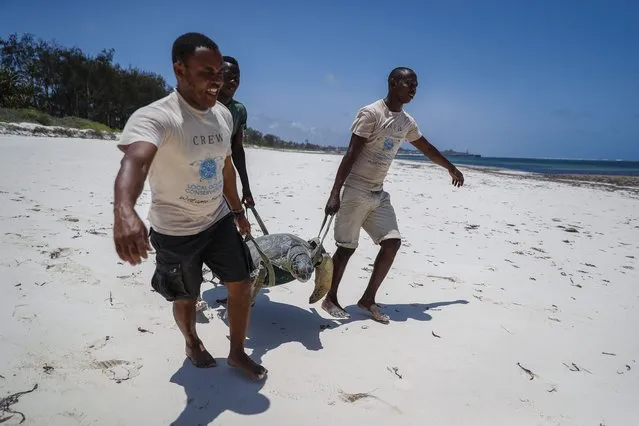
Fikiri Kiponda, left, and Wilson Saro, right, carry a green turtle that was unintentionally caught in a fisherman's net, before releasing it back into the Watamu National Marine Park on the Indian Ocean coast of Kenya Wednesday, September 22, 2021. A former accountant, Kiponda and the Local Ocean Conservation group rescue sea turtles that have been caught in fishermen's nets, and then release them back into the marine park or treat injured ones at a rescue center until they are fit. (Photo by Brian Inganga/AP Photo)

Fikiri Kiponda, left, and Wilson Saro, right, carry a green turtle that was unintentionally caught in a fisherman's net, before releasing it back into the Watamu National Marine Park on the Indian Ocean coast of Kenya Wednesday, September 22, 2021. A former accountant, Kiponda and the Local Ocean Conservation group rescue sea turtles that have been caught in fishermen's nets, and then release them back into the marine park or treat injured ones at a rescue center until they are fit. (Photo by Brian Inganga/AP Photo)
Details
29 Oct 2021 08:56:00
A woman uses a plastic bad to protect her head amid snowfall in Beijing, China on December 14, 2023. (Photo by Tingshu Wang/Reuters)

A woman uses a plastic bad to protect her head amid snowfall in Beijing, China on December 14, 2023. (Photo by Tingshu Wang/Reuters)
Details
20 Dec 2023 22:27:00