Loading...
Done
An exile Tibetan artisan waits to perform a traditional dance after an early morning prayer session to usher in the Year of the Water Hare in Dharamshala, India, Tuesday, February 21, 2023. (Photo by Ashwini Bhatia/AP Photo)

An exile Tibetan artisan waits to perform a traditional dance after an early morning prayer session to usher in the Year of the Water Hare in Dharamshala, India, Tuesday, February 21, 2023. (Photo by Ashwini Bhatia/AP Photo)
Details
09 Mar 2023 03:53:00
A fuzzy caterpillar on a basil plant in west Bengal, India on December 25, 2023. The caterpillar’s defence system is its hair, which has microscopic barbs that break off easily in the skin of would-be predators. (Photo by Soumyabrata Roy/NurPhoto/Rex Features/Shutterstock)

A fuzzy caterpillar on a basil plant in west Bengal, India on December 25, 2023. The caterpillar’s defence system is its hair, which has microscopic barbs that break off easily in the skin of would-be predators. (Photo by Soumyabrata Roy/NurPhoto/Rex Features/Shutterstock)
Details
09 Feb 2024 10:47:00
Catholic faithful attend a Palm Sunday mass at the start of Holy Week in San Lorenzo, Paraguay, Sunday, March 24, 2024. (Photo by Jorge Saenz/AP Photo)

Catholic faithful attend a Palm Sunday mass at the start of Holy Week in San Lorenzo, Paraguay, Sunday, March 24, 2024. (Photo by Jorge Saenz/AP Photo)
Details
12 Apr 2024 00:20:00
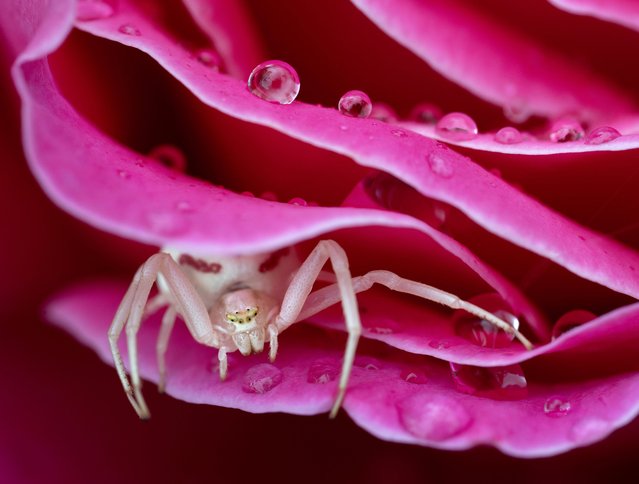
A white crab spider hides between the petals of a rain spotted rose blossom in the garden of a home near Oakland in southwestern Oregon on August 23, 2024. Crab spiders are ambush predators and wait patiently for their prey to approach. (Photo by Robin Loznak/ZUMA Press Wire/Rex Features/Shutterstock)

A white crab spider hides between the petals of a rain spotted rose blossom in the garden of a home near Oakland in southwestern Oregon on August 23, 2024. Crab spiders are ambush predators and wait patiently for their prey to approach. (Photo by Robin Loznak/ZUMA Press Wire/Rex Features/Shutterstock)
Details
31 Aug 2024 03:16:00
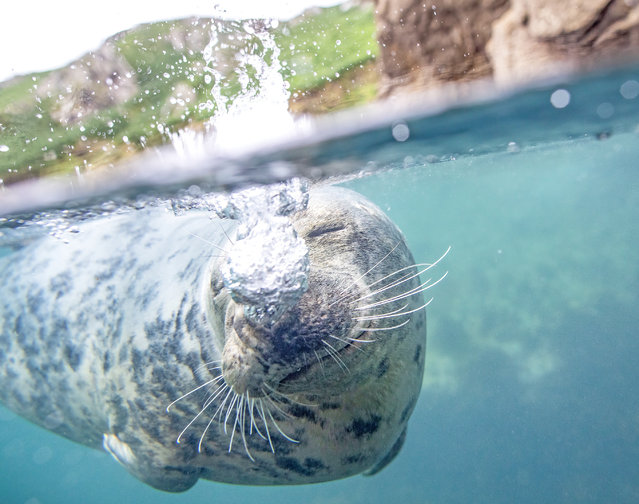
A curious grey seal investigates photographer Brian Matthews at Lundy Island off the north Devon coast, July 2024. *Photo by Brian Matthews/Solent News)

A curious grey seal investigates photographer Brian Matthews at Lundy Island off the north Devon coast, July 2024. *Photo by Brian Matthews/Solent News)
Details
23 Dec 2024 03:00:00
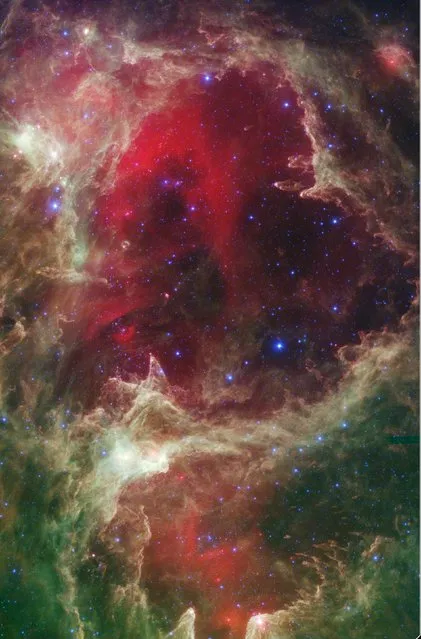
An infrared portrait from NASA's Spitzer Space Telescope which shows generations of stars is seen in this undated NASA handout image released February 14, 2013. In this wispy star-forming region, called W5, the oldest stars can be seen as blue dots in the centers of the two hollow cavities (other blue dots are background and foreground stars not associated with the region). Red shows heated dust that pervades the region's cavities, while green highlights dense clouds. (Photo by NASA/Reuters/JPL-Caltech/Harvard-Smithsonian/Handout)

An infrared portrait from NASA's Spitzer Space Telescope which shows generations of stars is seen in this undated NASA handout image released February 14, 2013. In this wispy star-forming region, called W5, the oldest stars can be seen as blue dots in the centers of the two hollow cavities (other blue dots are background and foreground stars not associated with the region). Red shows heated dust that pervades the region's cavities, while green highlights dense clouds. (Photo by NASA/Reuters/JPL-Caltech/Harvard-Smithsonian/Handout)
Details
03 Mar 2013 08:44:00
Dancers pose for photos at a park in Beijing, China, Thursday, October 14, 2021. (Photo by Ng Han Guan/AP Photo)

Dancers pose for photos at a park in Beijing, China, Thursday, October 14, 2021. (Photo by Ng Han Guan/AP Photo)
Details
20 Oct 2021 08:44:00
On August 31, 2012, a long filament of solar material that had been hovering in the sun's atmosphere, the corona, erupted out into space at 4:36 p.m. EDT. The coronal mass ejection, or CME, traveled at over 900 miles per second. The CME did not travel directly toward Earth, but did connect with Earth's magnetic environment, or magnetosphere, causing aurora to appear on the night of Monday, September 3. (Photo by NASA/GSFC/SDO)

On August 31, 2012, a long filament of solar material that had been hovering in the sun's atmosphere, the corona, erupted out into space at 4:36 p.m. EDT. The coronal mass ejection, or CME, traveled at over 900 miles per second. The CME did not travel directly toward Earth, but did connect with Earth's magnetic environment, or magnetosphere, causing aurora to appear on the night of Monday, September 3. (Photo by NASA/GSFC/SDO via The Atlantic)
Details
14 Sep 2012 09:01:00