Loading...
Done


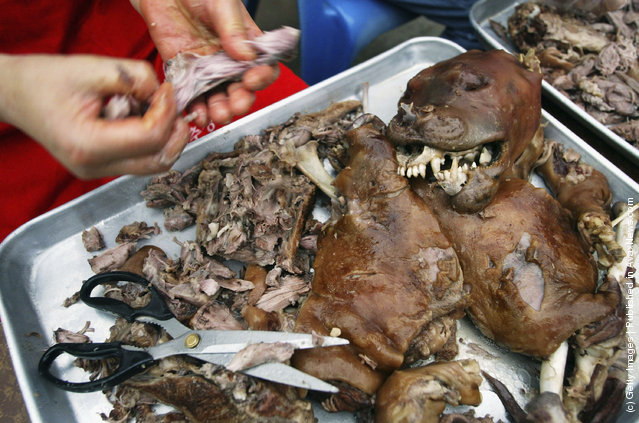
“Dog meat refers to edible parts and the flesh derived from (predominantly domestic) dogs. Human consumption of dog meat has been recorded in many parts of the world, including ancient China, ancient Mexico, and ancient Rome. According to contemporary reports, dog meat is consumed in a variety of countries such as Switzerland, China, Vietnam, the Philippines, and Korea. In addition, dog meat has also been used as survival food in times of war and/or other hardships”. – Wikipedia

Photo: A chef prepares dog meat at a restaurant on July 4, 2005 in Gwacheon, South Korea. Dog meat is a traditional dish in Korea dating back to the Samkuk period (period of the three kingdoms BC 57 – AD 668). Although many recipes existed historically for dog meat, now chefs only make soups, or dishes using boiled or roasted meat. Koreans traditionally eat dog meat on the hottest day of the summer, for it's reputed benefits of virility, invigoration and health. (Photo by Chung Sung-Jun/Getty Images)
Details
24 Jul 2011 13:21:00


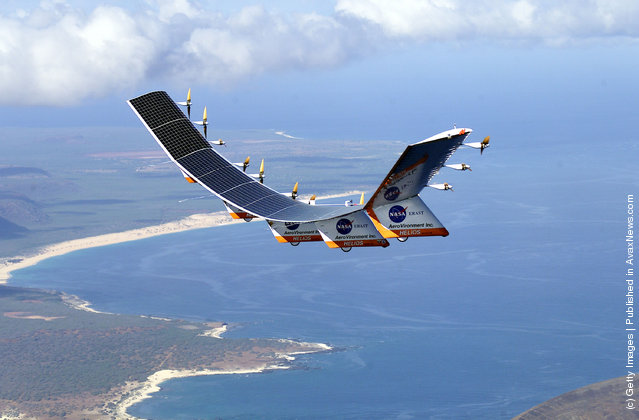
“NASA's Pathfinder, Pathfinder Plus, Centurion and Helios Prototype were an evolutionary series of solar- and fuel-cell-system-powered unmanned aerial vehicles. AeroVironment, Inc. developed the vehicles under NASA's Environmental Research Aircraft and Sensor Technology (ERAST) program. They were built to develop the technologies that would allow long-term, high-altitude aircraft to serve as “atmospheric satellites”, to perform atmospheric research tasks as well as serve as communications platforms”. – Wikipedia

Photo: The solar-electric Helios Prototype flying wing is flies over the Hawaiian islands of Niihau and Lehua during the first solar-powered test flight July 14, 2001 from the U.S. Navy's Pacific Missile Range Facility on Kauai, HI. The 18-hour flight was a functional checkout of the aircraft's systems and performance in preparation for an attempt to reach sustained flight at 100,000 feet altitude later in the summer. (Photo Courtesy of NASA/Getty Images)
Details
14 Jul 2011 09:24:00


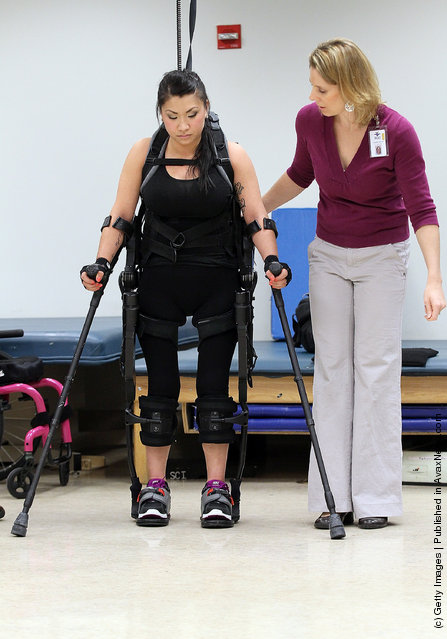
“eLEGS is a wearable, artificially intelligent, bionic device that enables people with paralysis to stand up and walk again. The exoskeleton is battery-powered and rechargeable, fitting comfortably and securely over clothing. Initially, eLEGS will be used under medical supervision for rehabilitation and training”. – BerkeleyBionics.com

Photo: Paralysis victim Stephanie Sablan (L) is helped by physical therapist Shonna Moran as she walks using eLEGS robotic legs at Santa Clara Valley Medical Center on May 25, 2011 in San Jose, California. Sablan, 24, was paralyzed from the waist down earlier this year when she was in a car accident and has begun using the newly developed eLEGS made by Berkeley Bionics. The robot-like battery powered eLEGS fit over clothing and enables people with paralysis to stand up and walk again. (Photo by Justin Sullivan/Getty Images)
Details
26 May 2011 09:56:00


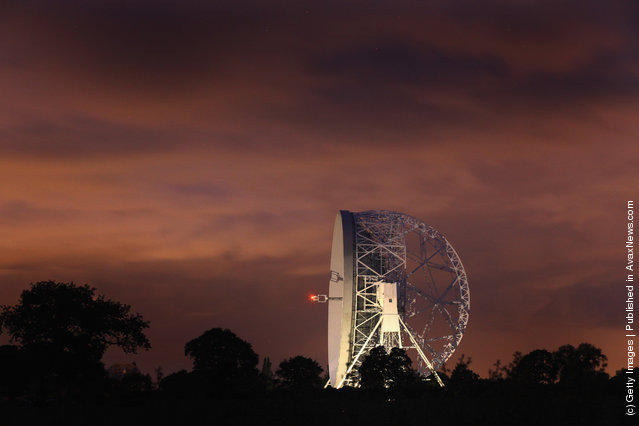
“The Lovell Telescope is a radio telescope at Jodrell Bank Observatory, near Goostrey, Cheshire in the north-west of England. When it was constructed in 1955, the telescope was the largest steerable dish radio telescope in the world at 76.2 m (250 ft) in diameter; it is now the third largest, after the Green Bank telescope in West Virginia, USA, and the Effelsberg telescope in Germany. It was originally known as the 250 ft (76 m) telescope or the Radio Telescope at Jodrell Bank, before becoming the Mark I telescope around 1961 when future telescopes (the Mark II, III, and IV) were being discussed. It was renamed to the Lovell Telescope in 1987 after Bernard Lovell, and became a Grade I listed building in 1988. The telescope forms part of the MERLIN and European VLBI Network arrays of radio telescopes”. – Wikipedia

Photo: The Lovell Telescope listens to the night sky for radio signals from space at Jodrell Bank on June 22, 2011 in Holmes Chapel, England. Jodrell Bank Centre for Astrophysics and it's world famous Lovell Telescope is on the shortlist of Britain's submission for Unesco World Heritage Site status. (Photo by Christopher Furlong/Getty Images)
Details
24 Jun 2011 09:34:00
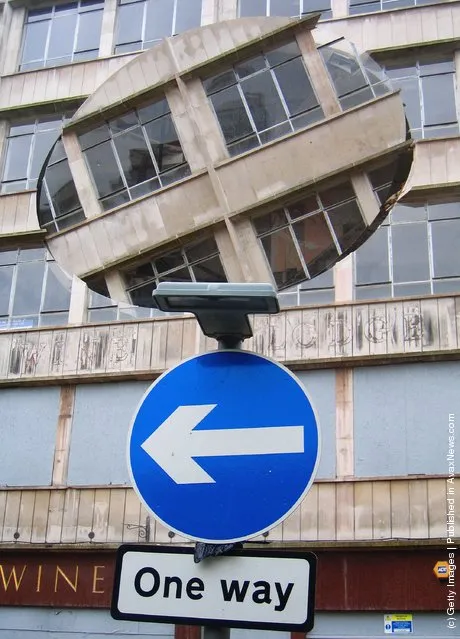
An installation by the artist Richard Wilson, entitled 'Turning the Place Over', is built into the condemned Cross Keys House in Moorfields as part of the Capital of Culture for 2008

“Richard Wilson (born May 24, 1953) is a sculptor, installation artist and musician. Wilson's work is characterised by architectural concerns with volume, illusionary spaces and auditory perception”. – Wikipedia

Photo: An installation by the artist Richard Wilson, entitled “Turning the Place Over”, is built into the condemned Cross Keys House in Moorfields as part of the Capital of Culture for 2008, on June 25, 2007 in Liverpool, England. The piece consists of an 8 metre ovoid cut from the building's facade that oscillates in three dimensions. (Photo by Jim Dyson/Getty Images)
Details
27 Mar 2012 10:31:00
Roma Community In Romania

“Inspired by the French authorities' solution to move Romas from point A to point B, Romanian authorities planned and started forced evictions of Roma informal settlements in cities like Cluj-Napoca and Baia Mare. Some of these settlements date back to the early 1990’s. These communities were tolerated by the authorities who verbally encouraged Romas to build in the area, meanwhile, reassuring them nothing bad would ever happen to them. However, the the reality today is that during political campaigns, authorities are planning forced evictions without reasons other than ethnic cleansing of the cities. My home documents the every day life of Roma communities in Romania, 2011”. – Mugur Varzariu. (Photo by Mugur Varzariu, 2011 FotoVisura Grant Finalist)
Details
20 Apr 2012 13:22:00
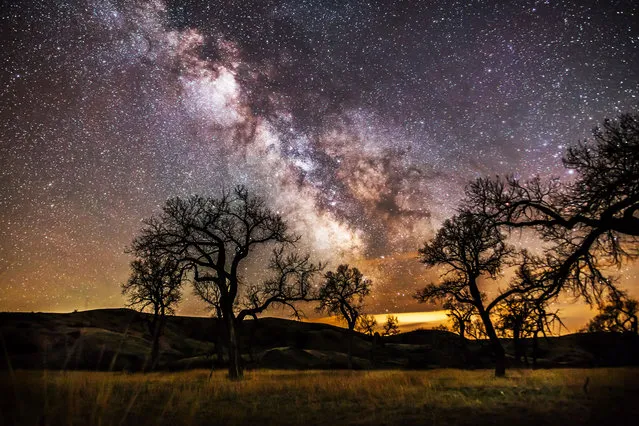
The stunning Milkyway in Midwestern U.S.A.  captured by photographer Randy Halverson in 2013. The stunning skies in Midwestern U.S.A. captured by photographer Randy Halverson. The videographer captured rare footage of the Milky Way, the elusive Northern Lights and raging night storms in some of the most isolated regions of the U.S.A. (Photo by Randy Halverson/Barcroft Media)

The stunning Milkyway in Midwestern U.S.A. captured by photographer Randy Halverson in 2013. The stunning skies in Midwestern U.S.A. captured by photographer Randy Halverson. The videographer captured rare footage of the Milky Way, the elusive Northern Lights and raging night storms in some of the most isolated regions of the U.S.A. The footage, which spans the skies of South Dakota, Wyoming and Utah, was taken between spring and autumn 2013. The 47-year-old spent 40 nights scattered across the eight-month period sat near his camera to capture the clear footage. Randy from Kennebec, South Dakota has been shooting timelapse for over 4 years. (Photo by Randy Halverson/Barcroft Media)
Details
20 Aug 2014 10:32:00
Dynam employees say a greeting message as they receive customer-care training ahead of the grand opening of the company's pachinko parlour in Fukaya, north of Tokyo July 29, 2014. (Photo by Issei Kato/Reuters)

Dynam employees say a greeting message as they receive customer-care training ahead of the grand opening of the company's pachinko parlour in Fukaya, north of Tokyo July 29, 2014. Japan's once-booming pachinko industry, grappling with a greying customer base and the threat of new competition from casinos, is adopting a softer touch and smoke-free zones to lure a new generation of players, particularly women. Pachinko, a modified version of pinball, is a fading national obsession, with about 12,000 parlours nation-wide and one in thirteen people playing the game. But that figure is declining as the population shrinks and younger people prefer games on their mobile phones. (Photo by Issei Kato/Reuters)
Details
25 Aug 2014 10:18:00