Loading...
Done
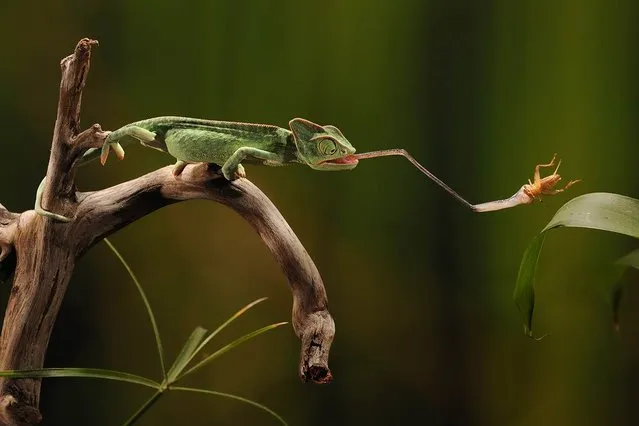
A veiled chameleon extends its tongue to catch a cricket

“Scott Linstead is an internationally published, freelance wildlife photographer/writer. His clients include Natural History Magazine, Hewlett Packard, Ranger Rick Magazine and a number of wildlife publications in North America and Europe. Scott's column on the techniques of bird photography appears in every issue of Outdoor Photography Canada”.

Photo: A veiled chameleon extends its tongue to catch a cricket. Canadian wildlife photographer Scott Linstead, formerly an aerospace engineer and high school teacher, uses a device called Phototrap “to not only photograph the elusive, but also the unimaginably quick”. (Photo by Scott Linstead)
Details
22 May 2012 11:32:00


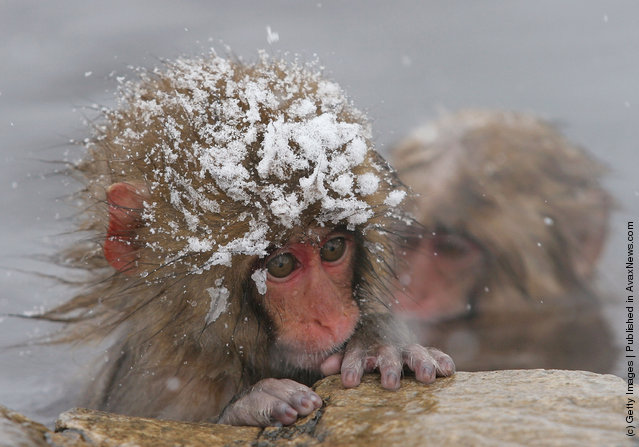
Japanese macaque monkeys enjoy sitting in the hot springs at Jigokudani-Onsen (Hell Valley) on January 23, 2005 in Jigokudani, Nagano-Prefecture, Japan. Japanese Macaques, also known as snow monkeys are the most northerly nonhuman primate in the world. In 1963 a female Macaque ventured into the hot springs to retrieve some soybeans. This behaviour was adopted by other monkeys, and eventually by the entire troop. This Macaque troop regularly visits the Jigokudani-Onsen springs to escape the cold. The hot springs are said to help relieve nerve pain and fatigue. (Photo by Koichi Kamoshida/Getty Images)
Details
20 May 2011 08:04:00
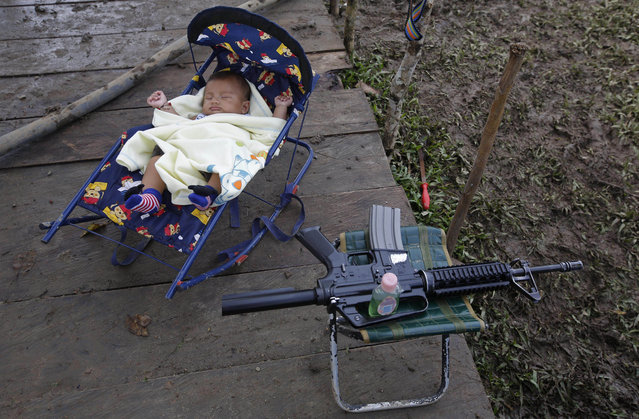
In this Tuesday, February 28, 2017 photo, 3-month-old Junior Alexis Patino, son of FARC rebel Deisy Garcia, sleeps next to his mother's weapon at a rebel camp in a demobilization zone in La Carmelita, in Colombia's southwestern Putumayo state. Amid the makeshift tents and communal kitchens where Colombia's largest rebel army is preparing to lay down its weapons, a new sound is emerging: the cries of babies. (Photo by Fernando Vergara/AP Photo)

In this Tuesday, February 28, 2017 photo, 3-month-old Junior Alexis Patino, son of FARC rebel Deisy Garcia, sleeps next to his mother's weapon at a rebel camp in a demobilization zone in La Carmelita, in Colombia's southwestern Putumayo state. Amid the makeshift tents and communal kitchens where Colombia's largest rebel army is preparing to lay down its weapons, a new sound is emerging: the cries of babies. (Photo by Fernando Vergara/AP Photo)
Details
09 Mar 2017 00:04:00
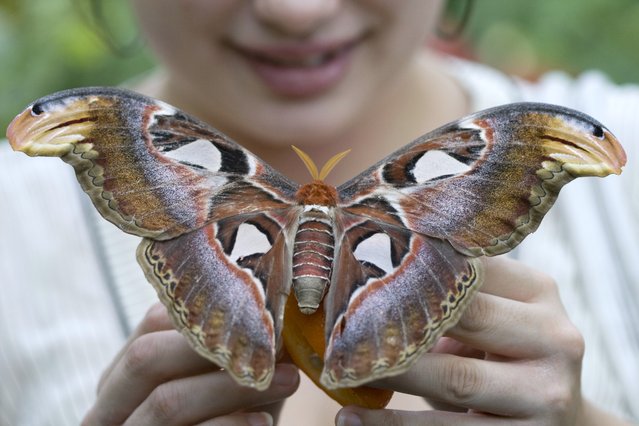
Atlas Moth @ Carleton. (Photo by Terri Oda)

“The Atlas moth (Attacus atlas) is a large saturniid moth found in the tropical and subtropical forests of Southeast Asia, and common across the Malay archipelago. Atlas moths are considered the largest moths in the world in terms of total wing surface area [upwards of c. 400 cm2 (62 sq in)]. Their wingspans are also amongst the largest, reaching over 25 cm (10 in). Females are appreciably larger and heavier”. – Wikipedia. Photo: Atlas Moth. (Photo by Terri Oda)


Details
10 Feb 2013 16:49:00
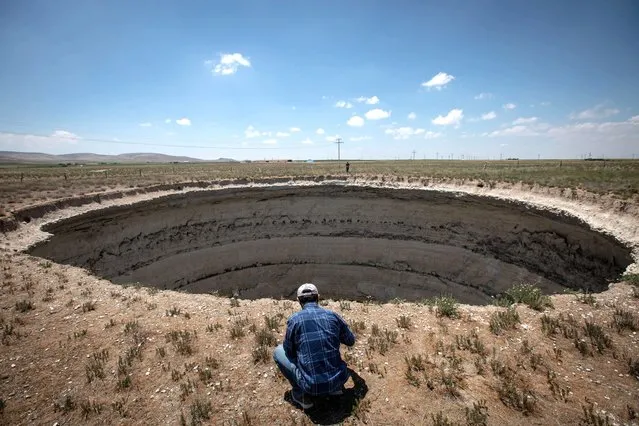
Geology Professor Fetullah Arik takes measurements next to a large sinkhole on June 03, 2021, in Karapinar, Turkey. (Photo by Chris McGrath/Getty Images)

Geology Professor Fetullah Arik takes measurements next to a large sinkhole on June 03, 2021, in Karapinar, Turkey. In Turkey’s Konya province, the heart of the country's agriculture sector, extreme drought conditions over the past two years are taking a heavy toll on farmers and the land. (Photo by Chris McGrath/Getty Images)
Details
15 Jun 2021 08:35:00
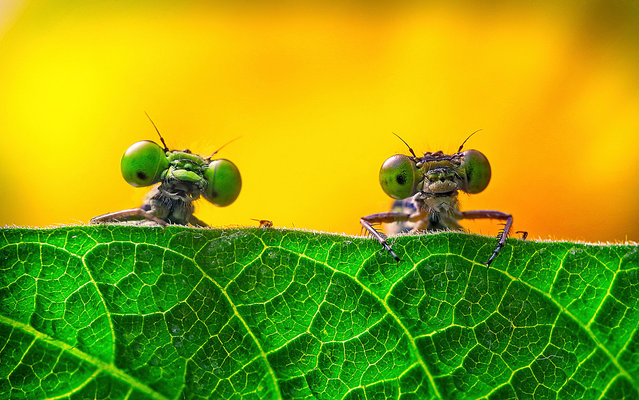
Shortlisted: “Two big eyes” by Miao Yong (Zejiang province, China). Damselflies look over the leaves. “I was photographing insects in a park near my home when suddenly I found two damselflies in the grass. They kept flying and it was very difficult to focus until suddenly they parked behind a leaf”. (Photo by Miao Yong/2017 Royal Society of Biology Photographer of the Year)

Shortlisted: “Two big eyes” by Miao Yong (Zejiang province, China). Damselflies look over the leaves. “I was photographing insects in a park near my home when suddenly I found two damselflies in the grass. They kept flying and it was very difficult to focus until suddenly they parked behind a leaf”. (Photo by Miao Yong/2017 Royal Society of Biology Photographer of the Year)
Details
16 Oct 2017 09:04:00
Imagine living in the sea where it is permanently dark, cold, and food is hard to find. For many animals at depth, it may be weeks to months between meals. If you find something to eat, you have to hang on to it

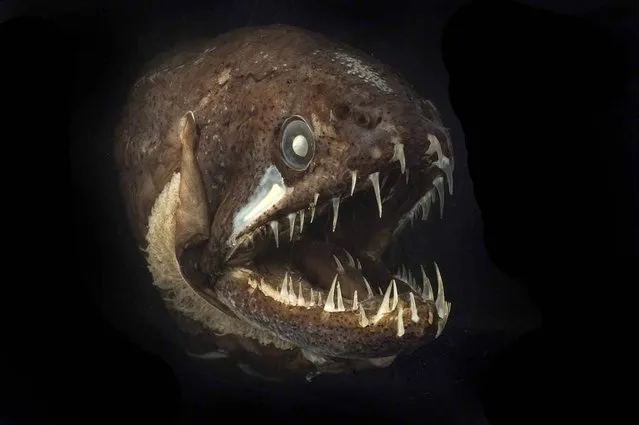
Imagine living in the sea where it is permanently dark, cold, and food is hard to find. For many animals at depth, it may be weeks to months between meals. If you find something to eat, you have to hang on to it. This is why so many deep-sea fishes have lots of big teeth. This dragonfish, spotted off the coast of Australia, even has teeth on its tongue. They would be terrifying animals ... if they weren’t the size of a banana. (Photo by Julian Finn/Museum Victoria)
Details
21 May 2012 12:14:00
Mangrove in Walakiri Beach after Sunset in East Sumba, Indonesia in 2018. (Photo by Sarubabel Malau/Rex Features/Shutterstock)

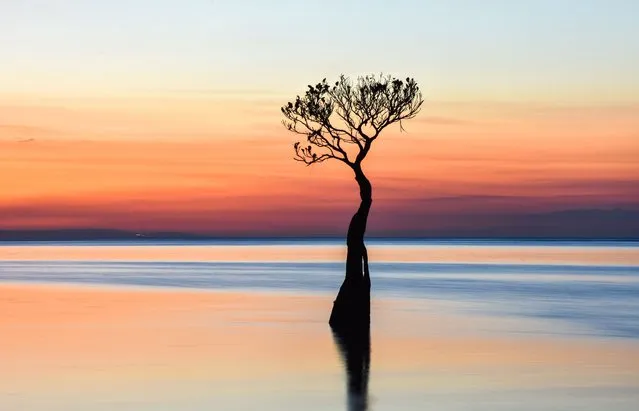
Mangrove in Walakiri Beach after Sunset in East Sumba, Indonesia in 2018. (Photo by Sarubabel Malau/Rex Features/Shutterstock)
Details
04 Apr 2022 05:47:00