Loading...
Done
Sculpture By Ervin Loranth Herve

There are not many sculptures in the world that were purposely made to be grotesque, especially on such a large scale. Thus, a Hungarian artist Ervin Loránth Hervé has apparently decided that there isn’t enough horror in this world and created the Feltépve – a sculpture of a stone giant ripping apart the earth in order to break free. However, when we look from another perspective this sculpture might depict a grouchy giant trying to cover himself with a blanket of earth so that everyone would leave him alone. The latter interpretation of this sculpture was probably not intended by the sculptor; however, the way the arms of the giant are positioned makes it look as if it was truly the case.
Details
04 Nov 2014 11:49:00
Crowds look on as the super moon rises behind the Fremantle War Memorial at Monument Hill on November 14, 2016 in Fremantle, Australia. A super moon occurs when a full moon passes closes to earth than usual, with the November 14th moon expected to be closer than it has been in over 70 years. (Photo by Paul Kane/Getty Images)

Crowds look on as the super moon rises behind the Fremantle War Memorial at Monument Hill on November 14, 2016 in Fremantle, Australia. A super moon occurs when a full moon passes closes to earth than usual, with the November 14th moon expected to be closer than it has been in over 70 years. (Photo by Paul Kane/Getty Images)
Details
15 Nov 2016 11:30:00
Indigenous people march during the annual Free Earth camp, where they discuss rights, territorial protection and their role in COP30, which will take place for the first time in the Amazon, in Brasilia, Brazil, Tuesday, April 8, 2025. (Photo by Eraldo Peres/AP Photo)

Indigenous people march during the annual Free Earth camp, where they discuss rights, territorial protection and their role in COP30, which will take place for the first time in the Amazon, in Brasilia, Brazil, Tuesday, April 8, 2025. (Photo by Eraldo Peres/AP Photo)
Details
15 Jun 2025 04:21:00
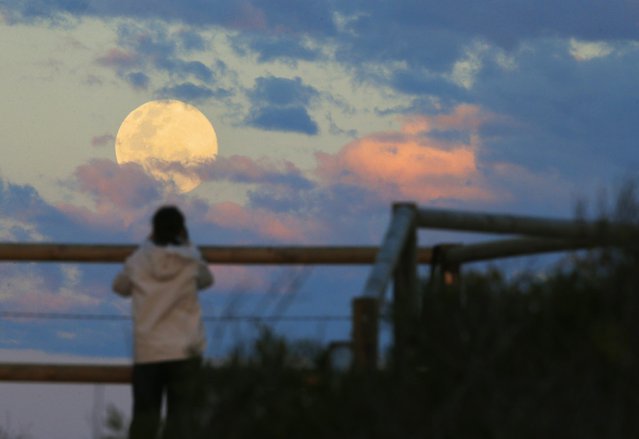
Sydney resident Virginia Maddock watches the supermoon rise off the Sydney beachside suburb of Wanda, August 10, 2014. The astronomical event occurs when the moon is closest to the Earth in its orbit, making it appear much larger and brighter than usual. (Photo by Jason Reed/Reuters)

Sydney resident Virginia Maddock watches the supermoon rise off the Sydney beachside suburb of Wanda, August 10, 2014. Sunday’s moon was at its closest approach to Earth, appearing bigger and brighter than any other moon this year. The moon was 221,765 miles away and looked 16 percent larger and 30 percent brighter than usual. (Photo by Jason Reed/Reuters)
Details
11 Aug 2014 11:50:00
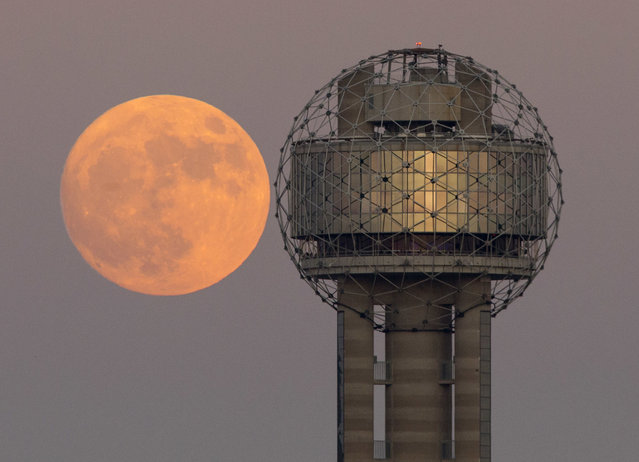
The moon rises behind Reunion Tower in downtown Dallas, Sunday evening, November 13, 2016. On Monday the supermoon will be the closest full moon to earth since 1948, and it won't be as close again until 2034. (Photo by Tom Fox/The Dallas Morning News via AP Photo)

The moon rises behind Reunion Tower in downtown Dallas, Sunday evening, November 13, 2016. On Monday the supermoon will be the closest full moon to earth since 1948, and it won't be as close again until 2034. (Photo by Tom Fox/The Dallas Morning News via AP Photo)
Details
14 Nov 2016 09:49:00
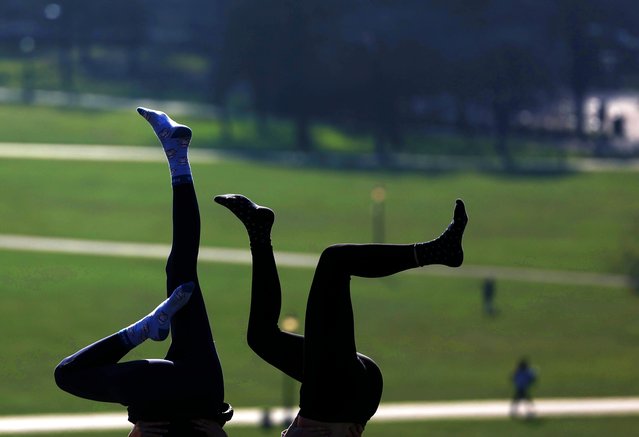
People exercise in Primrose Hill in London, Britain, 20 March 2025. The first day of spring in the UK astronomically occurs on the vernal equinox where earth's axis is not tilted towards or away from the sun, resulting in an equal amount of day and night on all latitudes. (Photo by Neil Hall/EPA/EFE)

People exercise in Primrose Hill in London, Britain, 20 March 2025. The first day of spring in the UK astronomically occurs on the vernal equinox where earth's axis is not tilted towards or away from the sun, resulting in an equal amount of day and night on all latitudes. (Photo by Neil Hall/EPA/EFE)
Details
10 Apr 2025 03:03:00
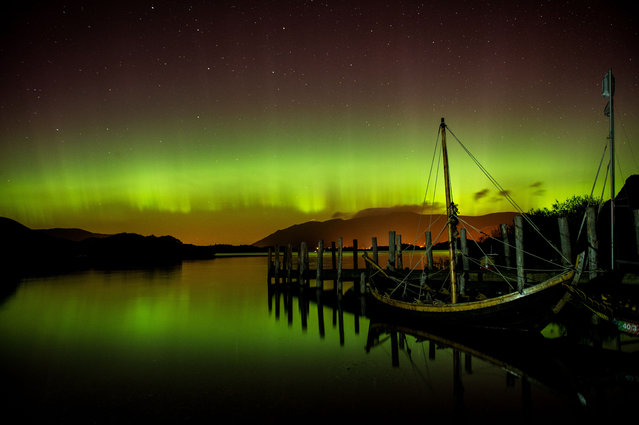
The aurora borealis, or the northern lights occur over Derwentwater, near Keswick, England, Thursday October 8, 2015. The northern lights are the result of collisions between gaseous particles in the Earth's atmosphere with charged particles released from the sun. (Photo by Owen Humphreys/PA via AP Photo)

The aurora borealis, or the northern lights occur over Derwentwater, near Keswick, England, Thursday October 8, 2015. The northern lights are the result of collisions between gaseous particles in the Earth's atmosphere with charged particles released from the sun. (Photo by Owen Humphreys/PA Wire via AP Photo)
Details
15 Oct 2015 08:06:00
A coil-shaped Helix Nebula showing a fine web of filamentary “bicycle-spoke” features embedded in the colorful red and blue ring of gas. At 650 light-years away, the Helix is one of the nearest planetary nebulae to Earth. A planetary nebula is the glowing gas around a dying, Sun-like star. (Photo by Reuters/NASA)

A coil-shaped Helix Nebula showing a fine web of filamentary “bicycle-spoke” features embedded in the colorful red and blue ring of gas. At 650 light-years away, the Helix is one of the nearest planetary nebulae to Earth. A planetary nebula is the glowing gas around a dying, Sun-like star. (Photo by Reuters/NASA)
Details
22 Oct 2014 14:01:00