Loading...
Done
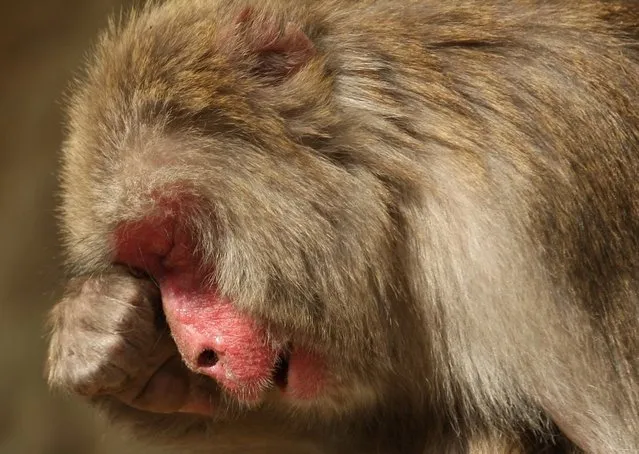
A 20-year-old Japanese macaque monkey named Monday scratches her eyes while suffering an allergy to pollen from the cedar tree at Awajishima Monkey Centre on March 17, 2013 in Sumoto, Japan. Many monkeys are suffering the effects of hay fever at this time of the year, with the typical symptoms being the same as with humans.  According to Awajishima Monkey center this year hay fever is higher than last year, the pollen season is from February to April.  (Photo by Buddhika Weerasinghe)

A 20-year-old Japanese macaque monkey named Monday scratches her eyes while suffering an allergy to pollen from the cedar tree at Awajishima Monkey Centre on March 17, 2013 in Sumoto, Japan. Many monkeys are suffering the effects of hay fever at this time of the year, with the typical symptoms being the same as with humans. According to Awajishima Monkey center this year hay fever is higher than last year, the pollen season is from February to April. (Photo by Buddhika Weerasinghe)
Details
18 Mar 2013 09:48:00
Wooden Sculpture By Zheng Chunhui

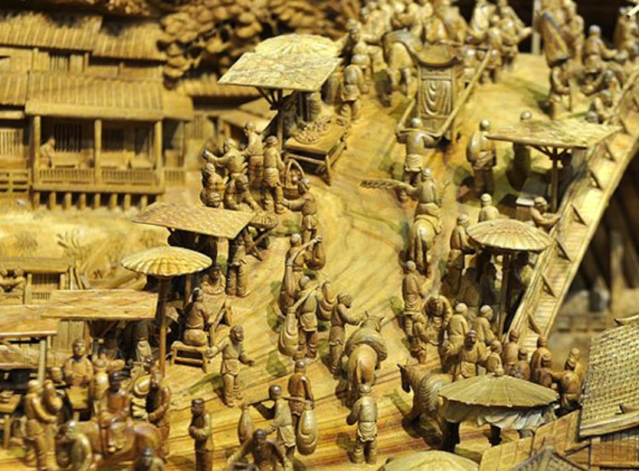
A famous Chinese wood carver, Zheng Chunhui has won a Guinness World Record after developing the longest wooden carving of the world. Zheng spent 4 years developing the artwork that is about forty feet long and made sculpture from a single tree trunk. The artwork is basically a copy of the popular Chinese painting named Along the River during the Qingming Festival that was made around one thousand years ago.
Details
11 Mar 2015 10:45:00
The Sugar Plum Fairy, Katherine Free, left, dances with the dog, Pig, during the Birmingham's Ballet “Mutt-cracker”, a rendition of the famous ballet “The Nutcracker”, in Birmingham, Alabama, December 8, 2016. (Photo by Brynn Anderson/AP Photo)

The Sugar Plum Fairy, Katherine Free, left, dances with the dog, Pig, during the Birmingham's Ballet “Mutt-cracker”, a rendition of the famous ballet “The Nutcracker”, in Birmingham, Alabama, December 8, 2016. (Photo by Brynn Anderson/AP Photo)
Details
14 Dec 2016 11:01:00
Aerial photo shows people enjoying the blooming plum blossoms in Zhuyuwan scenic spot in Yangzhou City, east China's Jiangsu Province on February 23, 2023. (Photo by Rex Features/Shutterstock)

Aerial photo shows people enjoying the blooming plum blossoms in Zhuyuwan scenic spot in Yangzhou City, east China's Jiangsu Province on February 23, 2023. (Photo by Rex Features/Shutterstock)
Details
17 Mar 2023 02:50:00
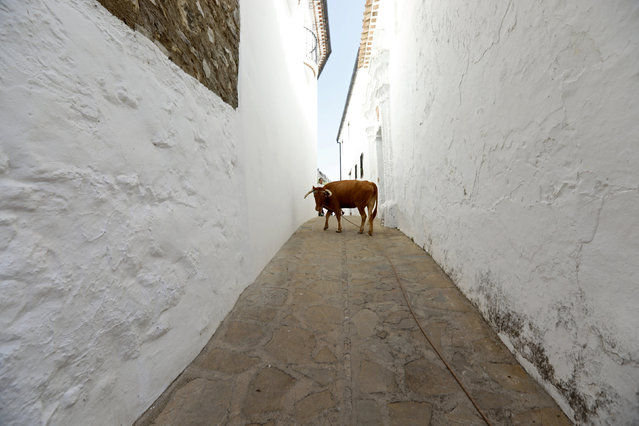
A heifer, tied with a rope, turns during “Toro de Cuerda” in the white village of Villaluenga del Rosario, southern Spain September 3, 2016. Dazzling clusters of cube-shaped houses perched on top of Andalusia's olive tree-studded mountains, the “Pueblos Blancos”, or white villages, of southern Spain are named for the lime wash the buildings are painted with to keep the interiors cool. The labyrinths of narrow alleyways are a throwback to when this region was known as Al-Andalus and was part of a medieval Muslim territory. While this region is stunningly beautiful and a big draw to tourists visiting the south of Spain, it is also one of the poorest areas in the country and has one of the highest unemployment rates in the European Union. (Photo by Marcelo del Pozo/Reuters)

A heifer, tied with a rope, turns during “Toro de Cuerda” in the white village of Villaluenga del Rosario, southern Spain September 3, 2016. Dazzling clusters of cube-shaped houses perched on top of Andalusia's olive tree-studded mountains, the “Pueblos Blancos”, or white villages, of southern Spain are named for the lime wash the buildings are painted with to keep the interiors cool. The labyrinths of narrow alleyways are a throwback to when this region was known as Al-Andalus and was part of a medieval Muslim territory. While this region is stunningly beautiful and a big draw to tourists visiting the south of Spain, it is also one of the poorest areas in the country and has one of the highest unemployment rates in the European Union. (Photo by Marcelo del Pozo/Reuters)
Details
20 Oct 2016 11:09:00
Glass Art By Kiva Ford

Glass artist Kiva Ford draws from his vast experience in scientific glassblowing to create perfect miniatures of wine glasses, beakers, and ribbon-striped vases, some scarcely an inch tall. A member of the American Scientific Glassblowers Society, Kiva creates instruments for scientists who require one-of-a-kind designs for various experiments. The same techniques and tools used for scientific equipment also apply to his artistic practice including the miniature works you see here, as well as larger sculptures, and ornate drinkware.
Details
21 Jul 2015 10:31:00


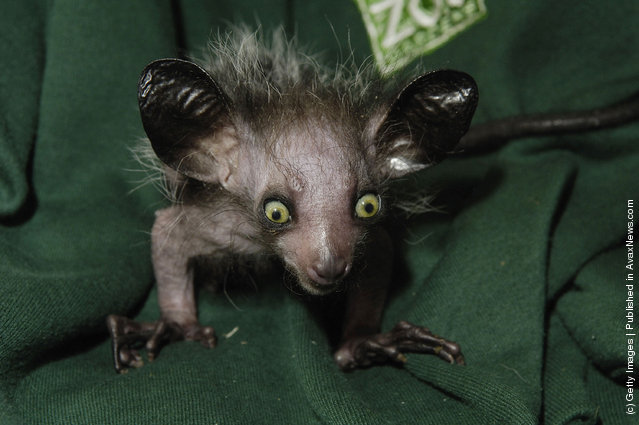
“The aye-aye (Daubentonia madagascariensis) is a lemur, a strepsirrhine primate native to Madagascar that combines rodent-like teeth and a special thin middle finger to fill the same ecological niche as a woodpecker. It is the world's largest nocturnal primate, and is characterized by its unusual method of finding food; it taps on trees to find grubs, then gnaws holes in the wood and inserts its narrow middle finger to pull the grubs out. The only other animal species known to find food in this way is the striped possum. From an ecological point of view the aye-aye fills the niche of a woodpecker as it is capable of penetrating wood to extract the invertebrates within”. – Wikipedia

Photo: In this handout image from Bristol Zoo is seen the first captive bred aye-aye in the UK named “Kintana” (meaning star in Malagasy) April 15, 2005 at Bristol Zoo Gardens, England. The zoo announced today only the second baby aye-aye to be hand-reared in the world (the first was in Jersey Zoo) and has now made his first public appearance since his birth on 11 February 2005. (Photo by Rob Cousins/Bristol Zoo via Getty Images)
Details
13 Apr 2011 13:33:00


“Yucca is a genus of perennial shrubs and trees in the agave family, Agavaceae. Its 40-50 species are notable for their rosettes of evergreen, tough, sword-shaped leaves and large terminal panicles of white or whitish flowers. They are native to the hot and dry (arid) parts of North America, Central America, South America, and the Caribbean. Early reports of the species were confused with the cassava (Manihot esculenta). Consequently, Linnaeus mistakenly derived the generic name from the Carib word for the latter, yuca. It is also colloquially known in the midwest United States as “Ghosts in the graveyard”, as it is commonly found growing in rural graveyards and when in bloom the flowers appear as an apparition floating.” – Wikipedia

Photo: A yucca standing among flowers bursts forth a very large stalk of flowers as a heavy wildflower bloom on June 21, 2005 in the Angeles National Forest northwest of La Canada, California. (Photo by David McNew/Getty Images)
Details
29 Mar 2011 07:31:00