Loading...
Done
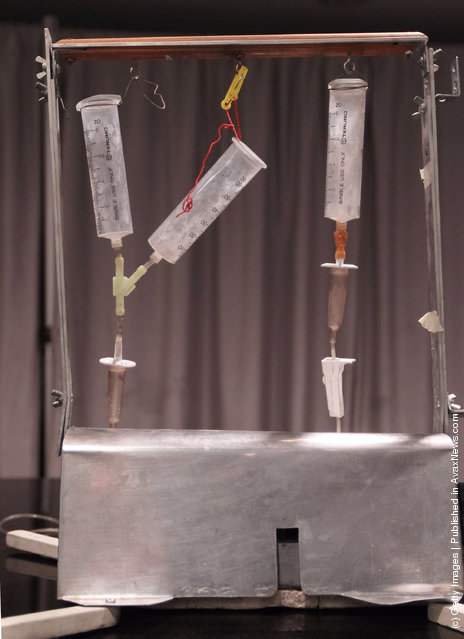
The Thanatron, often referred to as the Death Machine of Dr. Jack Kevorkian

“Jacob «Jack» Kevorkian (May 26, 1928 – June 3, 2011), commonly known as “Dr. Death”, was an American pathologist, euthanasia activist, painter, composer and instrumentalist. He is best known for publicly championing a terminal patient's right to die via physician-assisted suicide; he said he assisted at least 130 patients to that end. He famously said, «dying is not a crime»”. – Wikipedia

Photo: The “Thanatron”, often referred to as the “Death Machine”, is displayed during a press preview of an auction of the personal effects of Dr. Jack Kevorkian at the New York Institute of Technology on October 27, 2011 in New York City. The device was reportedly used by over 100 of Dr. Kevorkian's patients to terminate their lives. (Photo by Mario Tama/Getty Images)
Details
28 Oct 2011 12:26:00


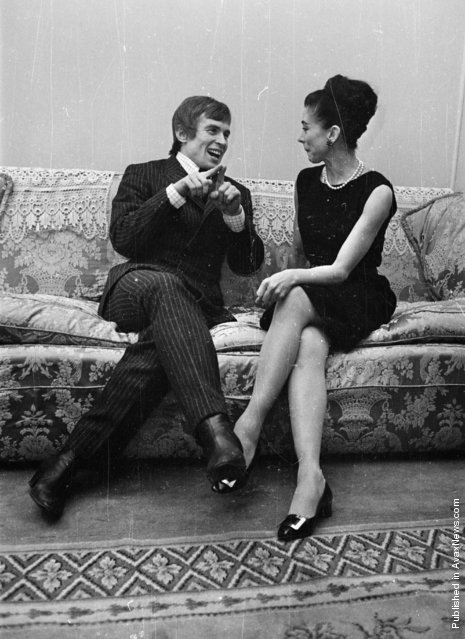
“Rudolf Khametovich Nureyev was a Russian Tatar dancer from the former Soviet Union, primarily known for his work in ballet. Nureyev's artistic skills explored expressive areas of the dance, providing a new role to the male ballet dancer who once served only as support to the women. He defected to the West, despite KGB efforts to stop him. According to KGB archives studied by Peter Watson, Nikita Khrushchev personally signed an order to have Nureyev killed”.

Photo: British ballerina Margot Fonteyn (Margaret Hookham) (1919 – 1991) and her professional partner during his tenure with the Royal Ballet Rudolf Nureyev. (Photo by Potter/Express/Getty Images). 12th December 1965. (Photo by Central Press/Getty Images)
Details
16 Mar 2011 09:10:00
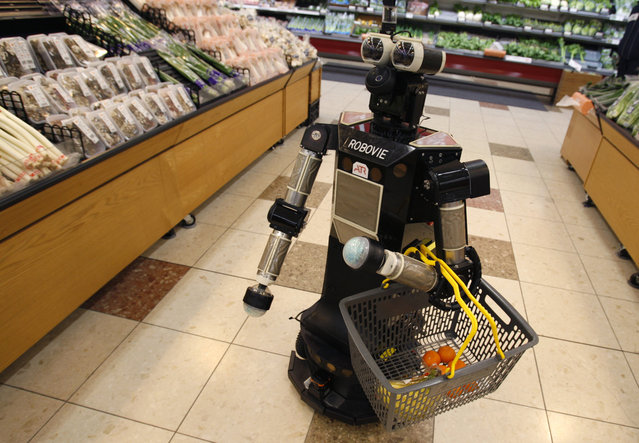
A robot named “Robovie-II”, developed by Japanese robotics research institution ATR, moves around at a grocery store during a shopping assisting experiment by utilizing the robot in an ubiquitous network technology platform in Kyoto, western Japan January 6, 2010. The robot greets the shopper at the entrance of the store, follows him to the shelves while holding a grocery basket and reminds him of the items on a shopping list, which the shopper would have entered beforehand in a specialized mobile device. The experiment is aimed to gather data in order to provide livelihood support for the elderly by using robots and network technologies, ATR's researcher Satoshi Koizumi said. (Photo by Yuriko Nakao/Reuters)

A robot named “Robovie-II”, developed by Japanese robotics research institution ATR, moves around at a grocery store during a shopping assisting experiment by utilizing the robot in an ubiquitous network technology platform in Kyoto, western Japan January 6, 2010. (Photo by Yuriko Nakao/Reuters)
Details
02 Feb 2018 06:54:00
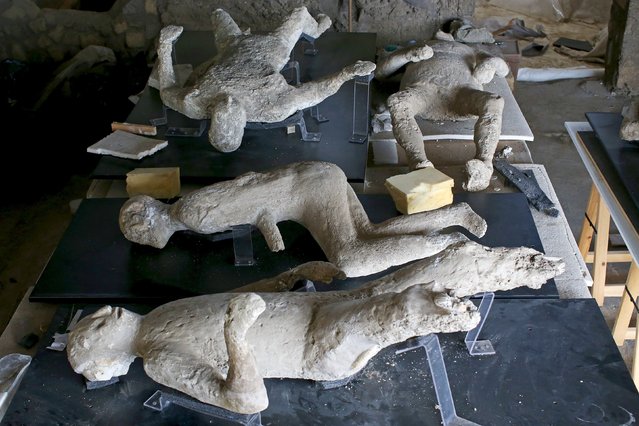
Plaster cast moulds of victims of the Mount Vesuvius eruption lie on a display table in a laboratory at Pompeii October 13, 2015. An expert team made up of archaeologists, radiologists, orthodontists and anthropologists began on September 2015 to use CAT scan technology (computerised axial tomography) to peer inside the plaster cast moulds of Pompeii's victims, in a study that has added more detail to previous findings. (Photo by Alessandro Bianchi/Reuters)

Plaster cast moulds of victims of the Mount Vesuvius eruption lie on a display table in a laboratory at Pompeii October 13, 2015. An expert team made up of archaeologists, radiologists, orthodontists and anthropologists began on September 2015 to use CAT scan technology (computerised axial tomography) to peer inside the plaster cast moulds of Pompeii's victims, in a study that has added more detail to previous findings. A 16-layer scan had to be used in order to penetrate the hardened plaster but the results showed up impressive skeletal remains and near perfect teeth. (Photo by Alessandro Bianchi/Reuters)
Details
22 Oct 2015 08:02:00
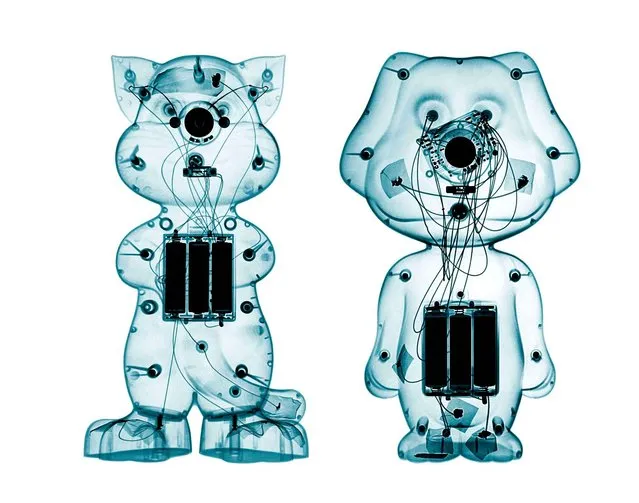
Australian photographer Brendan Fitzpatrick’s X-ray photographs expose the inner workings of toys. Fitzpatrick’s photographs are both whimsical and mechanical, evoking the curiosity of childhood and the desire to discover how things look and work from other perspectives. (Photo by Brendan Fitzpatrick)

Australian photographer Brendan Fitzpatrick’s X-ray photographs expose the inner workings of toys. Fitzpatrick’s photographs are both whimsical and mechanical, evoking the curiosity of childhood and the desire to discover how things look and work from other perspectives. The strategic placement of wires, batteries, and screws are revealed, the complexity of the inside contrasting with the seemingly simplistic design of the outside. Fitzpatrick uses chest X-ray and mammogram machines to photograph flowers, toys, and creatures, then enhances the color in the images in order to more effectively distinguish the various parts that have been exposed. This photographs are part of series he calls “Invisible Light”. (Photo by Brendan Fitzpatrick)
Details
08 Aug 2014 10:59:00
“Eye of a toad”. Animal Portraits, Łukasz Bożycki, Poland.  (Photo by Łukasz Bożycki)

“Eye of a toad”. Animal Portraits, Łukasz Bożycki, Poland. Early spring sees a pond near Łukasz’s home city of Warsaw, Poland, full of mating frogs and a few toads. On this March day, Łukasz shared the pond with them for an evening, sitting in the icy water in his chest-high waders, keeping as still as possible, despite the numbing cold, so that the amphibians could get used to him. “I wanted to find a fresh way of portraying the amphibians”, he says, “at water level”. Using a telephoto lens, he focused on one lone toad and waited for the sun to dip almost below the horizon before pressing the shutter, using flash to bring out the details in the shadow. His prize was “the glorious pool of sunset colour” and fiery glow of the toad’s eye. Nikon D80 + 70-300mm f4.5-5.6 lens + extension tube; 1/125 sec at f9 (-2.3 e/v); ISO 100; built-in flash. (Photo by Łukasz Bożycki)
Details
28 Aug 2013 11:45:00
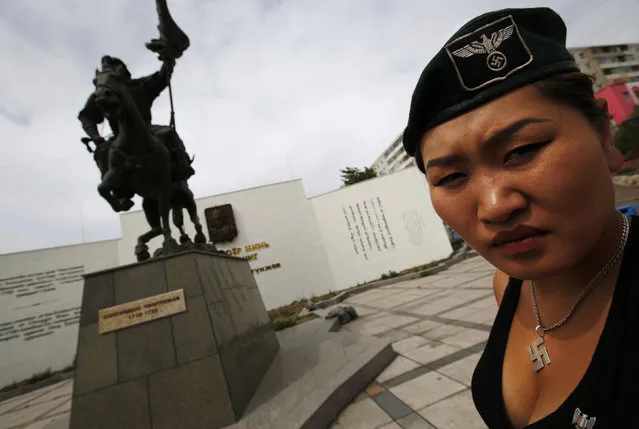
Uranjargal, a leader of the Mongolian neo-Nazi group Tsagaan Khass, stands next to a statue of Chingunjav, a Mongolian national hero, in Ulan Bator June 22, 2013. (Photo by Carlos Barria/Reuters)

Uranjargal, a leader of the Mongolian neo-Nazi group Tsagaan Khass, stands next to a statue of Chingunjav, a Mongolian national hero, in Ulan Bator June 22, 2013. The group has rebranded itself as an environmentalist organisation fighting pollution by foreign-owned mines, seeking legitimacy as it sends Swastika-wearing members to check mining permits. Over the past years, ultra-nationalist groups have expanded in the country and among those garnering attention is Tsagaan Khass, which has recently shifted its focus from activities such as attacks on women it accuses of consorting with foreign men to environmental issues, with the stated goal of protecting Mongolia from foreign mining interests. This ultra-nationalist group was founded in the 1990s and currently has 100-plus members. (Photo by Carlos Barria/Reuters)
Details
09 Jul 2013 07:23:00


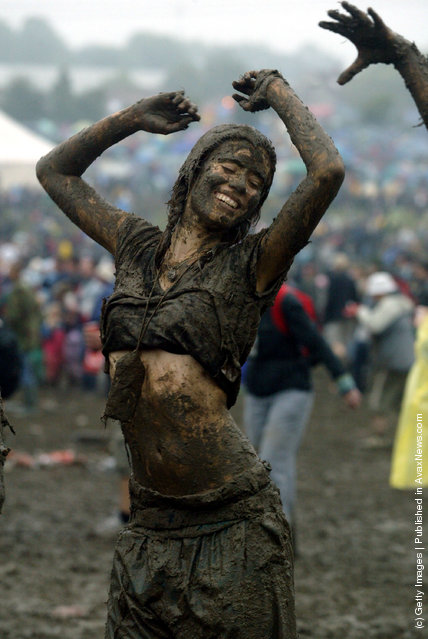
“The Glastonbury Festival of Contemporary Performing Arts, commonly abbreviated to Glastonbury is a British performing arts festival, best known for its contemporary music, but also for dance, comedy, theatre, circus, cabaret and many other arts. For 2005, the enclosed area of the festival was over 900 acres (3.6 km²), had over 385 live performances and was attended by around 150,000 people. In 2007, over 700 acts played on over 80 stages and the capacity expanded by 20,000 to 177,000. In 2011 UK Music published a report stating that Glastonbury Festival contributes over £100 million annually to the UK economy” – Wikipedia

Photo: Festival goers dance in the mud in front of the Pyramid stage at Worthy Farm, Pilton, Somerset, at the 2004 Glastonbury Festival, 26 June 2004. (Photo by Matt Cardy/Getty Images)
Details
21 Jun 2011 11:19:00