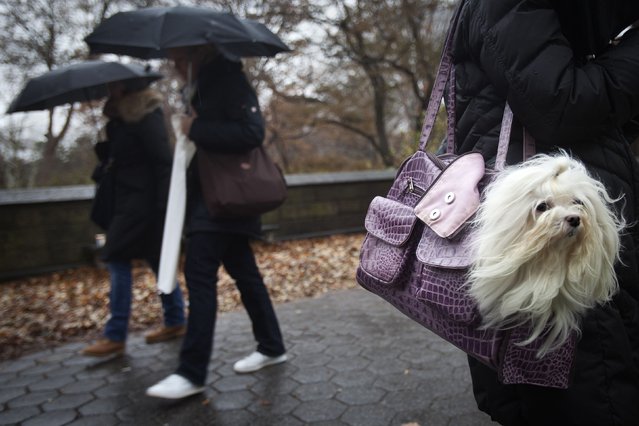
Emma the Maltese's fur blows in the wind as she rides in her owner's purse on 5th Avenue at Central Park in New York December 2, 2014. (Photo by Carlo Allegri/Reuters)
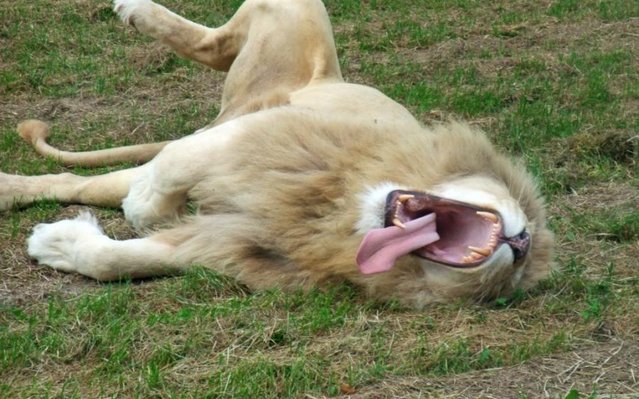
In animals, yawning can serve as a warning signal. For example, Charles Darwin, in his book The Expression of the Emotions in Man and Animals, mentioned that baboons yawn to threaten their enemies, possibly by displaying large canine teeth. Similarly, Siamese fighting fish yawn only when they see a conspecific (same species) or their own mirror-image, and their yawn often accompanies aggressive attack. Guinea pigs also yawn in a display of dominance or anger, displaying their impressive incisor teeth. This is often accompanied by teeth chattering, purring and scent marking.
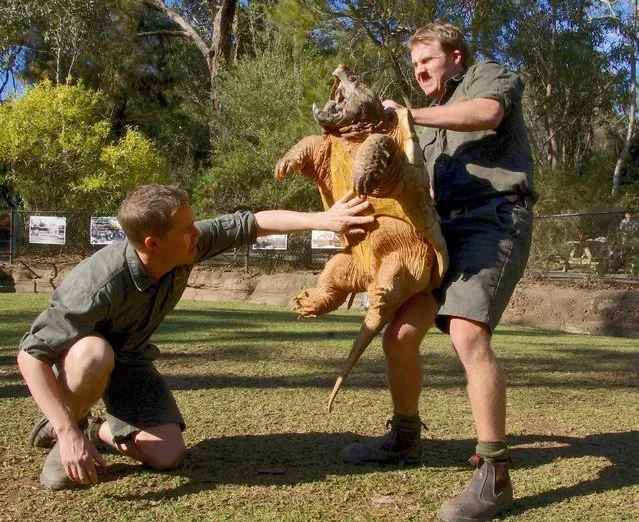
Two keepers at the Australian Reptile Park in New South Wales struggle with Leonardo, an alligator snapping turtle weighing 45 kilos at the park in Gosford, NSW 2 July 2015. The 50cm long Leonardo – who was smuggled illegally into Australia and found in a Sydney sewer in November 2000 – was removed from his tank for an annual health check. And as a gesture to onlooking press photographers demonstrated his strength by snapping a piece of bamboo in half. (Photo by EPA/HO)
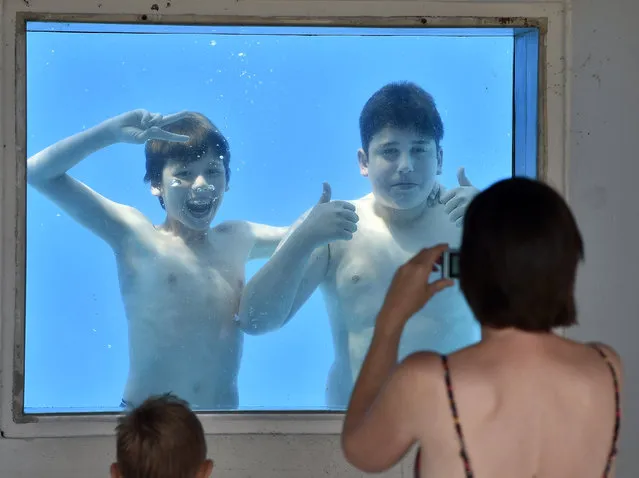
Julian, left, is photographed by his mother with friend Gianluca, right, under water at a public pool in Gelsenkirchen, Germany, on a hot Friday, July 3, 2015. Germany faces a heat wave with temperatures up to 38 degrees Celsius (100 degrees Fahrenheit) at the weekend. (Photo by Martin Meissner/AP Photo)
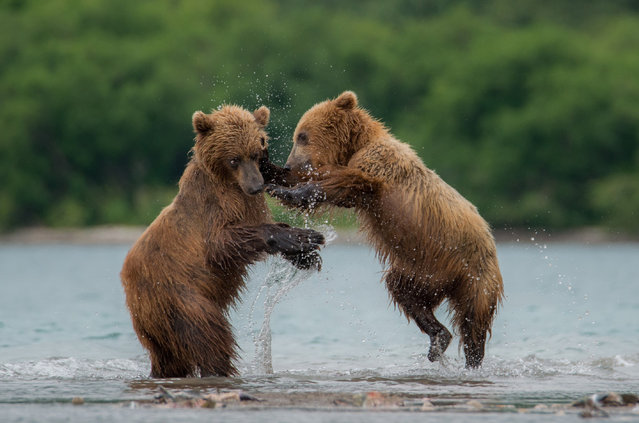
Kamchatka brown bears at Kurile Lake in Kamchatka peninsula’s volcanic terrain, Russia on August, 2017. Kamchatka brown bears are generally not dangerous to humans, and only 1% of encounters result in attack. (Photo by Igor Ivanko/Anadolu Agency/Getty Images)
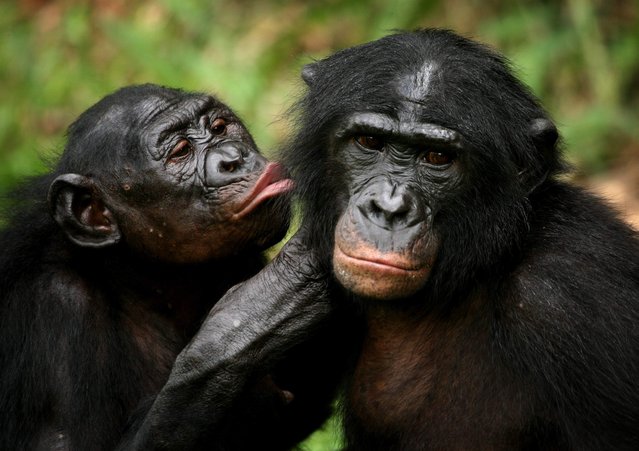
Bonobo apes, primates unique to Congo and humankind's closest relative, groom one another at a sanctuary just outside the capital Kinshasa, Congo on October 31, 2006. (Photo by Finbarr O'Reilly/Reuters)
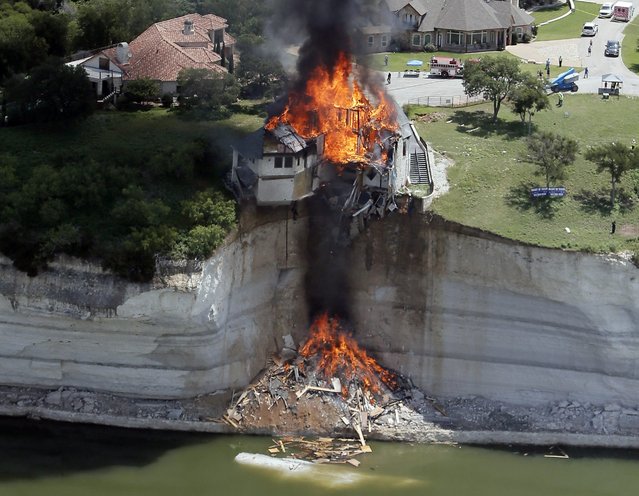
Smoke rises from a house days after part of the ground it was resting on collapsed into Lake Whitney, Texas in this June 13, 2014 file photo. I was covering the controlled burn of a house slowly falling into Lake Whitney due to the decaying cliff underneath. Asked to take photos from an aerial perspective, an instructor and I took off from Grand Prairie Municipal Airport around 9am. The burn, scheduled to start an hour later, was delayed. I love flying, but patience proved challenging as circling for nearly three hours gets boring fast. Once the fire started we only had 15 minutes to take photos because the plane was booked at 1pm. The owners invested their retirement savings in the house and were even advised by geologists that the ground was stable. To watch your investment literally go up in flames must take its toll emotionally. The owners said they don't expect their insurance to cover the loss. (Photo and caption by Brandon Wade/Reuters)
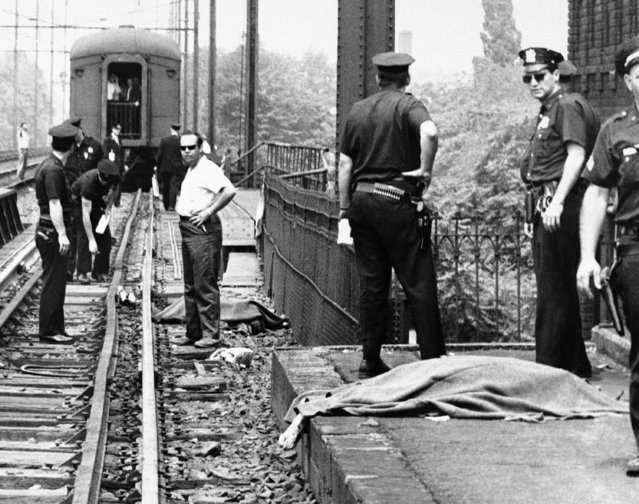
Blankets cover the bodies of a woman (right) and a man (left background) hit by a northbound Penn Central train (background) as they waited with a crowd at Pennsylvania Railroad station in Elizabeth, N.J. on June 8, 1968 to view the southbound train carrying the body of Sen. Robert F. Kennedy to Washington. The woman was identified as Mrs. Antoinette Severini, 54, and the man, John Curia (age unavailable), both of Elizabeth. (Photo by AP Photo)