Loading...
Done
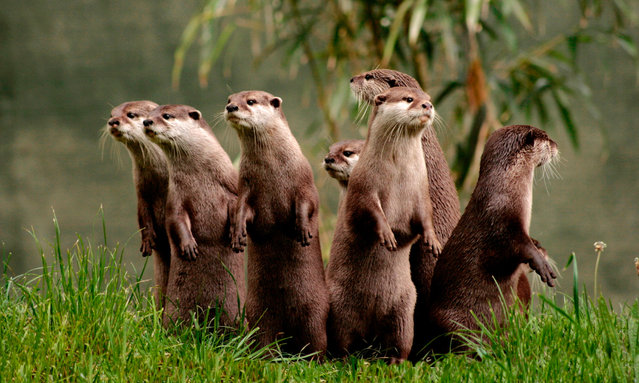
These Eurasian Otters seem ready for any danger as they all stand up on thier hind legs alert to any threats near to the English river bank. Amateur photographer and retired MOD worker Tony Moir, 57, spotted the otters whilst looking for kingfishers to photograph near the river Trent in East Yorkshire, UK. He was able to take just a couple of pictures before the excited animals spotted the photographer and ran away. (Photo by Tony Moir/Solent News)

These Eurasian Otters seem ready for any danger as they all stand up on thier hind legs alert to any threats near to the English river bank. Amateur photographer and retired MOD worker Tony Moir, 57, spotted the otters whilst looking for kingfishers to photograph near the river Trent in East Yorkshire, UK. He was able to take just a couple of pictures before the excited animals spotted the photographer and ran away. (Photo by Tony Moir/Solent News)
Details
23 Jul 2017 07:35:00
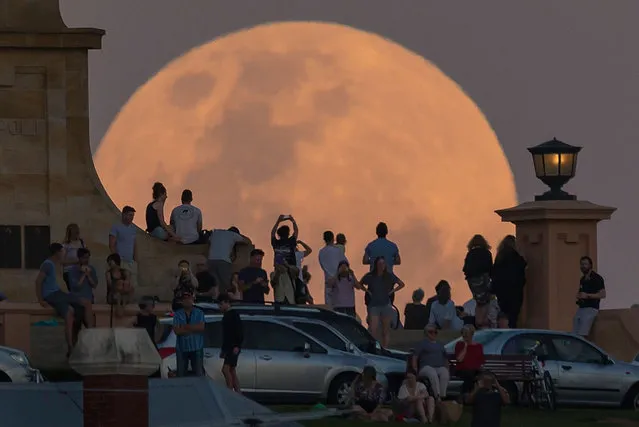
Crowds look on as the super moon rises behind the Fremantle War Memorial at Monument Hill on November 14, 2016 in Fremantle, Australia. A super moon occurs when a full moon passes closes to earth than usual, with the November 14th moon expected to be closer than it has been in over 70 years. (Photo by Paul Kane/Getty Images)

Crowds look on as the super moon rises behind the Fremantle War Memorial at Monument Hill on November 14, 2016 in Fremantle, Australia. A super moon occurs when a full moon passes closes to earth than usual, with the November 14th moon expected to be closer than it has been in over 70 years. (Photo by Paul Kane/Getty Images)
Details
15 Nov 2016 11:30:00
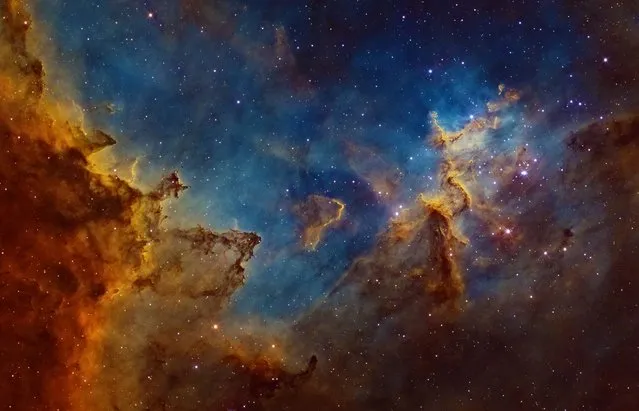
Centre of the Heart Nebula by Ivan Eder (Hungary). Situated 7500 light years away in the ‘W’-shaped constellation of Cassiopeia, the Heart Nebula is a vast region of glowing gas, energized by a cluster of young stars at its centre. The image depicts the central region, where dust clouds are being eroded and moulded into rugged shapes by the searing cosmic radiation. (Photo by Ivan Eder)

The competition, which is run by the Royal Observatory Greenwich in association with BBC Sky at Night Magazine, is now in its sixth year and has received over 2,500 entries. Photo: Centre of the Heart Nebula by Ivan Eder (Hungary). Situated 7500 light years away in the “W”-shaped constellation of Cassiopeia, the Heart Nebula is a vast region of glowing gas, energized by a cluster of young stars at its centre. The image depicts the central region, where dust clouds are being eroded and moulded into rugged shapes by the searing cosmic radiation. (Photo by Ivan Eder)
Details
03 Jul 2014 11:59:00
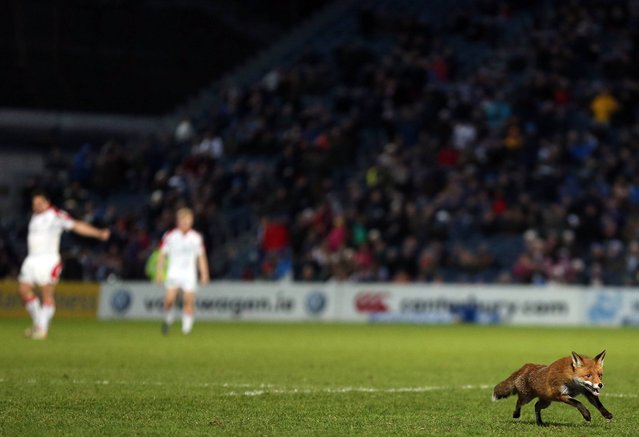
A fox runs out onto the pitch before the start of the second half. Celtic League 2012/13, Round 19, Leinster v Ulster, RDS, Ballsbridge, Dublin, March 30, 2013. (Photo by Paul Mohan)

A fox runs out onto the pitch before the start of the second half. Celtic League 2012/13, Round 19, Leinster v Ulster, RDS, Ballsbridge, Dublin, March 30, 2013. (Photo by Paul Mohan)
Details
06 Apr 2013 12:52:00
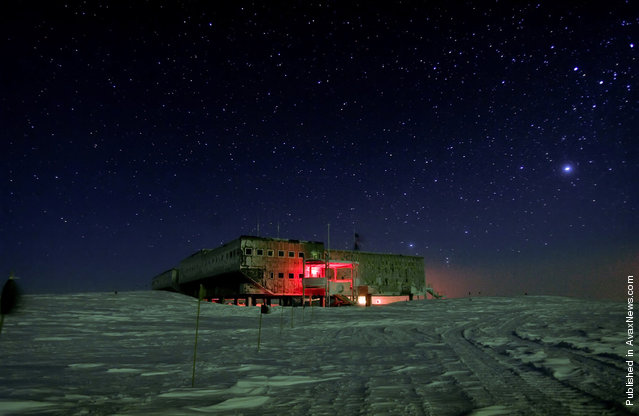
Amundsen-Scott South Pole Station experiences months of darkness. The sun dips below the horizon on March 21, after which follows several weeks of twilight before complete darkness results

Amundsen-Scott South Pole Station experiences months of darkness. The sun dips below the horizon on March 21, after which follows several weeks of twilight before complete darkness results. Photo taken on June 25, 2009. (National Science Foundation/Jeremy Johnson)
Details
08 Apr 2012 13:07:00


Lake Baikal is the world's oldest lake, at 25 million years (possibly older), and deepest, averaging 744.4 metres (2,442 ft).

Located in the south of the Russian region of Siberia, between Irkutsk Oblast to the northwest and the Buryat Republic to the southeast, it is the most voluminous freshwater lake in the world, containing roughly 20% of the world's unfrozen surface fresh water.
Details
08 May 2012 02:00:00
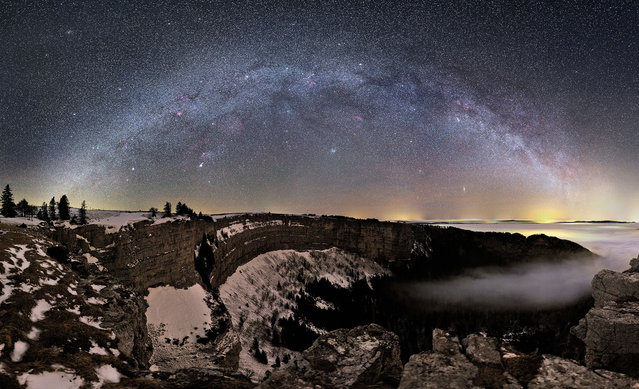
Milky Way over Switzerland

Milky Way over Switzerland

The Milky Way is the galaxy in which Earth is contained. This name derives from its appearance as a dim “milky” glowing band arching across the night sky, in which the naked eye cannot distinguish individual stars. The term “Milky Way” is a translation of the Classical Latin via lactea, from the Hellenistic Greek γαλαξίας κύκλος (pr. galaxías kýklos, “milky circle”). The Milky Way appears like a band because it is a disk-shaped structure being viewed from inside. The fact that this faint band of light is made up of stars was proven in 1610 when Galileo Galilei used his telescope to resolve it into individual stars. In the 1920s, observations by astronomer Edwin Hubble showed that the Milky Way is just one of many galaxies.


Details
20 Jun 2012 10:11:00
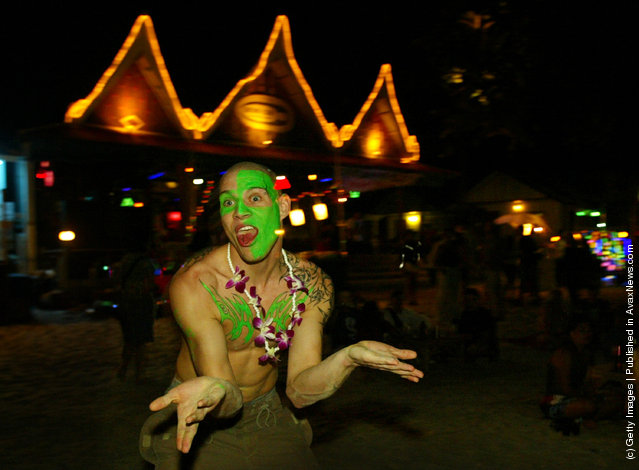
Koh Phangan, Thailand at the monthly Full Moon party

Thousands of revelers continue to enjoy themselves throughout the night on Sunrise Beach on February 25, 2005 in Haadrian, Koh Phangan. (Photo by Shaul Schwarz/Getty Images)
Details
08 Oct 2011 13:45:00