Loading...
Done
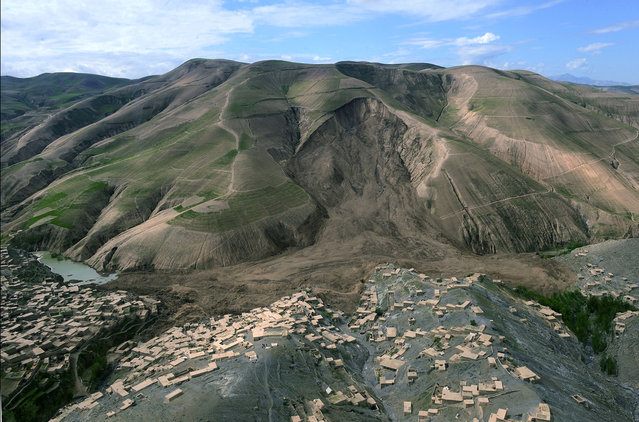
Massive Landslide Buries Remote Afghan Village

Last Friday, in Afghanistan's mountainous northeastern province of Badakhshan, an enormous landslide took place, burying much of a small village, and killing hundreds. Officials say that at least 300 residents of Abi Barik village were killed, but are uncertain about exact numbers, cautioning that the final number could be 500 or more. Rescue teams gave up hope on Saturday of finding any survivors, focusing energy on helping the hundreds suddenly made homeless. Many of the surviving families have struggled to get aid. Some have gone to nearby villages to stay with relatives or friends, while others have slept in tents provided by aid groups.
Details
30 May 2014 11:27:00
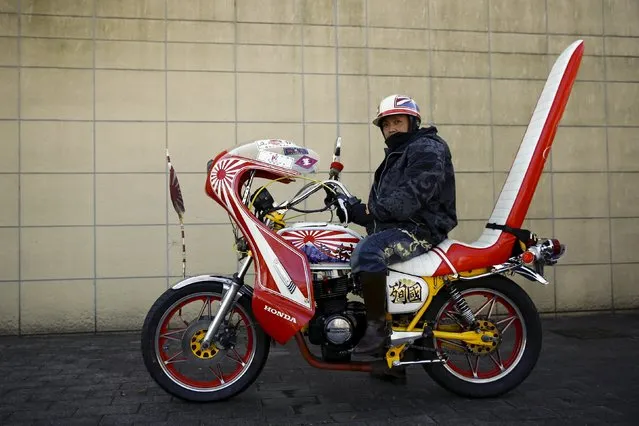
A biker poses on his Bousouzoku motorbike at the Dangouzaka rest stop in Yamanashi, west of Tokyo, Japan, January 3, 2016. (Photo by Thomas Peter/Reuters)

A biker poses on his Bousouzoku motorbike at the Dangouzaka rest stop in Yamanashi, west of Tokyo, Japan, January 3, 2016. Police on Sunday halted a group of about two dozen Bousouzoku bikers who paraded their noisy motorcycles during an annual New Year outing in the Mount Fuji region. This Japanese motorcycle subculture dated back to the 1950s and regularly chafes with the police because of their provocative traffic behaviour and bike customising, that is often deemed illegal. (Photo by Thomas Peter/Reuters)
Details
05 Jan 2016 08:06:00
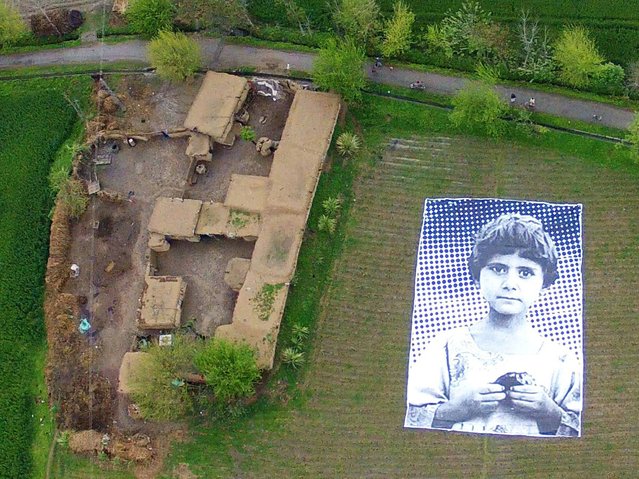
In this undated handout photograph from the “Inside Out Project”, a poster bearing the image of a Pakistani girl whose parents, lawyers say, were killed in a drone strike, lies in a field at an undisclosed location in the northwestern Khyber-Pakhtunkhwa province. (Photo by AFP Photo)

In this undated handout photograph from the “Inside Out Project”, a poster bearing the image of a Pakistani girl whose parents, lawyers say, were killed in a drone strike, lies in a field at an undisclosed location in the northwestern Khyber-Pakhtunkhwa province. A group of artists in Pakistan are hoping to generate “empathy” among US drone operators by placing giant posters of children in the country's troubled tribal regions. (Photo by AFP Photo)
Details
08 Apr 2014 10:39:00
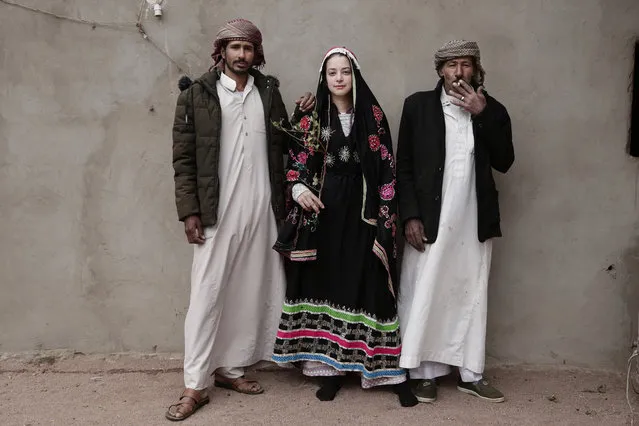
In this March 31, 2019 photo, an Egyptian student borrows a Bedouin wedding dress to pose for a photograph with Bedouin men from the Hamada tribe, in Wadi Sahw, Abu Zenima, in South Sinai, Egypt. Four Bedouin women are for the first time leading tours in Egypt’s Sinai Peninsula, breaking new ground in their deeply conservative community, where women almost never work outside the home or interact with outsiders.  The tourists can only be women, and the tours can’t go overnight. Each day before the sun sets, the group returns to the Hamada’s home village in Wadi Sahu, a narrow desert valley. (Photo by Nariman El-Mofty/AP Photo)

In this March 31, 2019 photo, an Egyptian student borrows a Bedouin wedding dress to pose for a photograph with Bedouin men from the Hamada tribe, in Wadi Sahw, Abu Zenima, in South Sinai, Egypt. Four Bedouin women are for the first time leading tours in Egypt’s Sinai Peninsula, breaking new ground in their deeply conservative community, where women almost never work outside the home or interact with outsiders. The tourists can only be women, and the tours can’t go overnight. Each day before the sun sets, the group returns to the Hamada’s home village in Wadi Sahu, a narrow desert valley. (Photo by Nariman El-Mofty/AP Photo)
Details
11 Apr 2019 00:01:00
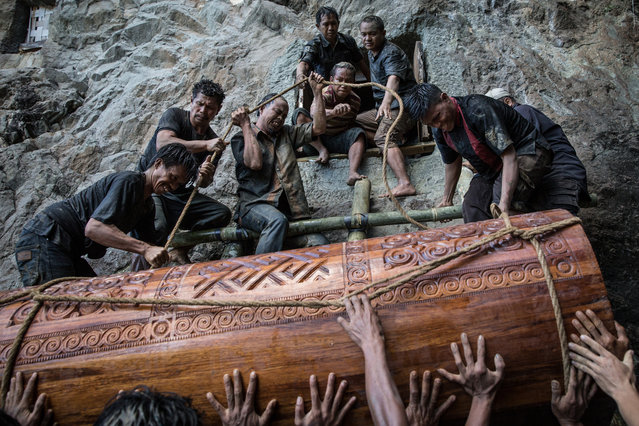
It is said that Torajans are people who “live to die”. For this Indonesian ethnic group, funerals are such extravagant events that they sometimes attract tourists. Families can postpone burials years (and the deceased are considered sick and hosted at home until the funeral) until the family can raise enough money and gather as many relatives as possible. And then it’s a jubilant multiday social event with a parade, dances and animal sacrifices. Agung Parameswara photographed these funerary practices when he traveled to South Sulawesi province, where the Torajans live. But often, their funeral isn’t the last time the dead are seen. In August, crypts are opened, coffins are slid back out and bodies delicately unsheathed. This tender ritual is known as Ma’Nene, which is customarily performed every few years. (Photo by Agung Parameswara/The Washington Post)

It is said that Torajans are people who “live to die”. For this Indonesian ethnic group, funerals are such extravagant events that they sometimes attract tourists. Families can postpone burials years (and the deceased are considered sick and hosted at home until the funeral) until the family can raise enough money and gather as many relatives as possible. And then it’s a jubilant multiday social event with a parade, dances and animal sacrifices. Agung Parameswara photographed these funerary practices when he traveled to South Sulawesi province, where the Torajans live. (Photo by Agung Parameswara/The Washington Post)
Details
06 Oct 2016 09:15:00
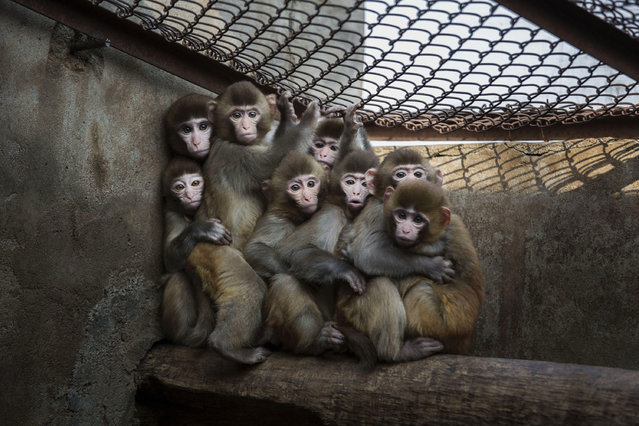
Macaque monkeys crowd together in their cage at a monkey farm on February 3, 2016 in Xinye county, Henan province, China. The area boasts a centuries-long and lucrative history of raising and training monkeys for performance. In Xinye, villagers are seeing an increase in business with the lunar calendar's “Year of the Monkey”. Farmers say most of the monkeys are bred and raised for domestic zoos, circuses, and performing groups, but add that some are also sold for medical research in China and the United States. Despite the popularity of the tradition, critics contend the training methods and conditions constitute animal cruelty. (Photo by Kevin Frayer/Getty Images)

Macaque monkeys crowd together in their cage at a monkey farm on February 3, 2016 in Xinye county, Henan province, China. The area boasts a centuries-long and lucrative history of raising and training monkeys for performance. In Xinye, villagers are seeing an increase in business with the lunar calendar's “Year of the Monkey”. Farmers say most of the monkeys are bred and raised for domestic zoos, circuses, and performing groups, but add that some are also sold for medical research in China and the United States. Despite the popularity of the tradition, critics contend the training methods and conditions constitute animal cruelty. (Photo by Kevin Frayer/Getty Images)
Details
31 Dec 2016 09:56:00
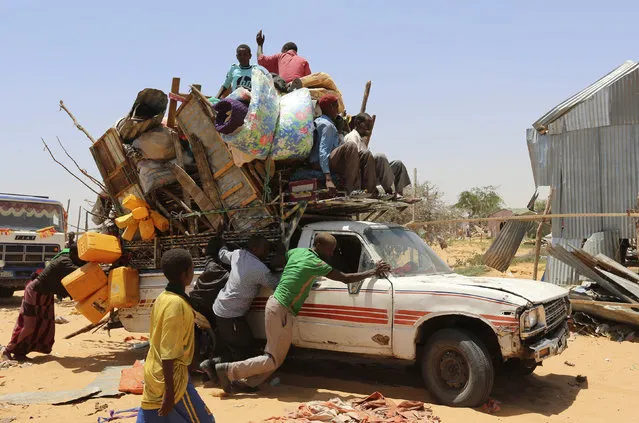
More than 6 billion people live in countries where serious levels of public sector corruption are fueling inequality and exploitation, according to Transparency International's 2015 index of perceived public sector corruption. The group's annual report measures perceptions of corruption due to the secrecy surrounding most corrupt dealings. Two thirds of the 168 countries assessed were identified as having a serious corruption problem. Somalia, which has been mired in conflict since civil war broke out in 1991, ranks bottom of the list. (Photo by Feisal Omar/Reuters)

More than 6 billion people live in countries where serious levels of public sector corruption are fueling inequality and exploitation, according to Transparency International's 2015 index of perceived public sector corruption. The group's annual report measures perceptions of corruption due to the secrecy surrounding most corrupt dealings. Two thirds of the 168 countries assessed were identified as having a serious corruption problem. Somalia, which has been mired in conflict since civil war broke out in 1991, ranks bottom of the list. (Photo by Feisal Omar/Reuters)
Details
13 May 2016 12:10:00
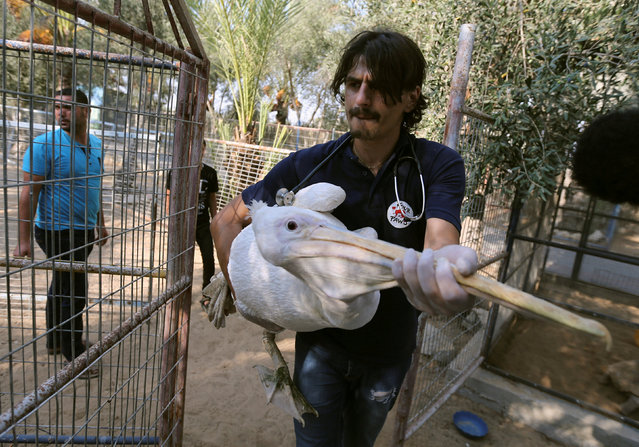
A member of Four Paws International team carries a pelican to be taken out of Gaza, at a zoo in Khan Younis in the southern Gaza Strip August 23, 2016. Fifteen animals including a bengal tiger were removed from “the world’s worst zoo” in the Gaza town of Khan Younis as it was finally closed down. Animal welfare group, Four Paws International, will help bring most of the refugees to a zoo in Jordan, but the tiger will be taken to a refuge in South Africa. Five monkeys, a porcupine, an emu and the tiger, among others, crossed from the occupied territory into Israel after the zoo suffered from years of difficulty. With lack of awareness of animal welfare in Gaza, the densely-populated territory has previously made headlines after another zoo painted donkeys with stripes to resemble zebras in 2009. (Photo by Ibraheem Abu Mustafa/Reuters)

A member of Four Paws International team carries a pelican to be taken out of Gaza, at a zoo in Khan Younis in the southern Gaza Strip August 23, 2016. Fifteen animals including a bengal tiger were removed from “the world’s worst zoo” in the Gaza town of Khan Younis as it was finally closed down. Animal welfare group, Four Paws International, will help bring most of the refugees to a zoo in Jordan, but the tiger will be taken to a refuge in South Africa. (Photo by Ibraheem Abu Mustafa/Reuters)
Details
26 Aug 2016 10:22:00