Loading...
Done
Noriaki Iwashima gestures as he lies in a coffin to try it out during an end-of-life seminar held by Japan's largest retailer Aeon Co in Tokyo October 24, 2014. (Photo by Toru Hanai/Reuters)

Noriaki Iwashima gestures as he lies in a coffin to try it out during an end-of-life seminar held by Japan's largest retailer Aeon Co in Tokyo October 24, 2014. Funeral arrangements are normally left to those who have been left behind but the latest trend in Japan, which literally translates to “End of life” preparations, is for the ageing to prepare their own funerals and graves before they set off on their journey to the great beyond. With a population that is expected to shrink by nearly 30 million people over the next 50 years, the market for funerals, graves and anything related to the afterlife is still very much alive. (Photo by Toru Hanai/Reuters)
Details
10 Nov 2014 13:48:00
The Ending Of Life Of The Cargo Ship

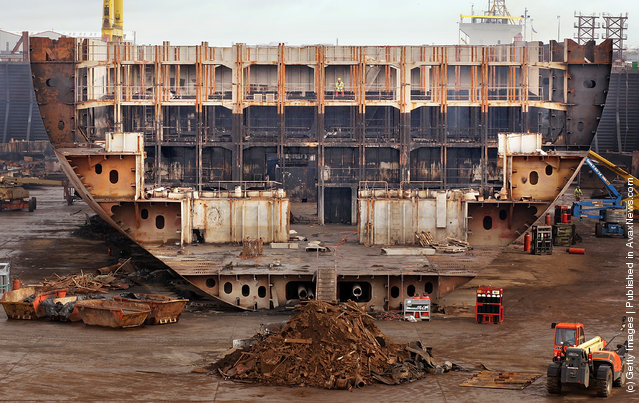
The MSC Napoli cargo ship lies in a dry dock at Harland and Wolff ship builders as it is dismantled for recycling on April 11, 2008 in Belfast, Northern Ireland. (Photo by Peter Macdiarmid/Getty Images)
Details
23 Oct 2011 14:47:00
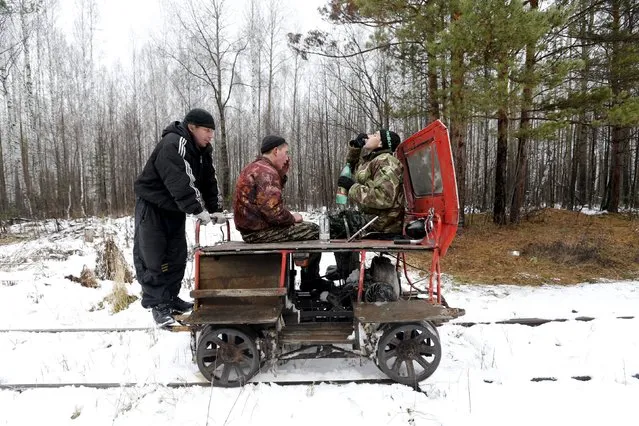
(L-R) A man nicknamed "Barcelona", Alexey Bolotov and Alexey Jakushin drink vodka as they travel by a pioneer motorised railcar on their way to Kalach, Sverdlovsk region, Russia October 18, 2015. The "pioneer," a light auxiliary rail vehicle, is a popular form of transport among people who live along the Alapayevsk railway. (Photo by Maxim Zmeyev/Reuters)

(L-R) A man nicknamed "Barcelona", Alexey Bolotov and Alexey Jakushin drink vodka as they travel by a pioneer motorised railcar on their way to Kalach, Sverdlovsk region, Russia October 18, 2015. The "pioneer," a light auxiliary rail vehicle, is a popular form of transport among people who live along the Alapayevsk railway. In a remote corner of the Urals region at the end of a narrow-gauge railway is Kalach, population about a dozen. Three decades ago 600 people called the village home, but the local forestry industry suffered as the former Soviet Union imploded and people moved away in search of work. In Kalach today there are no telephones, no mobile reception and only a few hours of electricity a day. (Photo by Maxim Zmeyev/Reuters)
Details
15 Nov 2015 08:06:00
Women in yukatas, or casual summer kimonos, take their selfie in front of paper lanterns during the annual Mitama Festival at the Yasukuni Shrine, where more than 2.4 million war dead are enshrined, in Tokyo, Japan July 13, 2017. (Photo by Kim Kyung-Hoon/Reuters)

Women in yukatas, or casual summer kimonos, take their selfie in front of paper lanterns during the annual Mitama Festival at the Yasukuni Shrine, where more than 2.4 million war dead are enshrined, in Tokyo, Japan July 13, 2017. (Photo by Kim Kyung-Hoon/Reuters)
Details
18 Aug 2017 08:39:00
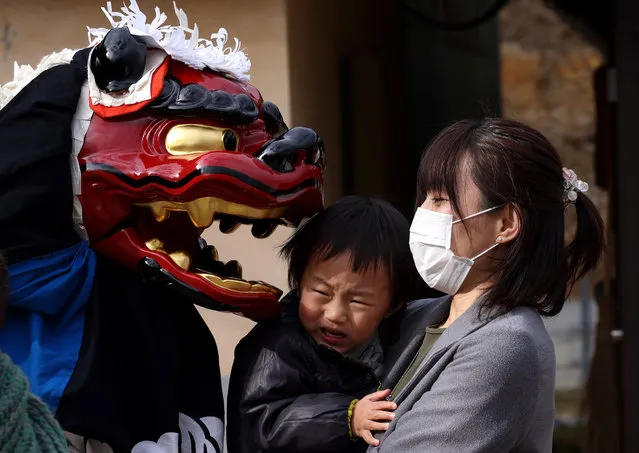
A performer wearing a lion mask performs the Ise Daikagura lion dance at the remote village of Yamanawa on February 08, 2021 in Ryuo, Japan. Ise Daikagura is a group of traditional Lion Dance performers who pray in front of farmers houses and businesses for good grain harvests and disease-free lives. Performers play sacred music using drums and flutes with two lion mask dancers. A lion mask is considered a symbol of God, who enters the house and performs in front of the Shinto God, a statue placed inside the house, mostly in the kitchen. These prayers are called “Kamodo Barai”. After the prayers, they are gifted with money, rice, sake and Japanese sweets from the householders. A group can travel for more than one hundred days to thousands of households and businesses throughout rural-villages in western Japan, and pray to those who are unable to visit the country’s most sacred shrine, the Grand Ise Shrine in Mie Prefecture. The group started its performance in the Edo era between 1603 to 1868 according to Japanese history. The Japanese government designated it as an important folk cultural national property in 1981. (Photo by Buddhika Weerasinghe/Getty Images)

A performer wearing a lion mask performs the Ise Daikagura lion dance at the remote village of Yamanawa on February 08, 2021 in Ryuo, Japan. Ise Daikagura is a group of traditional Lion Dance performers who pray in front of farmers houses and businesses for good grain harvests and disease-free lives. (Photo by Buddhika Weerasinghe/Getty Images)
Details
18 Feb 2021 09:27:00
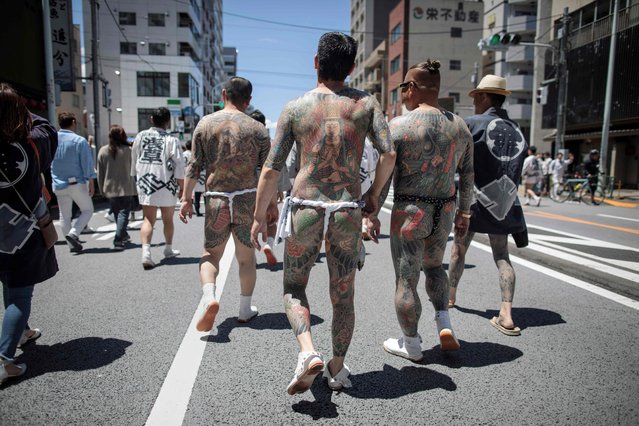
Participants with traditional Japanese tattoos (Irezumi), related to the Yakuza, walk through the Asakusa district during the annual Sanja Matsuri festival in Tokyo on May 20, 2018. Sanja Matsuri festival is a celebration for the three founders of Sensoji Temple in the Asakusa neighbourhood with nearly two million people visiting during the three-day event. (Photo by Behrouz Mehri/AFP Photo)

Participants with traditional Japanese tattoos (Irezumi), related to the Yakuza, walk through the Asakusa district during the annual Sanja Matsuri festival in Tokyo on May 20, 2018. Sanja Matsuri festival is a celebration for the three founders of Sensoji Temple in the Asakusa neighbourhood with nearly two million people visiting during the three-day event. (Photo by Behrouz Mehri/AFP Photo)
Details
17 Jul 2018 00:05:00
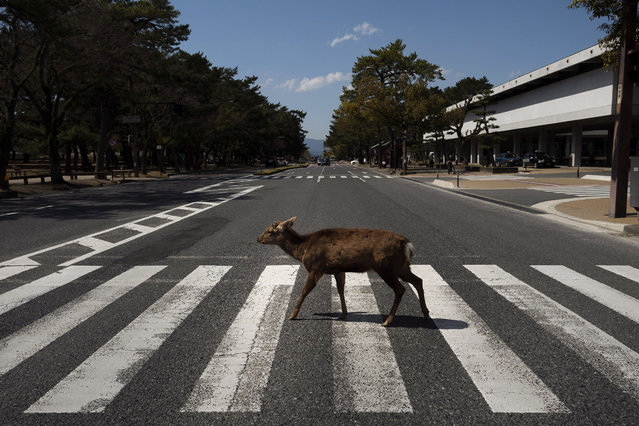
A deer walks across a pedestrian crossing in Nara, Japan, Thursday, March 19, 2020. More than 1,000 deer roam free in the ancient capital city of Japan. Despite the town's tourism decline, these wild animals are doing just fine without treats from tourists, according to a deer protection group. (Photo by Jae C. Hong/AP Photo)

A deer walks across a pedestrian crossing in Nara, Japan, Thursday, March 19, 2020. More than 1,000 deer roam free in the ancient capital city of Japan. Despite the town's tourism decline, these wild animals are doing just fine without treats from tourists, according to a deer protection group. (Photo by Jae C. Hong/AP Photo)
Details
31 Mar 2020 00:01:00
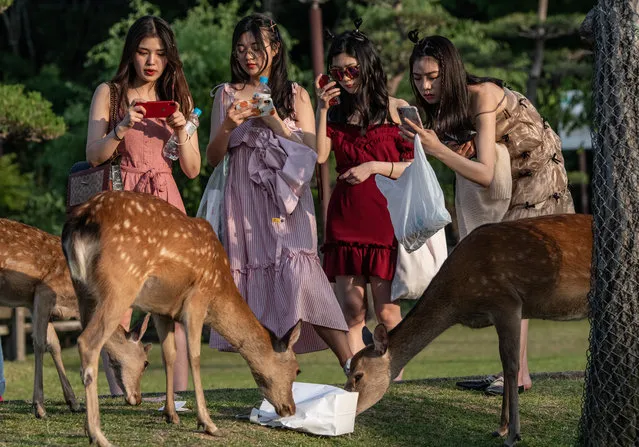
Tourists take photographs as a wild sika deer eats a bag on June 6, 2019 in Nara, Japan. Nara's free-roaming deer have become a huge attraction for tourists. However, an autopsy on a deer that was recently found dead near one of the city's famous temples discovered 3.2kg of plastic in its stomach and caused concern at the effect of tourism as Japan struggles to cope with a huge increase in domestic and international tourists. Alongside a growing Japanese tendency to holiday domestically, a record 31 million people visited the country in 2018 up 8.7 percent from the previous year, with many people now worrying about the environmental impact caused by such large visitor numbers. (Photo by Carl Court/Getty Images)

Tourists take photographs as a wild sika deer eats a bag on June 6, 2019 in Nara, Japan. Nara's free-roaming deer have become a huge attraction for tourists. However, an autopsy on a deer that was recently found dead near one of the city's famous temples discovered 3.2kg of plastic in its stomach and caused concern at the effect of tourism as Japan struggles to cope with a huge increase in domestic and international tourists. (Photo by Carl Court/Getty Images)
Details
19 Jun 2019 00:03:00