Loading...
Done
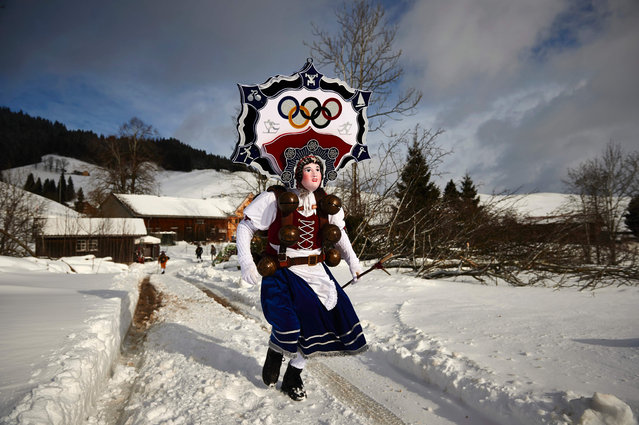
A leader “Rolli” of a yodel group “Schuppel” runs in the snow in front of a farmstead during the “Silvesterchlausen” in the early morning in Urnaesch in the Swiss canton Appenzell Ausserroden on January 13, 2017. The “Silvesterchlausen” is a tradition of the Swiss canton Appenzell, where colorfull characters organized in groups called “Schuppel”, chase out the old year and welcome the new one. They run all day long from farmstead to farmstead, gather together to sing a jodel and great the farmers. A “Schuppel” consists of some “Schelli” and two “Rolli”, sometimes with female dresses and nice scenes over the head, despite the dress all participants are males. The Silversterchlausen run twice a year, first for the new Silvester on December 31, and then again on January 13, for the old Silvester following the Julian calendar. (Photo by Michael Buholzer/AFP Photo)

A leader “Rolli” of a yodel group “Schuppel” runs in the snow in front of a farmstead during the “Silvesterchlausen” in the early morning in Urnaesch in the Swiss canton Appenzell Ausserroden on January 13, 2017. (Photo by Michael Buholzer/AFP Photo)
Details
14 Jan 2017 12:41:00
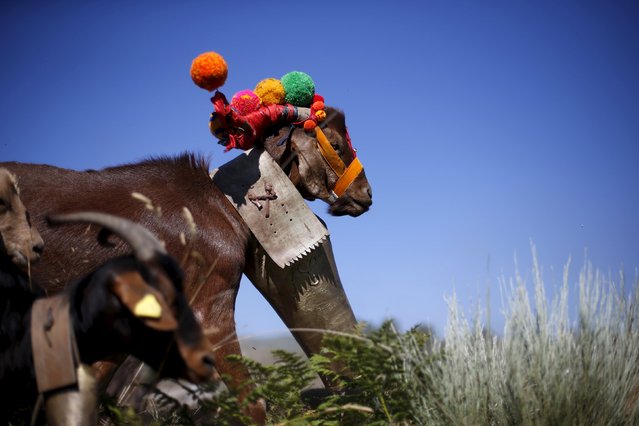
Sheep walk as they are herded to summer pastures in Serra da Estrela, near Seia, Portugal June 27, 2015. (Photo by Rafael Marchante/Reuters)

Sheep walk as they are herded to summer pastures in Serra da Estrela, near Seia, Portugal June 27, 2015. In late June, shepherds young and old in the Seia region of central Portugal start guiding sheep, goats and cattle to the Serra da Estrela, the country’s highest mountains, in search of better pastures. There they stay until the end of September. Modern-day shepherds may have mobile phones to keep in touch with family and friends, but their lifestyle has changed little for centuries. The sound of cowbells and the bark of longhaired mastiffs starts early in the morning as the animals – often decorated with traditional woollen balls on their horns – are herded up steep, narrow paths. (Photo by Rafael Marchante/Reuters)

Details
14 Jul 2015 13:48:00
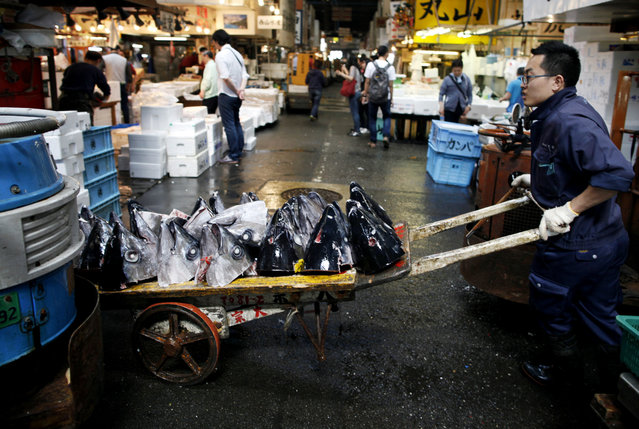
In this April 28, 2015 file photo, heads of tuna on a cart are carried by a fish dealer after the day's auction at Tsukiji Wholesale Market in Tokyo. In one of the biggest of Japan's many New Year holiday rituals, early on Tuesday, January 5, 2016, Tokyo's Tsukiji market will auction off with much fanfare a huge, glistening tuna, likely destined for one of the big sushi chains. If all goes as planned, it will be the last such auction at 80-year-old Tsukiji. (Photo by Shuji Kajiyama/AP Photo)

In this April 28, 2015 file photo, heads of tuna on a cart are carried by a fish dealer after the day's auction at Tsukiji Wholesale Market in Tokyo. In one of the biggest of Japan's many New Year holiday rituals, early on Tuesday, January 5, 2016, Tokyo's Tsukiji market will auction off with much fanfare a huge, glistening tuna, likely destined for one of the big sushi chains. If all goes as planned, it will be the last such auction at 80-year-old Tsukiji. (Photo by Shuji Kajiyama/AP Photo)
Details
06 Jan 2016 08:03:00
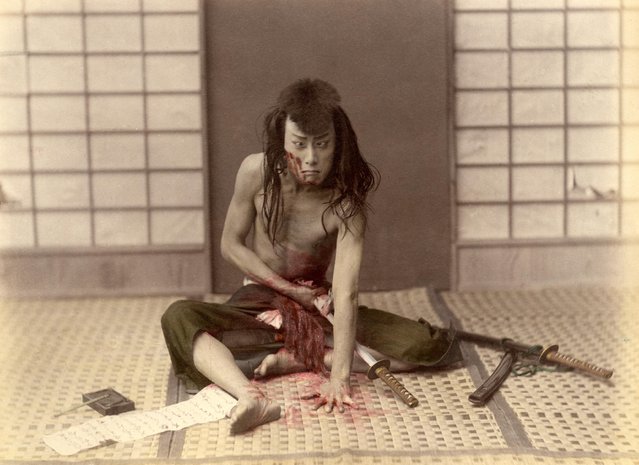
Samurai commiting seppuku (hara-kiri) in Japan, circa 1880. (Photo by adoc-photos/Corbis via Getty Images)

Samurai commiting seppuku (hara-kiri) in Japan, circa 1880. (Photo by adoc-photos/Corbis via Getty Images)
Details
27 Jan 2017 10:43:00
Team Strong Silvers member Ngai Hin Kwok, 66, works out as teammate Ng Siu Chi, 57, watches at a stadium in Singapore March 15, 2015. Team Strong Silvers, is a group of senior citizens who train in calisthenics. The trio trains individually at least three times a week, and meets up for joint calisthenics at least twice a month. (Photo by Edgar Su/Reuters)

Team Strong Silvers member Ngai Hin Kwok, 66, works out as teammate Ng Siu Chi, 57, watches at a stadium in Singapore March 15, 2015. Team Strong Silvers, is a group of senior citizens who train in calisthenics. The trio trains individually at least three times a week, and meets up for joint calisthenics at least twice a month. (Photo by Edgar Su/Reuters)
Details
16 Mar 2015 10:25:00
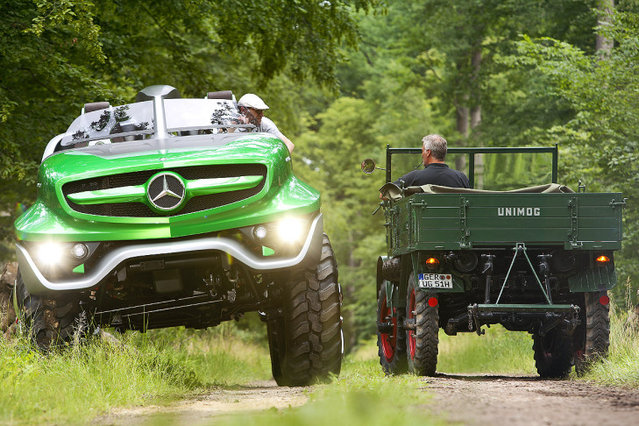
Mercedes-Benz Unimog Concept

How much do things change in 60 years? Sometimes the best answer to that kind of question is a picture. Here you can see an original Unimog (right), built sometime between the start of production in 1948 and 1951, when Mercedes bought the operation in order to expand it enough to keep up with demand. On the left is a “60th Anniversary” Unimog design concept, celebrating not the actual birth of the Unimog, but its purchase by Mercedes. Needless to say, the contrast between the two is… breathtaking. And if you’re curious about the evolution of this hugely influential vehicle, if you can’t help wondering how it grew from a (relatively) tiny, spartan utility vehicle to a garish, Mercedes-starred behemoth.
Details
31 Oct 2012 11:24:00
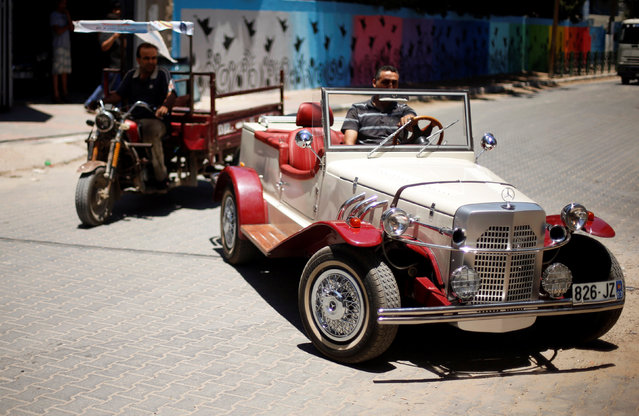
Palestinian Munir Shindi, 36, drives a replica of a 1927 Mercedes Gazelle that he built from scratch, on a street in Gaza City June 19, 2016. (Photo by Mohammed Salem/Reuters)

Palestinian Munir Shindi, 36, drives a replica of a 1927 Mercedes Gazelle that he built from scratch, on a street in Gaza City June 19, 2016. (Photo by Mohammed Salem/Reuters)
Details
21 Jun 2016 06:58:00


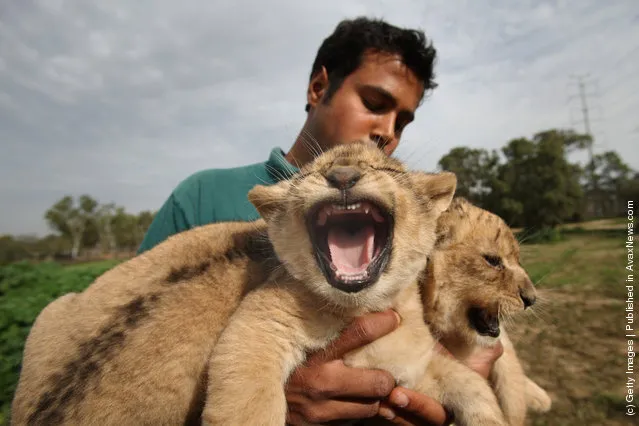
Three one-month-old lioness cubs are held by a keeper as they take their first outing on February 21, 2010 at the Ramat Gan Safari Park near Tel Aviv, Israel. The still unnamed cubs are the first triplet females to be born at the safari park and officials say their birth will ensure the continuity of the park's pride of lions. (Photo by David Silverman/Getty Images)
Details
06 Apr 2011 08:42:00