Loading...
Done
An infrared portrait from NASA's Spitzer Space Telescope which shows generations of stars is seen in this undated NASA handout image released February 14, 2013. In this wispy star-forming region, called W5, the oldest stars can be seen as blue dots in the centers of the two hollow cavities (other blue dots are background and foreground stars not associated with the region). Red shows heated dust that pervades the region's cavities, while green highlights dense clouds. (Photo by NASA/Reuters/JPL-Caltech/Harvard-Smithsonian/Handout)

An infrared portrait from NASA's Spitzer Space Telescope which shows generations of stars is seen in this undated NASA handout image released February 14, 2013. In this wispy star-forming region, called W5, the oldest stars can be seen as blue dots in the centers of the two hollow cavities (other blue dots are background and foreground stars not associated with the region). Red shows heated dust that pervades the region's cavities, while green highlights dense clouds. (Photo by NASA/Reuters/JPL-Caltech/Harvard-Smithsonian/Handout)
Details
03 Mar 2013 08:44:00
Bride Fan Huixiang (front R), a 25-year-old cancer patient, receives flowers from nurses on her bed before her wedding ceremony at a hospital in Zhengzhou, Henan province November 17, 2014. Fan was diagnosed with late stage adenocarcinoma, a type of cancerous tumor, at her thoracic vertebra this June. (Photo by Reuters/China Daily)

Bride Fan Huixiang (front R), a 25-year-old cancer patient, receives flowers from nurses on her bed before her wedding ceremony at a hospital in Zhengzhou, Henan province November 17, 2014. Fan was diagnosed with late stage adenocarcinoma, a type of cancerous tumor, at her thoracic vertebra this June. She and her 24-year-old husband Yu Haining held their wedding ceremony at the hospital on Monday after five years of relationship, local media reported. (Photo by Reuters/China Daily)
Details
19 Nov 2014 14:15:00
Employees conduct a final check to fix any cavities in the seams of balls inside the soccer ball factory that produces official match balls for the 2014 World Cup in Brazil, in Sialkot, Punjab province May 16, 2014. (Photo by Sara Farid/Reuters)

Employees conduct a final check to fix any cavities in the seams of balls inside the soccer ball factory that produces official match balls for the 2014 World Cup in Brazil, in Sialkot, Punjab province May 16, 2014. It was when he felt the roar of the crowd at the 2006 World Cup in Germany that Pakistani factory owner Khawaja Akhtar first dreamt up a goal of his own: to manufacture the ball for the biggest soccer tournament on the planet. Last year he finally got his chance – but only 33 days to make it happen. (Photo by Sara Farid/Reuters)
Details
26 May 2014 13:59:00
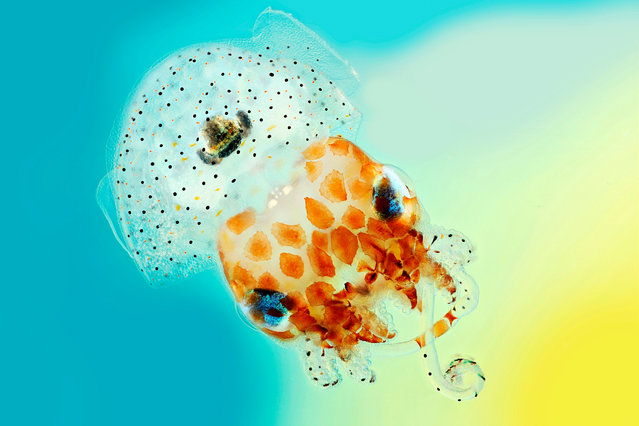
With its huge eyes, comical name and diminutive size, Mark R. Smith’s image of a baby Hawaiian bobtail squid can’t help but raise a smile. A curiously endearing creature, the cephalopod is just 1.5cm across, its mantle cavity bearing more than a passing resemblance to a rather natty shower cap. But it is also a beautiful example of symbiosis – nature’s version of “I’ll scratch your back if you scratch mine” – for on the underside of the squid is a light organ which houses bioluminescent bacteria. The squid offers the bacteria protection and food, while the bacteria emit a glow – a handy trait that the squid uses to offset its silhouette, helping it to evade predators in the depths below. Mark R. Smith’s entry combines several images of a Hawaiian bobtail squid with different focus lengths to create a final picture with greater depth of field than normal. (Photo by Mark R. Smith/Wellcome Images/Macroscopic Solutions)

With its huge eyes, comical name and diminutive size, Mark R. Smith’s image of a baby Hawaiian bobtail squid can’t help but raise a smile. A curiously endearing creature, the cephalopod is just 1.5cm across, its mantle cavity bearing more than a passing resemblance to a rather natty shower cap. But it is also a beautiful example of symbiosis – nature’s version of “I’ll scratch your back if you scratch mine” – for on the underside of the squid is a light organ which houses bioluminescent bacteria. The squid offers the bacteria protection and food, while the bacteria emit a glow – a handy trait that the squid uses to offset its silhouette, helping it to evade predators in the depths below. Mark R. Smith’s entry combines several images of a Hawaiian bobtail squid with different focus lengths to create a final picture with greater depth of field than normal. (Photo by Mark R. Smith/Wellcome Images/Macroscopic Solutions)
Details
08 Mar 2017 00:05:00
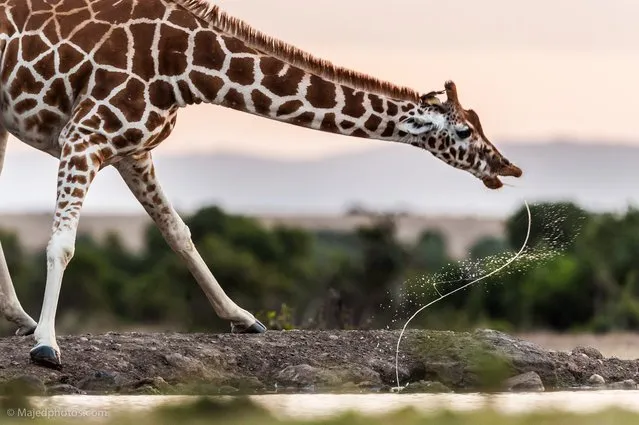
“We just want to move to search to the Leopard at that morning but we found a group of giraffes come toward a small lake and start drinking it was a nice moment when the Giraffe finish from drinking and leave a letters S with motion in the air”. (Photo and caption by Majed Ali)

National Geographic invites photographers from around the world to enter the 2013 National Geographic Photography Contest. The grand-prize winner will receive $10,000 (USD) and a trip to National Geographic headquarters in Washington, D.C., to participate in the annual National Geographic Photography Seminar in January 2014. Photo: “We just want to move to search to the Leopard at that morning but we found a group of giraffes come toward a small lake and start drinking it was a nice moment when the Giraffe finish from drinking and leave a letters “S” with motion in the air”. (Photo and caption by Majed Ali/National Geographic Photography Contest)
Details
15 Nov 2013 14:34:00
Cattle keepers from the Dinka tribe perform a traditional dance after a prayer session for peace and good health along the route to Rajaf Payam outside the capital Juba October 18, 2014. (Photo by Jok Solomon/Reuters)

Cattle keepers from the Dinka tribe perform a traditional dance after a prayer session for peace and good health along the route to Rajaf Payam outside the capital Juba October 18, 2014. (Photo by Jok Solomon/Reuters)
Details
25 Oct 2014 13:12:00
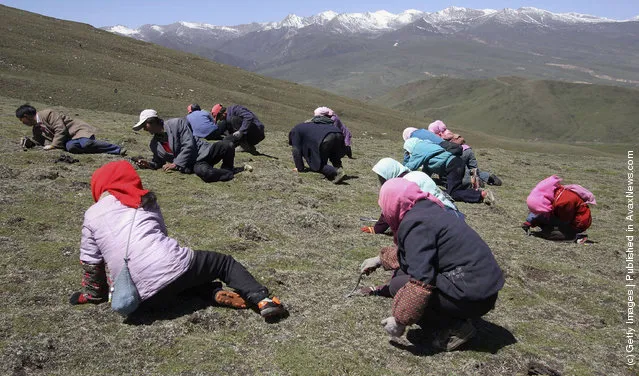
Ophiocordyceps Sinensis A.K.A. Caterpillar Fungus

“There are over 680 documented species of the sac fungus genus Ophiocordyceps, and one of the best known of these is Ophiocordyceps sinensis, colloquially known as caterpillar fungus. The fungus is known in Tibetan as yartsa gunbu or yatsa gunbu. O. sinensis is known in the West as a medicinal mushroom and its use has a long history in Traditional Chinese medicine as well as Traditional Tibetan medicine. The highly valuable fungus-caterpillar combination is hand-collected and is used as an aphrodisiac and as a treatment for a variety of ailments from fatigue to cancer”. – Wikipedia

Photo: Nomads dig for Chinese caterpillar fungus from a mountain May 25, 2007 in Guide County, Hainan Prefecture, Qinghai Province, China. Nomads can earn about 2,000 yuan to 5,000 yuan (about U.S. $260 to $653 ) through their work during the fifty-day Chinese caterpillar fungus gathering season. (Photo by China Photos/Getty Images)
Details
26 Sep 2011 10:47:00
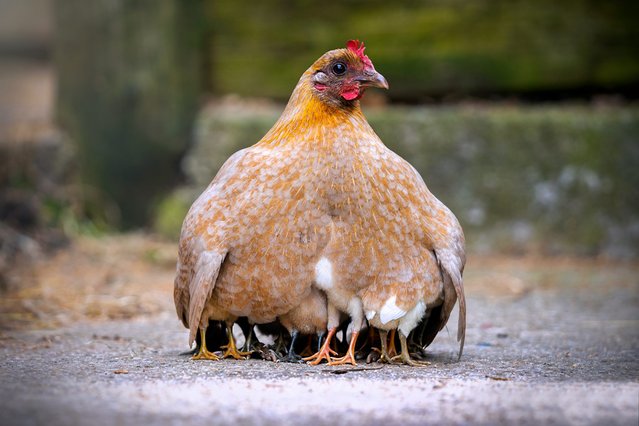
Mother hen chicken with cute tiny baby chicks all protected beneath her wings keeping warm outdoors only their 12 legs visible poking out the bottom outside. (Photo by Matthew Troke/iStockphoto via Getty Images)

Mother hen chicken with cute tiny baby chicks all protected beneath her wings keeping warm outdoors only their 12 legs visible poking out the bottom outside. (Photo by Matthew Troke/iStockphoto via Getty Images)
Details
22 Aug 2024 03:41:00