Loading...
Done
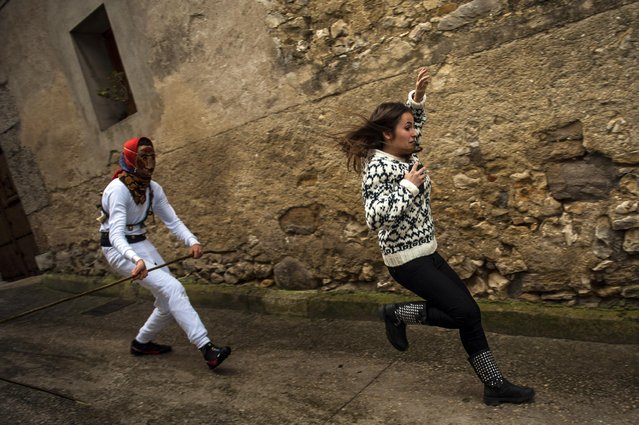
In this photo taken on Sunday, February 15, 2015 a girl runs away from a “Mamuxarro” during the carnival, in the small town of Unanu, northern Spain. While Rio de Janeiro may boast the world’s most famous carnival, the festive period of masquerades and wild and colorful costumes that precedes the Christian religious season of Lent is also a permanent and popular fixture for celebration in Spain and Portugal, with each country having its own strange and unique way of doing it. (Photo by Alvaro Barrientos/AP Photo)

In this photo taken on Sunday, February 15, 2015 a girl runs away from a “Mamuxarro” during the carnival, in the small town of Unanu, northern Spain. In the northern Spanish ancient village of Unamu, people dress up as “Mamuxarro”, folkloric figures in white with a red sash and a metal mask to cover their faces as they pursue townsfolk with sticks. According to custom, their “victims” (usually young women) must kneel and kiss the mamuxarro’s knee after he makes the sign of the cross on their forehead. (Photo by Alvaro Barrientos/AP Photo)
Details
22 Feb 2015 10:51:00
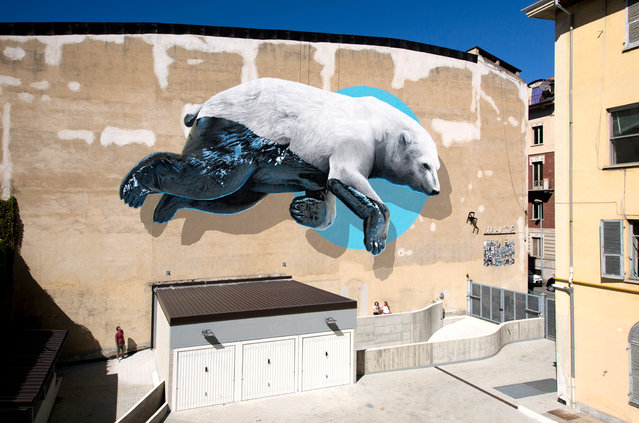
A polar bear whose bottom half is caked in oily black gunk. A whale wrapped in striped fabric: a pseudo straightjacket. These are the messes climate change leaves behind, the things we know are happening but often don’t have the opportunity to see with our own eyes. Swiss street art duo Christian Rebecchi and Pablo Togni, otherwise known as NeverCrew, met in art school when they were 15 and started making work together soon after. As a team, the artists adorn the world with eye-popping and gut-wrenching images depicting the consequences of humanity’s actions on earth. Here: “Black machine” mural painting and installation on the Colosseo theater in Turin, Italy, in September 2015. (Photo by NeverCrew/The Huffington Post)

A polar bear whose bottom half is caked in oily black gunk. A whale wrapped in striped fabric: a pseudo straightjacket. These are the messes climate change leaves behind, the things we know are happening but often don’t have the opportunity to see with our own eyes. Swiss street art duo Christian Rebecchi and Pablo Togni, otherwise known as NeverCrew, met in art school when they were 15 and started making work together soon after. As a team, the artists adorn the world with eye-popping and gut-wrenching images depicting the consequences of humanity’s actions on earth. (Photo by NeverCrew/The Huffington Post)
Details
13 Aug 2016 11:09:00
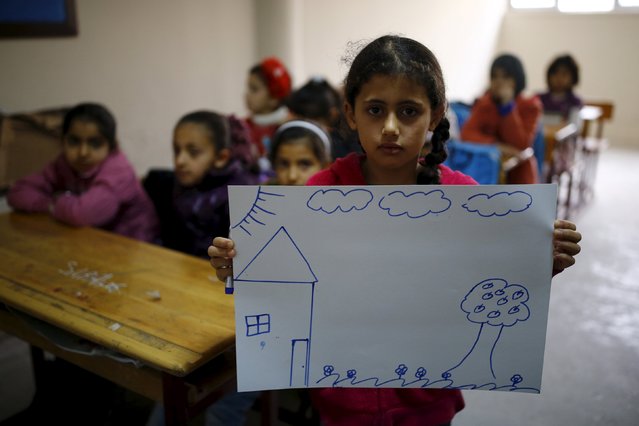
Syrian refugee girl Nur El-Huda, 9, shows a drawing of her home in Syria, in her classroom in Yayladagi refugee camp in Hatay province near the Turkish-Syrian border, Turkey, December 16, 2015. (Photo by Umit Bektas/Reuters)

Syrian refugee girl Nur El-Huda, 9, shows a drawing of her home in Syria, in her classroom in Yayladagi refugee camp in Hatay province near the Turkish-Syrian border, Turkey, December 16, 2015. Syria's conflict has left hundreds of thousands dead, pushed millions more into exile, and had a profound effect on children who lost their homes or got caught up in the bloodletting. The drawings of young refugees living in Turkey show their memories of home and hopes for its future. The pictures also point to the mental scars borne by 2.3 million Syrian refugees living in Turkey, more than half of them children. (Photo by Umit Bektas/Reuters)
Details
16 Jan 2016 08:05:00
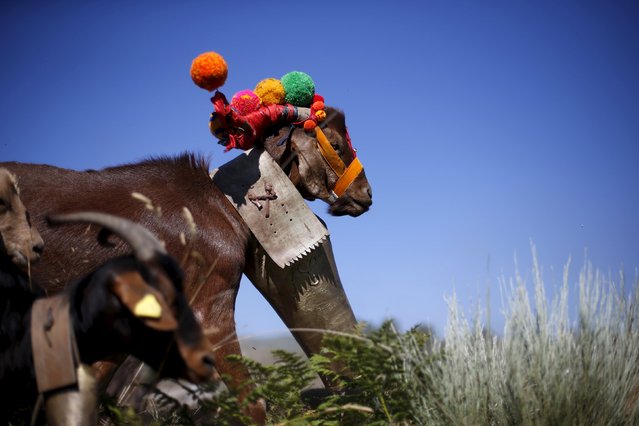
Sheep walk as they are herded to summer pastures in Serra da Estrela, near Seia, Portugal June 27, 2015. (Photo by Rafael Marchante/Reuters)

Sheep walk as they are herded to summer pastures in Serra da Estrela, near Seia, Portugal June 27, 2015. In late June, shepherds young and old in the Seia region of central Portugal start guiding sheep, goats and cattle to the Serra da Estrela, the country’s highest mountains, in search of better pastures. There they stay until the end of September. Modern-day shepherds may have mobile phones to keep in touch with family and friends, but their lifestyle has changed little for centuries. The sound of cowbells and the bark of longhaired mastiffs starts early in the morning as the animals – often decorated with traditional woollen balls on their horns – are herded up steep, narrow paths. (Photo by Rafael Marchante/Reuters)
Details
14 Jul 2015 13:48:00
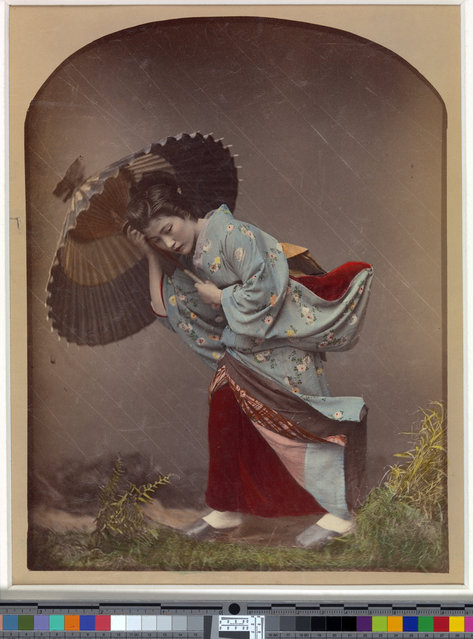
“Woman with Umbrella in Rain” by Raimund von Stillfried. Artist: Kusakabe Kimbei (Japanese, 1841–1934), 1870s. (Photo courtesy of The Metropolitan Museum of Art)

“Woman with Umbrella in Rain” by Raimund von Stillfried. Artist: Kusakabe Kimbei (Japanese, 1841–1934), 1870s. Commercial photography studios in Meiji-era Japan were renowned for the subtlety and refinement of their coloring techniques. This hand-tinted image of a young woman caught in a heavy rainstorm achieved its naturalistic effect by knitting together multiple strands of artifice: the greenery in the foreground was a studio prop; the flaps of the kimono were suspended by thin wires to create the impression of a strong wind; and long, diagonal marks were made on the negative to suggest streaks of rain. (Photo courtesy of The Metropolitan Museum of Art)
Details
12 May 2013 10:13:00
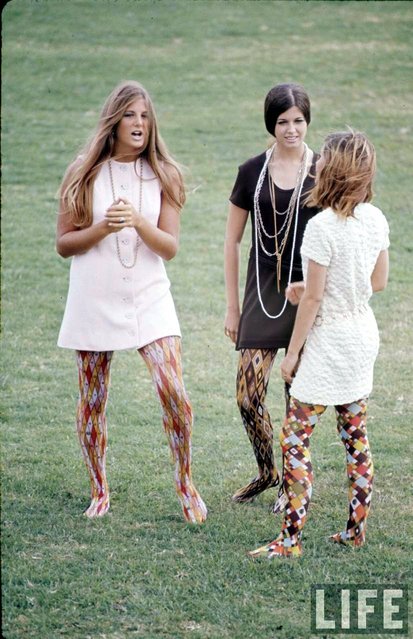
Corona del Mar High School students Kim Robertson, Pat Auvenshine and Pam Pepin wear “hippie” fashions, 1969. (Photo by Arthur Schatz/Time & Life Pictures/Getty Images)

“By 1969, the fashion choices of tens of millions of young American men and women were as variegated and ever-evolving as the world around them. Cultural transformation was an irresistible force during the Sixties, and across America and around the globe civil rights, women’s and gay liberation, the sexual revolution and, of course, the explosive soundtrack of R&B, soul and rock and roll informed everything from politics to fashion”. – LIFE. Photo: Corona del Mar High School students Kim Robertson, Pat Auvenshine and Pam Pepin wear “hippie” fashions, 1969. (Photo by Arthur Schatz/Time & Life Pictures)
Details
11 Aug 2013 12:43:00
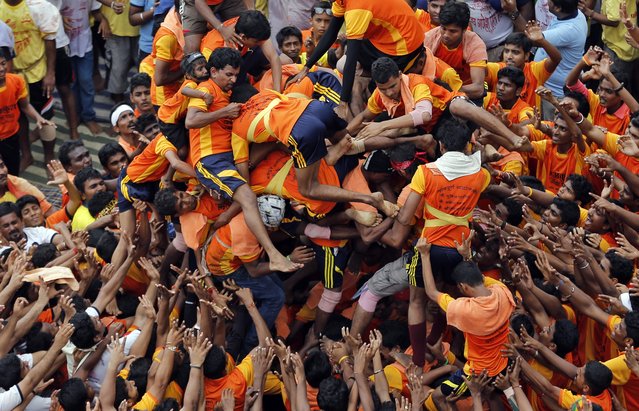
People fall down as they try to form a human pyramid to break the “Dahi handi”, an earthen pot filled with curd, an integral part of celebrations to mark Janmashtami in Mumbai, India, Monday, August 18, 2014. (Photo by Rafiq Maqbool/AP Photo)

People fall down as they try to form a human pyramid to break the “Dahi handi”, an earthen pot filled with curd, an integral part of celebrations to mark Janmashtami in Mumbai, India, Monday, August 18, 2014. Hindu devotees take part in the celebration in which an earthen pot is suspended high above the ground and groups of young men and children form a human pyramid to reach the pot and break it. The festival celebrates the birth of Hindu god Lord Krishna, one of the most popular gods in Hinduism. (Photo by Rafiq Maqbool/AP Photo)
Details
21 Aug 2014 09:38:00
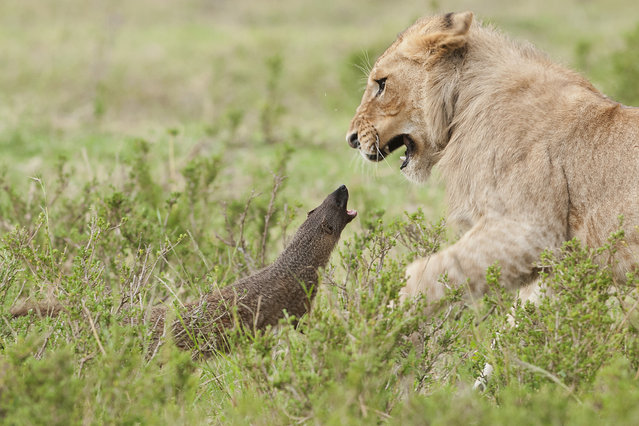
A mongoose growls at a startled lion on September 10, 2011 in Maasai Mara, Kenya. Four lions were left with their tails between their legs when a mongoose bravely took on the predators. Despite being under two feet tall, the aggressive mongoose growled at the felines and even bit one on the nose. (Photo by Jerome Guillaumot/Barcroft Media)

A mongoose growls at a startled lion on September 10, 2011 in Maasai Mara, Kenya. Four lions were left with their tails between their legs when a mongoose bravely took on the predators. Despite being under two feet tall, the aggressive mongoose growled at the felines and even bit one on the nose. The shocking fight, which was photographed in 2011 but has just been released, began in the Masaai Mara National Park, Kenya, when photographer Jerome Guillaumot came across four young lions surrounding the terrified marsh mongoose. The lions chased the mongoose into a hole in the ground but the small animal reemerged to fight the predators once again before running for cover. (Photo by Jerome Guillaumot/Barcroft Media)
Details
03 Sep 2014 10:33:00