Loading...
Done
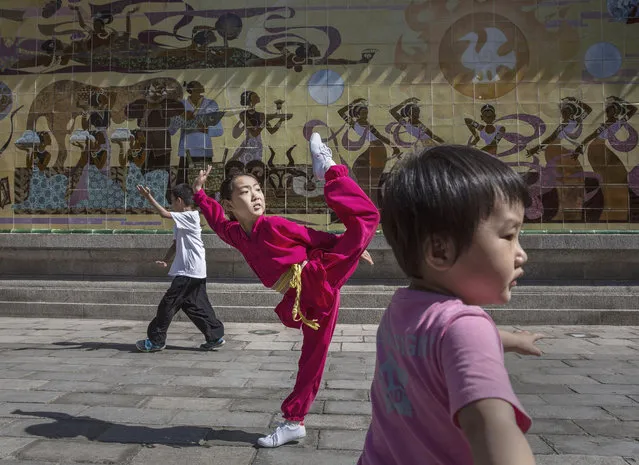
A young Chinese girl kicks during a kung-fu class at Ritan Park on June 11, 2016 in Beijing, China. Ritan, meaning “sun altar”, is among the oldest parks in Beijing, built in the early 1500s during the Ming dynasty for the emperor to make sacrifices to the sun. Less than half a kilometer square, Ritan these days is considered an oasis of green space in a sprawling city of skyscrapers, notorious air pollution, and a population of over 20 million people. Most Chinese live in small apartments with no access to gardens, leaving parks as a welcome haven for people, especially the elderly, to exercise, socialize, or enjoy a degree of privacy. (Photo by Kevin Frayer/Getty Images)

A young Chinese girl kicks during a kung-fu class at Ritan Park on June 11, 2016 in Beijing, China. Ritan, meaning “sun altar”, is among the oldest parks in Beijing, built in the early 1500s during the Ming dynasty for the emperor to make sacrifices to the sun. (Photo by Kevin Frayer/Getty Images)
Details
14 Jun 2016 13:01:00
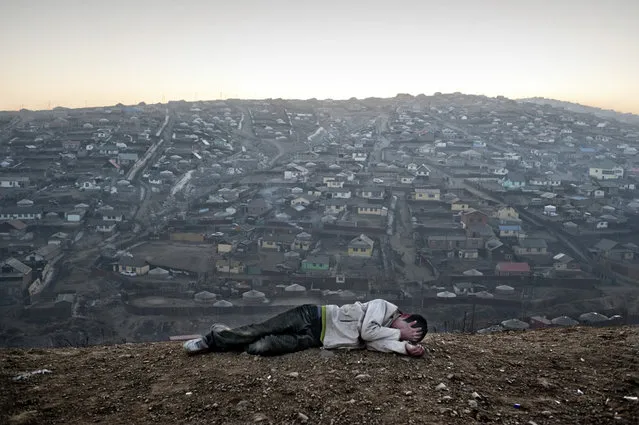
Asia, Mongolia, March 27, 2011. A view of Ulaan Baator over the shoulder of a slumbering drunk. Alcoholism is a huge problem in the city, home to almost half of Mongolia's people. The capital's population has doubled in the past two years, expanding outward in a haphazard sprawl, and many inhabitants live in slums known as the “Gher District”. (Photo by Alessandro Grassani)

“Environmental Migrants: The Last Illusion” by photographer Alessandro Grassani, documents the life of people in Kenya, Mongolia and Bangladesh who migrate to escape environmental stresses to the city of their own countries in hopes for a better life. Here: Asia, Mongolia, March 27, 2011. A view of Ulaan Baator over the shoulder of a slumbering drunk. Alcoholism is a huge problem in the city, home to almost half of Mongolia's people. The capital's population has doubled in the past two years. High levels of unemployment and poverty await herders who abandon rural areas and arrive in the city, illiterate and untrained in any skills necessary for urban jobs. (Photo by Alessandro Grassani)
Details
21 Jul 2015 10:10:00
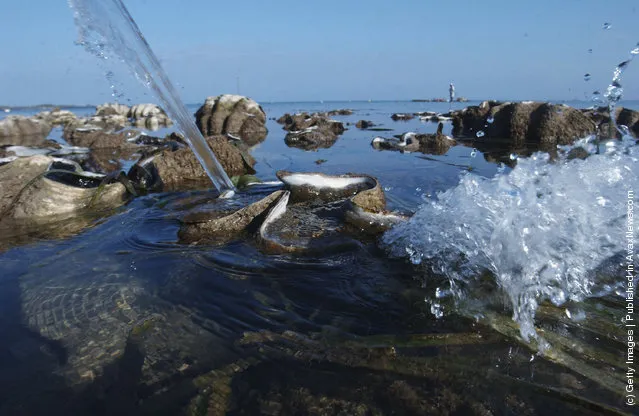
Tridacna Gigas, or Giant Clams

“The giant clam, Tridacna gigas (known as pā’ua in Cook Islands Māori), is the largest living bivalve mollusc. T. gigas is one of the most endangered clam species. It was mentioned as early as 1825 in scientific reports. One of a number of large clam species native to the shallow coral reefs of the South Pacific and Indian oceans, they can weigh more than 200 kilograms (440 lb) measure as much as 120 cm (47 in) across, and have an average lifespan in the wild of 100 years or more”. – Wikipedia

Photo: Tridacna Gigas, or Giant Clams spew water as a traditional fisherman passes by a small sanctuary on January 23, 2004 near Bolinao in the Northern Philippines. The clams, prime builders for coral reefs and providing shelter for spawning fish and other marine life, are exposed by low tides in the sanctuary. Overfishing and pollution throughout the country are not only threatening food security, but are also starting to choke one of the few working clam sanctuaries in the world. (Photo by David Greedy/Getty Images)

Details
01 Oct 2011 13:10:00
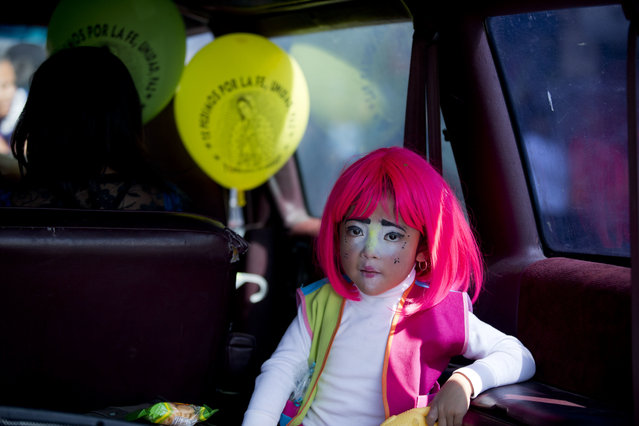
In this December 14, 2015, file photo, a young clown rides in the back of a car following a procession to the Basilica of Our Lady of Guadalupe in Mexico City. Hundreds belonging to various clown associations made their annual pilgrimage to the Basilica to pay their respects to the Virgin of Guadalupe, Mexico's patron saint. (Photo by Rebecca Blackwell/AP Photo)

As the world marks the International Day of the Girl Child, women's rights activists point to progress on a wide array of issues but say more needs to be done to protect girls from child marriage, sexual assault and other forms of exploitation. Here is a selection of pictures showing the daily lives of girls across the globe, all taken by female Associated Press photojournalists. Here: In this December 14, 2015, file photo, a young clown rides in the back of a car following a procession to the Basilica of Our Lady of Guadalupe in Mexico City. Hundreds belonging to various clown associations made their annual pilgrimage to the Basilica to pay their respects to the Virgin of Guadalupe, Mexico's patron saint. (Photo by Rebecca Blackwell/AP Photo)
Details
19 Oct 2018 00:03:00
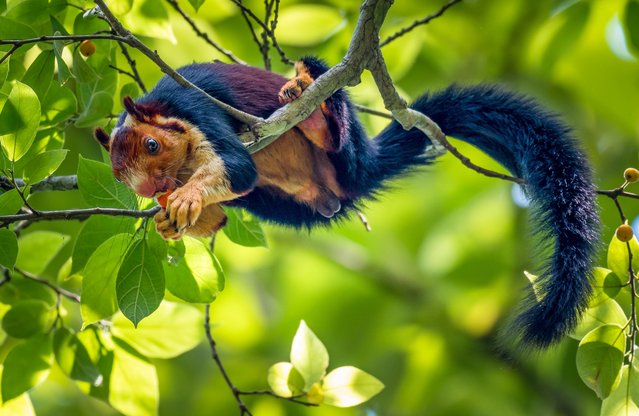
Its main predators are the birds of prey and the leopard. The Giant Squirrel is mostly active in the early hours of the morning and in the evening, resting in the midday. They are typically solitary animals that only come together for breeding. (Photo by Kaushik Vijayan/South West News Service)

The Malabar Giant squirrel – double the size of their grey relatives and measuring up to 36 inches (91.5 cm) from head to tail – lives deep in the forests of India. The athletic animals can leap an incredible 20 feet (6 m) between trees. Photographer Kaushik Vijayan, 39, snapped the animals in their native habit to produce these stunning images. Kaushik, from Kerala State, India, said: “Up until that point I had never heard about a squirrel like that or seen one. The sight was an absolute feast for my eyes. The squirrels fascinated me and I got excited to capture this beauty on my camera”. (Photo by Kaushik Vijayan/South West News Service)
Details
04 Apr 2019 00:03:00
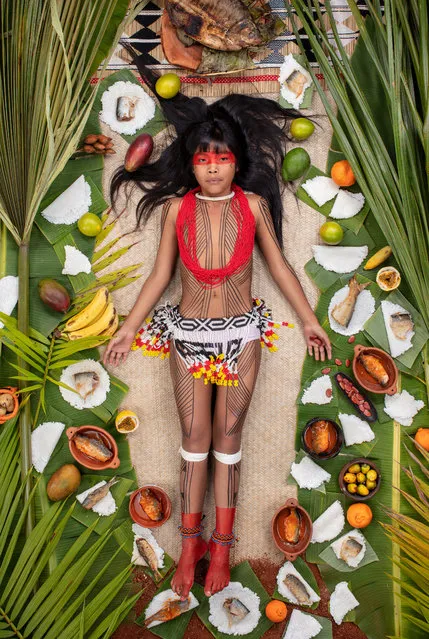
Kawakanih Yawalapiti, 9, Upper Xingu region of Mato Grosso, Brazil, 2018: Kawakanih lives with her tribe, the Yawalapiti, in Xingu national park, a preserve in the Amazon basin of Brazil. The Yawalapiti collect seeds to preserve species unique to their ecosystem, which lies between the rain forest and savannah. Kawakanih’s diet is simple, consisting mainly of fish, cassava, porridge, fruit and nuts. “It takes five minutes to catch dinner”, says Kawakanih. “When you’re hungry, you just go to the river with your net”. (Photo by Gregg Segal/The Guardian)

Photographer Gregg Segal travelled the world to document children and the food they eat in a week. Partly inspired by the increasing problems of childhood obesity, he tracked traditional regional diets as yet unaffected by globalisation, and ironically, found that the healthiest diets were often eaten by the least well off. (Photo by Gregg Segal/The Guardian)
Details
03 Jul 2019 00:03:00
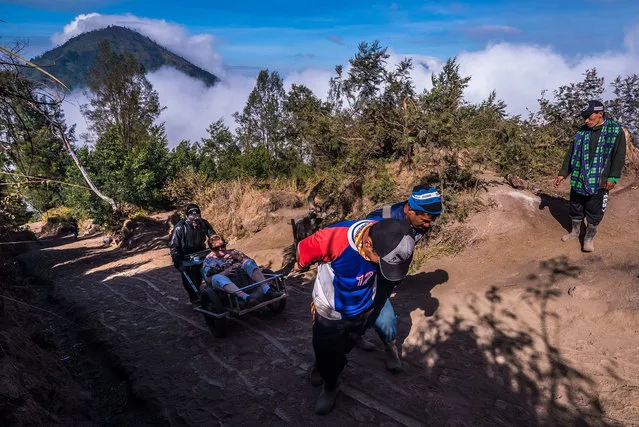
Miners pulling up lazy tourists to the rim of Kawah Ijen (Ijen Volcano), East Java, Indonesia on September 21, 2017. They will earn as much as they would bring down a load of sulfur. Nomadic Explorer, Cultural Lifestyle Photographer Claudio Sieber captured striking images of miners working at Ijen volcanic range in East Java, Indonesia. The sulphur miners risk their lives daily as they climb the active volcano carrying heavy loads, which they sell to sugar refineries. Shortly after midnight curious tourists are flocking in hundreds through the gate of Ijen's foothills to be right on time, driven by the images others took before them. Kawah Ijen is the one of the world's largest acidic volcanic crater lake; famous for its turquoise color as well as the unreal atmosphere it offers during darkness. A dusty path zigzags 3 kilometers up to the crater rim. This doesn't mean anything challenging; in particular, special sights have to be deserved anyway. The irritating smell of sulfur announces the near of the crater's existence. Arriving on the crater's rim the reward for the torture becomes visible. Blue fire darts its tongues through the fumes of sulfur dioxide. Somehow, the spectacle isn't as romantic as expected, since it is also the rough working space of approx. 150 sulfur miners who start their shift at 1 am. Lately, harvesting the abundance of devil's gold received international attention. This did obviously not really improve a miner's lifestyle; neither did it contribute to a better wage. (Photo by Claudio Sieber/Barcroft Images)

Miners pulling up lazy tourists to the rim of Kawah Ijen (Ijen Volcano), East Java, Indonesia on September 21, 2017. They will earn as much as they would bring down a load of sulfur. Nomadic Explorer, Cultural Lifestyle Photographer Claudio Sieber captured striking images of miners working at Ijen volcanic range in East Java, Indonesia. The sulphur miners risk their lives daily as they climb the active volcano carrying heavy loads, which they sell to sugar refineries. (Photo by Claudio Sieber/Barcroft Images)
Details
02 Oct 2017 08:31:00
A performer wearing a lion mask performs the Ise Daikagura lion dance at the remote village of Yamanawa on February 08, 2021 in Ryuo, Japan. Ise Daikagura is a group of traditional Lion Dance performers who pray in front of farmers houses and businesses for good grain harvests and disease-free lives. Performers play sacred music using drums and flutes with two lion mask dancers. A lion mask is considered a symbol of God, who enters the house and performs in front of the Shinto God, a statue placed inside the house, mostly in the kitchen. These prayers are called “Kamodo Barai”. After the prayers, they are gifted with money, rice, sake and Japanese sweets from the householders. A group can travel for more than one hundred days to thousands of households and businesses throughout rural-villages in western Japan, and pray to those who are unable to visit the country’s most sacred shrine, the Grand Ise Shrine in Mie Prefecture. The group started its performance in the Edo era between 1603 to 1868 according to Japanese history. The Japanese government designated it as an important folk cultural national property in 1981. (Photo by Buddhika Weerasinghe/Getty Images)

A performer wearing a lion mask performs the Ise Daikagura lion dance at the remote village of Yamanawa on February 08, 2021 in Ryuo, Japan. Ise Daikagura is a group of traditional Lion Dance performers who pray in front of farmers houses and businesses for good grain harvests and disease-free lives. (Photo by Buddhika Weerasinghe/Getty Images)
Details
18 Feb 2021 09:27:00