Loading...
Done
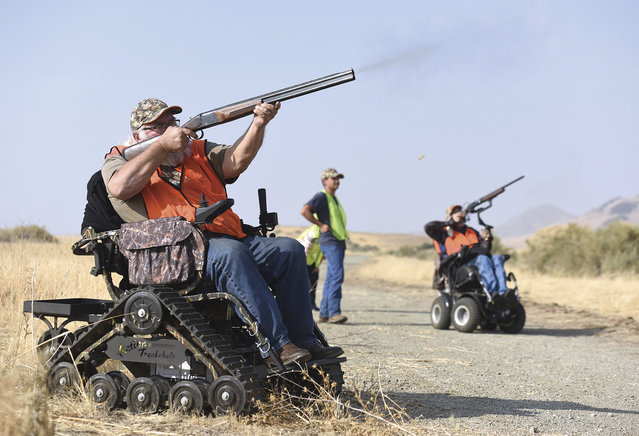
In this November 16, 2018, file photo, Duane Townsend, left, shoots a pheasant at Special Friday Pheasant Hunts, sponsored by Southern Tulare County Sportsman's Association, at Lake Success Recreation Area in Porterville, Calif. A Utah man who has been in a wheelchair for more than three decades has created a pheasant hunt for people like him who need help getting into the outdoors. The Daily Herald in Provo reports that Clint Robinson broke his neck after being thrown off a horse at a rodeo 32 years ago. The event called “Wheelchairs in the Wild” pairs people that have physical disabilities with hunters who help them with whatever they need. Many go in off-road vehicles. (Photo by Chieko Hara/The Porterville Recorder via AP Photo/File)

In this November 16, 2018, file photo, Duane Townsend, left, shoots a pheasant at Special Friday Pheasant Hunts, sponsored by Southern Tulare County Sportsman's Association, at Lake Success Recreation Area in Porterville, Calif. A Utah man who has been in a wheelchair for more than three decades has created a pheasant hunt for people like him who need help getting into the outdoors. The Daily Herald in Provo reports that Clint Robinson broke his neck after being thrown off a horse at a rodeo 32 years ago. The event called “Wheelchairs in the Wild” pairs people that have physical disabilities with hunters who help them with whatever they need. Many go in off-road vehicles. (Photo by Chieko Hara/The Porterville Recorder via AP Photo/File)
Details
19 Oct 2019 00:01:00
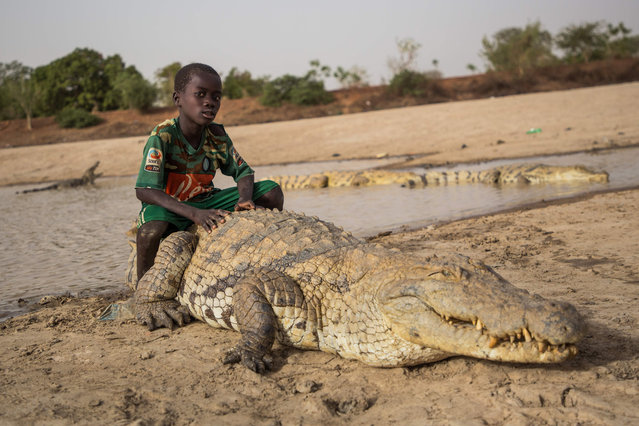
A boy sits on the back of a crocodile on May 19, 2018 at a pond in Bazoule in Burkina Faso, a village which happily shares its local pond with “sacred” crocodiles. Crocodiles may be one of the deadliest hunters in the animal kingdom, but in a small village in Burkina Faso it is not unusual to see someone sitting atop one of the fearsome reptiles. According to local legend, the startling relationship with the predators dates back to at least the 15 th century. The village was in the grip of an agonising drought until the crocodiles led women to a hidden pond where the population could slake their thirst. (Photo by Olympia de Maismont/AFP Photo)

A boy sits on the back of a crocodile on May 19, 2018 at a pond in Bazoule in Burkina Faso, a village which happily shares its local pond with “sacred” crocodiles. Crocodiles may be one of the deadliest hunters in the animal kingdom, but in a small village in Burkina Faso it is not unusual to see someone sitting atop one of the fearsome reptiles. According to local legend, the startling relationship with the predators dates back to at least the 15 th century. The village was in the grip of an agonising drought until the crocodiles led women to a hidden pond where the population could slake their thirst. (Photo by Olympia de Maismont/AFP Photo)
Details
17 Jul 2018 00:01:00
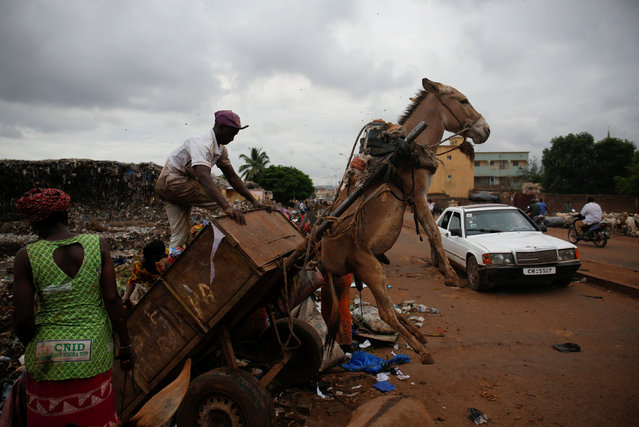
A waste picker unloads garbage at a waste transfer station in Bamako, Mali, August 19, 2018. In the Malian capital of Bamako, donkey carts driven by young men like 19-year-old Arouna Diabate play a vital role battling the fast-growing city's waste problem. Every morning before dawn, Diabate hitches his donkey to a cart and sets off on his rounds, going door-to-door to collect household garbage which he delivers to a local waste transfer station for a monthly salary of around $35. “I won't be picking up trash with a donkey cart for the rest of my life, but for now people appreciate us because we help clean up the homes of Bamako”, Diabate said. (Photo by Luc Gnago/Reuters)

A waste picker unloads garbage at a waste transfer station in Bamako, Mali, August 19, 2018. In the Malian capital of Bamako, donkey carts driven by young men like 19-year-old Arouna Diabate play a vital role battling the fast-growing city's waste problem. Every morning before dawn, Diabate hitches his donkey to a cart and sets off on his rounds, going door-to-door to collect household garbage which he delivers to a local waste transfer station for a monthly salary of around $35. “I won't be picking up trash with a donkey cart for the rest of my life, but for now people appreciate us because we help clean up the homes of Bamako”, Diabate said. (Photo by Luc Gnago/Reuters)
Details
18 Sep 2018 00:01:00
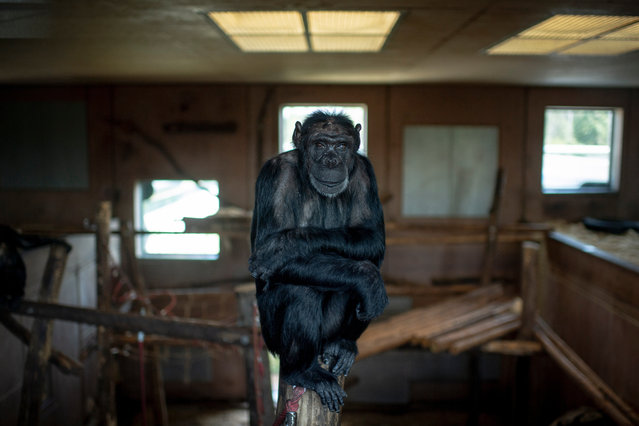
A chimpanzee looks in the direction of a camera at the Gut Aiderbichl Sanctuary for Traumatized Chimpanzees and other Primates in Gaenserndorf, near Vienna, 17 September 2018. 34 former laboratory chimpanzees of former Austrian pharmaceutical company Immuno AG spend their lives at the Gut Aiderbichl Sanctuary for Traumatized Chimpanzees and other Primates since 2009. U.S.-based Baxter International Inc. took over the Immuno AG in 1996, banned experiments with primates and rebuilt a former safari park for the Gut Aiderbichl Sanctuary for Traumatized Chimpanzees and other Primates. After three decades in captivity in too small cages, the chimpanzees, most of them came from Sierra Leone as cubs, have species-appropriate indoor and outdoor enclosures. The financial support by Baxter International Inc. and Austrian officials will end by 2019. (Photo by Christian Bruna/EPA/EFE)

A chimpanzee looks in the direction of a camera at the Gut Aiderbichl Sanctuary for Traumatized Chimpanzees and other Primates in Gaenserndorf, near Vienna, 17 September 2018. 34 former laboratory chimpanzees of former Austrian pharmaceutical company Immuno AG spend their lives at the Gut Aiderbichl Sanctuary for Traumatized Chimpanzees and other Primates since 2009. (Photo by Christian Bruna/EPA/EFE)
Details
23 Sep 2018 00:03:00
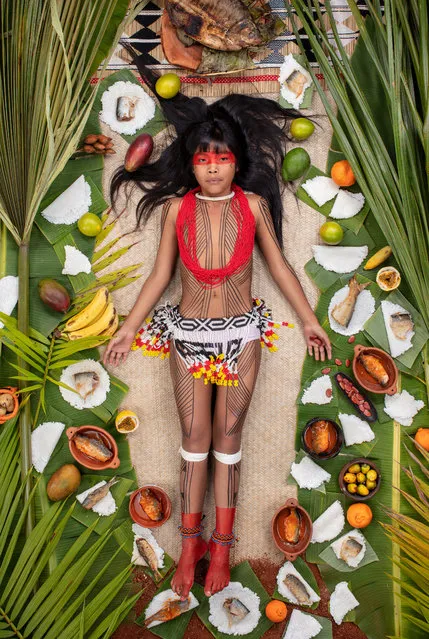
Kawakanih Yawalapiti, 9, Upper Xingu region of Mato Grosso, Brazil, 2018: Kawakanih lives with her tribe, the Yawalapiti, in Xingu national park, a preserve in the Amazon basin of Brazil. The Yawalapiti collect seeds to preserve species unique to their ecosystem, which lies between the rain forest and savannah. Kawakanih’s diet is simple, consisting mainly of fish, cassava, porridge, fruit and nuts. “It takes five minutes to catch dinner”, says Kawakanih. “When you’re hungry, you just go to the river with your net”. (Photo by Gregg Segal/The Guardian)

Photographer Gregg Segal travelled the world to document children and the food they eat in a week. Partly inspired by the increasing problems of childhood obesity, he tracked traditional regional diets as yet unaffected by globalisation, and ironically, found that the healthiest diets were often eaten by the least well off. (Photo by Gregg Segal/The Guardian)
Details
03 Jul 2019 00:03:00


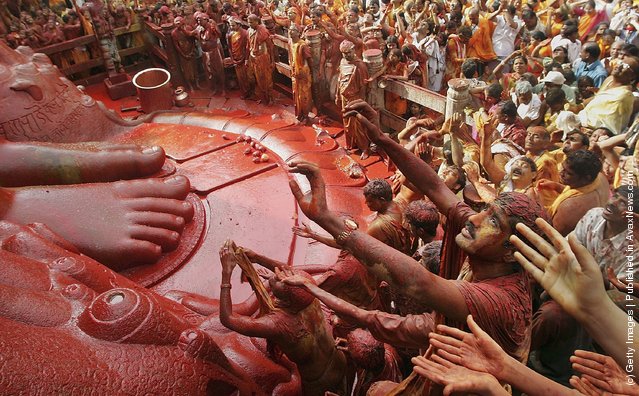
“The Mahamasthakabhisheka (or Mahamasthak Abhishek) is an important Jain festival held once every twelve years in the town of Shravanabelagola in Karnataka state, India. The festival is held in veneration of an immense 18 meter high statue of the Bhagwan (or Saint) Gomateshwara Bahubali. The anointing last took place in February 2006, and the next ceremony will occur in 2018”. – Wikipedia

Photo: A Jain Sadhu (2nd L) and devotees gather and pray at the feet of the monolithic statue of Jain sage Gomateswara during preparations for the Mahamastak Abhisheka ceremony February 7, 2006 in Shravanabelagola, India. The Mahamastak Abhisheka ceremony is held just once every twelve years where the statue will be bathed with milk, yogurt, saffron, gold coins and other religious items. The statue is said to be the world's largest monolith. The ceremony officially runs February 8-19. (Photo by Mario Tama/Getty Images)
Details
21 Jun 2011 12:27:00
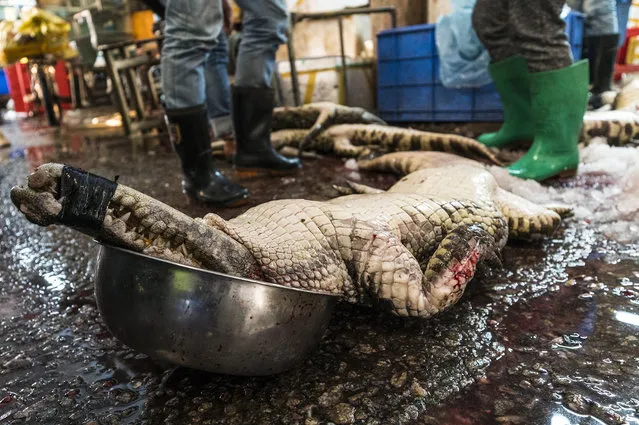
A dead crocodile is seen on Huangsha Seafood Market in Guangzhou, Guandong Province, China, 22 January 2018. Tsukiji Market of China or Huangsha Seafood Market is biggest one in Southern China and one of the biggest in China, as there are literally hundreds of different varieties of fish and seafood scattered throughout the market. Since the proximity of the fish market is so close to the Zhujiang River, it's quite easy for the large fishing vessels and fishermen to unload their fresh catch right at the market, which ensures that the fish and seafood remain fresh. Fish and other seafood are coming there from all around the globe. Seafood Market is full of different kinds of live fish, live shellfish, and live seafood on display in crystal clear tanks and it's common to see 5-star chefs, retailers and expats to source for fresh and high-quality seafood supplies for reasonable prices. While it is a wholesale fish market, since many Guangzhou restaurants and businesses come to purchase their seafood here, the public is welcome to come and even purchase. Many local Chinese have the vendors slice up fresh salmon fillets to take home or carry seafood into one of the nearby specialty restaurants, where they will cook if for them and serve it with vegetables and other side dishes of their choice. One of the biggest attractions for both, tourists and buyers, on market are crocodiles, which are brought there alive in wooden cases with taped jaws so they can?t accidentally bite. They are from crocodile farms from Guangdong, China and from Vietnam. Crocodile meat is popular in most Asian countries and it is consider as delicate one. Crocodiles weight from 10 to 25 kg and bigger ones are about 2 years old. They cost about 70 RMB (8.90 EURO) when bout as whole, or if you buy as parts most expensive and appreciated parts are paws 120 RMB (15.26 EURO) per kg, and tail 100 RMB (12.72 EURO) per kg. (Photo by Aleksandar Plavevski/EPA/EFE)

A dead crocodile is seen on Huangsha Seafood Market in Guangzhou, Guandong Province, China, 22 January 2018. Tsukiji Market of China or Huangsha Seafood Market is biggest one in Southern China and one of the biggest in China, as there are literally hundreds of different varieties of fish and seafood scattered throughout the market. (Photo by Aleksandar Plavevski/EPA/EFE)
Details
17 Apr 2020 00:05:00
Alexei Gruk, 45, mechanic and supporter of presidential candidate Pavel Grudinin, poses for a picture in St. Petersburg, Russia, January 31, 2018. “The most important thing for me is that our foreign policy stays the same”, said Gruk. “To hell with the sanctions… So what if they don’t bring foreign stuff here anymore? As if that means we have to give up. I don't care”. (Photo by Anton Vaganov/Reuters)

Most Russians intending to vote for Vladimir Putin in Sunday's election say stability is at the root of their faith in their candidate – though many young voters believe it's time for a change of leader. Putin, 65, is expected to win a fourth term in office with 69 percent of the vote, according to the latest survey by a state-run pollster. Reuters correspondents and photographers who travelled around the country talking to voters ahead of the March 18 election found nothing to contradict expectation of an emphatic Putin victory. (Photo by Anton Vaganov/Reuters)
Details
15 Mar 2018 00:01:00