Loading...
Done
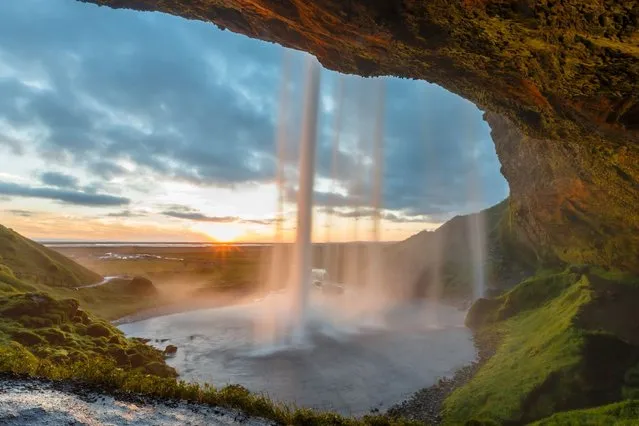
Seljalandsfoss waterfall, located in Iceland. (Photo by HotSpot Media)

Seljalandsfoss waterfall, located in Iceland. Seljalandsfoss is one of the most famous waterfalls of Iceland. This waterfall of the river Seljalandsá drops 60 metres (200 ft) over the cliffs of the former coastline. It's possible to go behind the waterfall. (Photo by HotSpot Media)
Details
16 Apr 2014 12:54:00
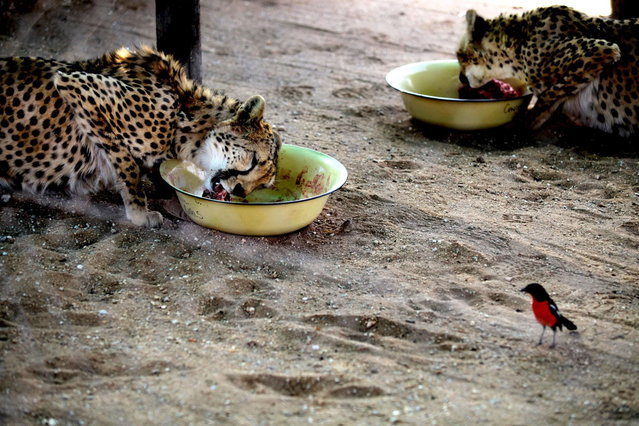
Young cheetahs eat meat at The Cheetah Conservation Fund (CCF) center in Otjiwarongo, Namibia, on August 13, 2013. The CCF started breeding Anatolian livestock dogs to promote cheetah-friendly farming after some 10,000 big cats – the current total worldwide population – were killed or moved off farms in the 1980s.  Up to 1,000 cheetahs were being killed a year, mostly by farmers who saw them as livestock killers. But the use of dogs has slashed losses for sheep and goat farmers and led to less retaliation against the vulnerable cheetah. (Photo by Jennifer Bruce/AFP Photo)

Young cheetahs eat meat at The Cheetah Conservation Fund (CCF) center in Otjiwarongo, Namibia, on August 13, 2013. The CCF started breeding Anatolian livestock dogs to promote cheetah-friendly farming after some 10,000 big cats – the current total worldwide population – were killed or moved off farms in the 1980s. Up to 1,000 cheetahs were being killed a year, mostly by farmers who saw them as livestock killers. But the use of dogs has slashed losses for sheep and goat farmers and led to less retaliation against the vulnerable cheetah. (Photo by Jennifer Bruce/AFP Photo)
Details
29 Aug 2013 10:56:00
Uranjargal, a leader of the Mongolian neo-Nazi group Tsagaan Khass, stands next to a statue of Chingunjav, a Mongolian national hero, in Ulan Bator June 22, 2013. (Photo by Carlos Barria/Reuters)

Uranjargal, a leader of the Mongolian neo-Nazi group Tsagaan Khass, stands next to a statue of Chingunjav, a Mongolian national hero, in Ulan Bator June 22, 2013. The group has rebranded itself as an environmentalist organisation fighting pollution by foreign-owned mines, seeking legitimacy as it sends Swastika-wearing members to check mining permits. Over the past years, ultra-nationalist groups have expanded in the country and among those garnering attention is Tsagaan Khass, which has recently shifted its focus from activities such as attacks on women it accuses of consorting with foreign men to environmental issues, with the stated goal of protecting Mongolia from foreign mining interests. This ultra-nationalist group was founded in the 1990s and currently has 100-plus members. (Photo by Carlos Barria/Reuters)

Details
09 Jul 2013 07:23:00


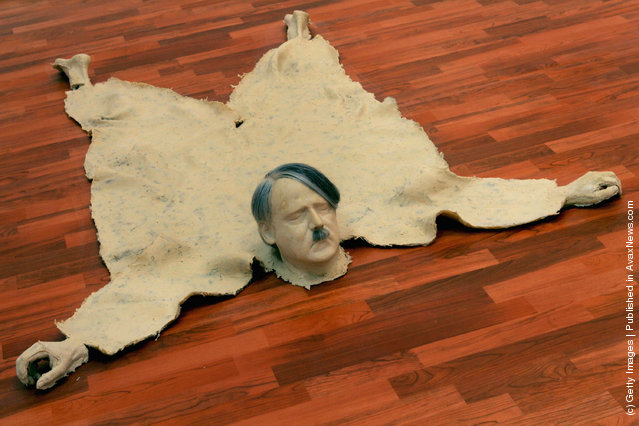
A silicon rug in the form of Adolph Hitler on display during an exhibition by Israeli artist Boaz Arad, at the Center for Contemporary Art February 22, 2007 in Tel Aviv, Israel. Arad is an Israeli artist who is dealing with the Holocaust in a provocative way. He uses the Holocaust to discuss human evil and contemporary Israel, which he says is torn and crumbling. (Photo by David Silverman/Getty Images)
Details
29 Mar 2011 11:51:00
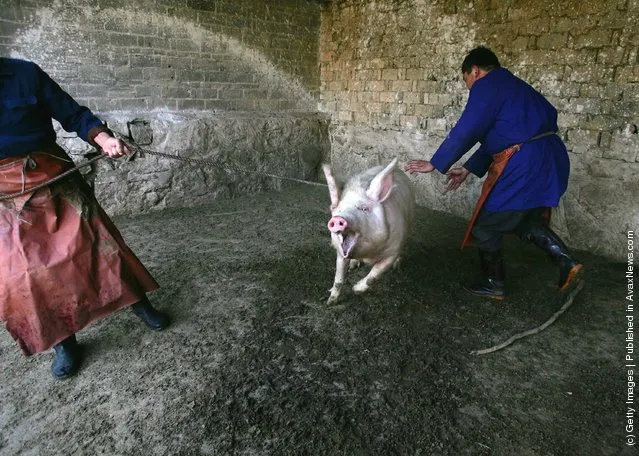
Pig

Chinese butchers catch a pig to slaughter on January 31, 2005 in Jinzhai County, Anhui Province, China. (Photo by Cancan Chu/GettyImages)
Details
20 Aug 2011 12:17:00
Liu Yang, China's first female astronaut, waves during a departure ceremony at Jiuquan Satellite Launch Center, on June 16, 2012. (Photo by Jason Lee/Reuters via The Atlantic)

Liu Yang, China's first female astronaut, waves during a departure ceremony at Jiuquan Satellite Launch Center, on June 16, 2012. (Photo by Jason Lee/Reuters via The Atlantic)
Details
10 Jul 2013 08:37:00
TV prosthetics artist Rene Abelardo tries on a sample of his prosthetic face mask, his latest creation as TV projects took a halt amid the coronavirus disease (COVID-19) outbreak, in San Pedro, Laguna, Philippines, June 17, 2020. (Photo by Eloisa Lopez/Reuters)

TV prosthetics artist Rene Abelardo tries on a sample of his prosthetic face mask, his latest creation as TV projects took a halt amid the coronavirus disease (COVID-19) outbreak, in San Pedro, Laguna, Philippines, June 17, 2020. (Photo by Eloisa Lopez/Reuters)
Details
31 Aug 2020 00:03:00
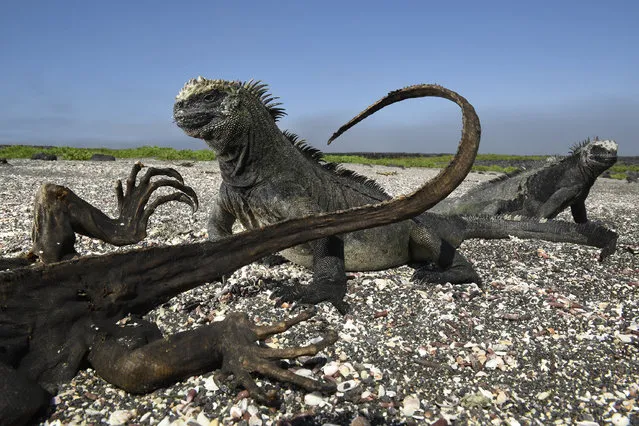
Galapagos – Rocking the Cradle: Four major ocean currents converge along the Galapagos archipelago, creating the conditions for an extraordinary diversity of animal life, April 25, 2016. The islands are home to at least 7,000 flora and fauna species, of which 97 percent of the reptiles, 80 percent of the land birds, 50 percent of the insects and 30 percent of the plants are endemic. The local ecosystem is highly sensitive to the changes in temperature, rainfall and ocean currents that characterize the climatic events known as El Niño and La Niña. These changes cause marked fluctuations in weather and food availability. Many scientists expect the frequency of El Niño and La Niña to increase as a result of climate change, making the Galapagos a possible early-warning location for its effects. (Photo by Thomas P. Peschak for National Geographic/World Press Photo)

Galapagos – Rocking the Cradle: Four major ocean currents converge along the Galapagos archipelago, creating the conditions for an extraordinary diversity of animal life, April 25, 2016. The islands are home to at least 7,000 flora and fauna species, of which 97 percent of the reptiles, 80 percent of the land birds, 50 percent of the insects and 30 percent of the plants are endemic. (Photo by Thomas P. Peschak for National Geographic/World Press Photo)
Details
16 Apr 2018 00:01:00