Loading...
Done
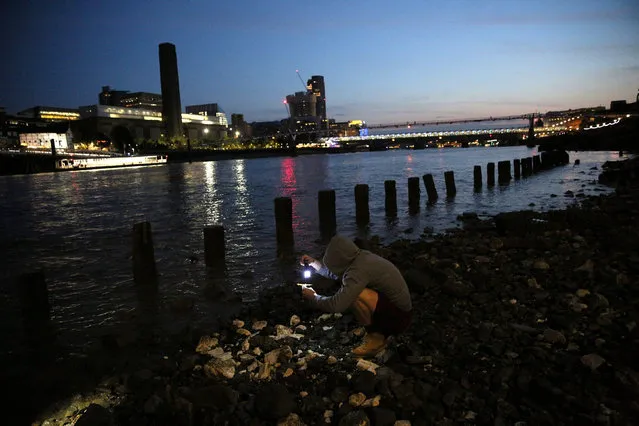
A mudlark uses a torch to look for items on the bank of the River Thames in London, Britain June 06, 2016. Mudlarking is believed to trace its origins to the 18th and 19th century, when scavengers searched the Thames' shores for items to sell. These days, history and archaeology fans are the ones hoping to find old relics such as coins, ceramics, artifacts or everyday items from across centuries. They wait for the low tide and then scour specific areas of exposed shores. "If you're in a field you could be out all day long, with the river you're restricted to about two or three hours," mudlark Nick Stevens said. While many just use the naked eye for their searches, others rely on metal detectors for which a permit from the Port of London Authority is needed. Digging also requires consent. (Photo by Neil Hall/Reuters)

A mudlark uses a torch to look for items on the bank of the River Thames in London, Britain June 06, 2016. Mudlarking is believed to trace its origins to the 18th and 19th century, when scavengers searched the Thames' shores for items to sell. These days, history and archaeology fans are the ones hoping to find old relics such as coins, ceramics, artifacts or everyday items from across centuries. their finds with the Portable Antiquities Scheme. Any item over 300 years old must be recorded. (Photo by Neil Hall/Reuters)
Details
27 Aug 2016 10:43:00
A crane loads logs at the Novoyeniseisk wood processing plant, with the air temperature at about minus 20 degrees Celsius (minus 4 degrees Fahrenheit), in the town of Lesosibirsk in Krasnoyarsk Region, Siberia, Russia, February 16, 2016. The plant exports timber to Europe, Northern Africa and Asia. The Taiga, also known as the boreal forest, on the coast of the Angara River and Yenisei River is one of the main areas for the industrial cutting of wood thanks to the high quality of the Angara pine. (Photo by Ilya Naymushin/Reuters)

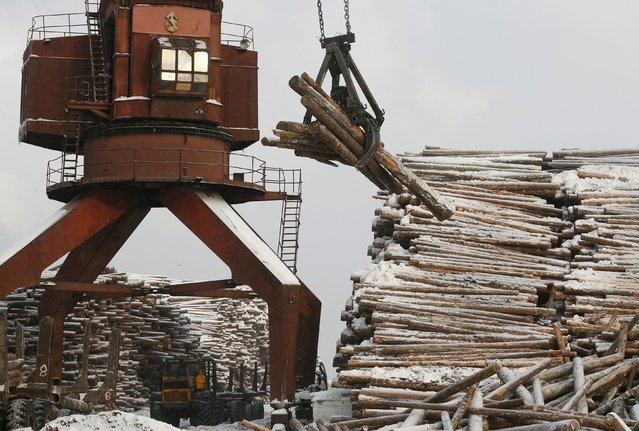
A crane loads logs at the Novoyeniseisk wood processing plant, with the air temperature at about minus 20 degrees Celsius (minus 4 degrees Fahrenheit), in the town of Lesosibirsk in Krasnoyarsk Region, Siberia, Russia, February 16, 2016. The plant exports timber to Europe, Northern Africa and Asia. The Taiga, also known as the boreal forest, on the coast of the Angara River and Yenisei River is one of the main areas for the industrial cutting of wood thanks to the high quality of the Angara pine. Open air work continues all year around regardless to temperatures which can drop to minus 52 degrees Celsius (minus 61.6 degrees Fahrenheit), according to employees. (Photo by Ilya Naymushin/Reuters)
Details
18 Feb 2016 13:10:00
A woman wearing a face mask has her hair curled by a special equipment at a beauty salon in Bangkok on July 12, 2020. (Photo by Mladen Antonov/AFP Photo)

A woman wearing a face mask has her hair curled by a special equipment at a beauty salon in Bangkok on July 12, 2020. (Photo by Mladen Antonov/AFP Photo)
Details
09 Aug 2020 00:05:00
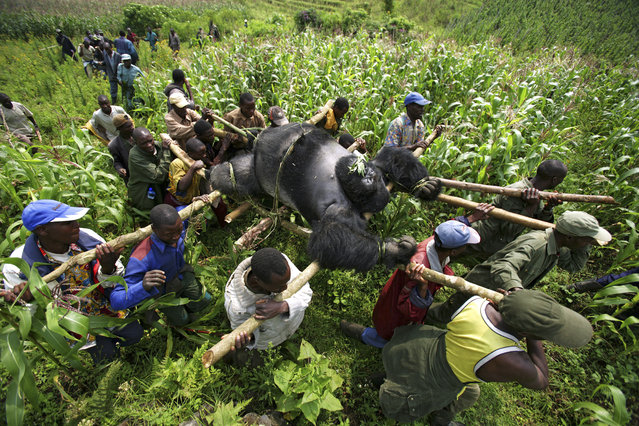
2008 Visa d'or Feature: Brent Stirton. Conservation Rangers from an Anti-Poaching unit work with locals to evacuate the bodies of four Mountain Gorrillas killed in mysterious circumstances in the park,  July 24, 2007, Virunga National Park, Eastern Congo. (Photo by Brent Stirton/Exclusive by Getty Images)

Jean-François Leroy launched Visa Pour l’Image, the international photojournalism festival, in Perpignan in 1989. Before heading up the festival, Leroy was shooting reportage for the agency Sipa Press and also working for Photo-Reporter, Le Photographe, Photo-Revue and Photo Magazine. He is the chairman of the company Images Evidence. Photo: 2008 Visa d'or Feature: Brent Stirton. Conservation Rangers from an Anti-Poaching unit work with locals to evacuate the bodies of four Mountain Gorrillas killed in mysterious circumstances in the park, July 24, 2007, Virunga National Park, Eastern Congo. (Photo by Brent Stirton/Exclusive by Getty Images)
Details
27 Aug 2013 10:42:00
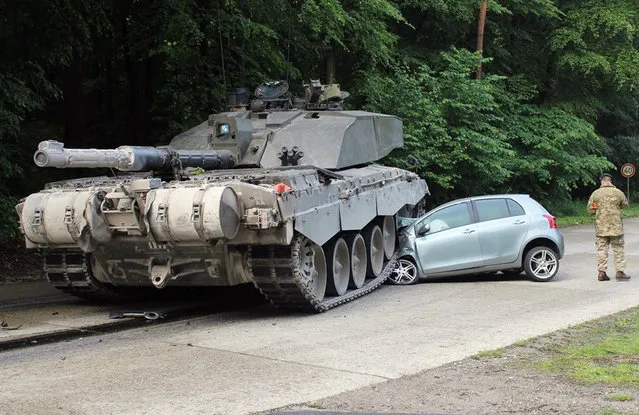
A handout photo provided by the Police department in Lippe on 01 June 2015 of a British “Challenger 2” tank after it rolled over a car's front in Lippe, Germany, 01 June 2015. Police reported that a 18-year old female driving beginner from Detmold apparently overlooked a convoy of tanks when she turned left onto the Panzeringstrasse (lit. Tank Ring Road). The driver of the convoy'e leading tank, a 24-year old British national, was not able to stop his vehicle fast enough, hit the car and overran the vehicle's front. The young female car driver remained unhurt. The exclusive damage to the car was estimated at about 12,000 euro. (Photo by EPA/Polizei Lippe)

A handout photo provided by the Police department in Lippe on 01 June 2015 of a British “Challenger 2” tank after it rolled over a car's front in Lippe, Germany, 01 June 2015. Police reported that a 18-year old female driving beginner from Detmold apparently overlooked a convoy of tanks when she turned left onto the Panzeringstrasse (lit. Tank Ring Road). (Photo by EPA/Polizei Lippe)
Details
06 Mar 2020 00:03:00
Russian police cadets march during general rehearsal of the Victory Day parade on the Dvortsovaya Square in St. Petersburg, Russia, 07 May 2021. The military parade marking the 76th anniversary of the victory over Nazi Germany in the World War II will take place on the Dvortsovaya Square on 09 May 2021. (Photo by Anatoly Maltsev/EPA/EFE)

Russian police cadets march during general rehearsal of the Victory Day parade on the Dvortsovaya Square in St. Petersburg, Russia, 07 May 2021. The military parade marking the 76th anniversary of the victory over Nazi Germany in the World War II will take place on the Dvortsovaya Square on 09 May 2021. (Photo by Anatoly Maltsev/EPA/EFE)
Details
08 May 2021 09:12:00
“Lofoten Glow”. I was desperately searching a good sunrise spot this particular morning. Normally Storvatnet Lake is completely covered in snow, so you can only imagine my surprise when I saw these crazy ice formations almost being shot out of the frozen lake. I put my crampons on and took a big risk walking out. Photo location: Storvatnet, Lofoten Islands in Northern Norway. (Photo and caption by Stian Klo/National Geographic Photo Contest)

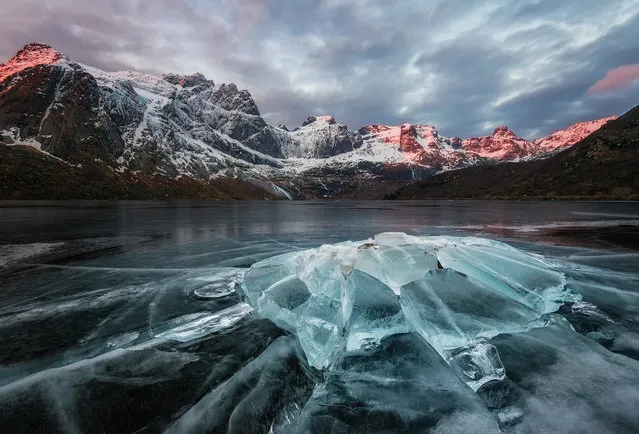
“Lofoten Glow”. I was desperately searching a good sunrise spot this particular morning. Normally Storvatnet Lake is completely covered in snow, so you can only imagine my surprise when I saw these crazy ice formations almost being shot out of the frozen lake. I put my crampons on and took a big risk walking out. I could hear the ice cracking underneath my feet, and when you’re all alone in a fjord/canyon like this – the cracks are echoed and sound really frightening. Was it worth it? I sure think so! Photo location: Storvatnet, Lofoten Islands in Northern Norway. (Photo and caption by Stian Klo/National Geographic Photo Contest)
Details
08 Apr 2014 09:40:00
Igor Gavrilov, the main taxidermist of the Zoological centre at Tel Aviv University, works on a taxidermied animal, part of a collection which will be housed at the Steinhardt Museum of Natural History, a new Israeli natural history museum set to open next year in Tel Aviv, Israel June 8, 2016. Legions of insects, sea creatures and ancient fossils are lining up in a new museum shaped liked a giant Noah's Ark, telling the story of a crucial evolutionary byway across Israel. Experts say all humans and other animals had to pass through Israel on their first journey out of Africa into Europe and Asia. (Photo by Nir Elias/Reuters)

Igor Gavrilov, the main taxidermist of the Zoological centre at Tel Aviv University, works on a taxidermied animal, part of a collection which will be housed at the Steinhardt Museum of Natural History, a new Israeli natural history museum set to open next year in Tel Aviv, Israel June 8, 2016. Legions of insects, sea creatures and ancient fossils are lining up in a new museum shaped liked a giant Noah's Ark, telling the story of a crucial evolutionary byway across Israel. (Photo by Nir Elias/Reuters)
Details
25 Aug 2016 09:42:00