Loading...
Done
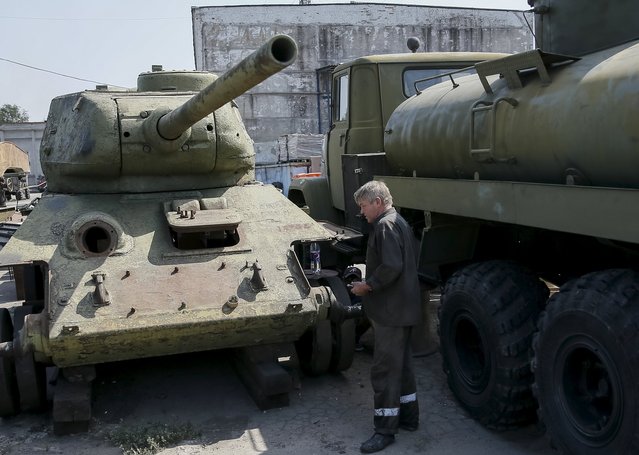
A worker looks at an old soviet tank T-34 (L) as he fixes military vehicle (R) at a Phaeton museum in Zaporizhia, Ukraine, August 11, 2015. (Photo by Gleb Garanich/Reuters)

A worker looks at an old soviet tank T-34 (L) as he fixes military vehicle (R) at a Phaeton museum in Zaporizhia, Ukraine, August 11, 2015. The museum stopped the restoration works of their collection of about 120 retro autos and motorcycles to help the Ukrainian army to restore military vehicles and equipment which will be used in the conflict in Ukraine eastern regions. (Photo by Gleb Garanich/Reuters)
Details
12 Aug 2015 12:54:00
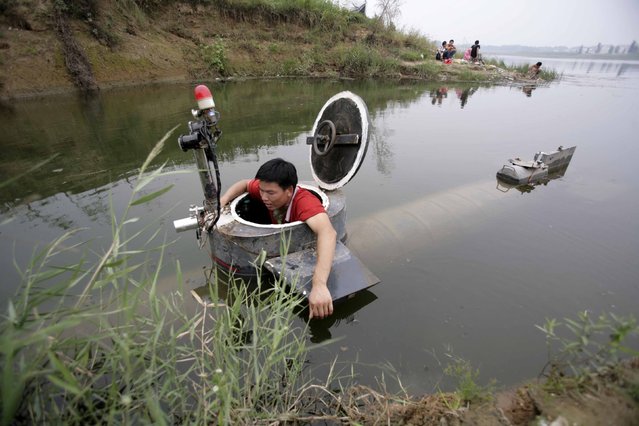
Tao Xiangli gets out of his homemade submarine after operating it in a lake on the outskirts of Beijing September 3, 2009. Amateur inventor Tao, 34,  made a fully functional submarine, which has a periscope, depth control tanks, electric motors, manometer, and two propellers, from old oil barrels and tools which he bought at a second-hand market. He took 2 years to invent and test the submarine which costs 30,000 yuan ($4,385). (Photo by Christina Hu/Reuters)

Tao Xiangli gets out of his homemade submarine after operating it in a lake on the outskirts of Beijing September 3, 2009. Amateur inventor Tao, 34, made a fully functional submarine, which has a periscope, depth control tanks, electric motors, manometer, and two propellers, from old oil barrels and tools which he bought at a second-hand market. He took 2 years to invent and test the submarine which costs 30,000 yuan ($4,385). (Photo by Christina Hu/Reuters)
Details
05 May 2013 12:06:00
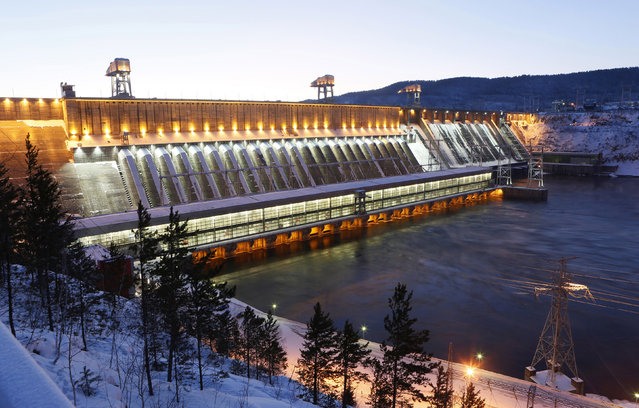
A general view shows the Krasnoyarsk hydro-electric power station on the Yenisei River near the Siberian city of Krasnoyarsk, Russia, January 13, 2016. The power plant, owned by EuroSibEnergo company, part of En+ Group, with a generating capacity of 6,000 megawatt (MW), has a ferro-concrete dam 124-metres high and 1065-metres long and is the second largest Russian hydroelectric power station. About 85% of the energy generated is intended for the Rusal Krasnoyarsk aluminium smelter, according to representatives of the power station. (Photo by Ilya Naymushin/Reuters)

A general view shows the Krasnoyarsk hydro-electric power station on the Yenisei River near the Siberian city of Krasnoyarsk, Russia, January 13, 2016. The power plant, owned by EuroSibEnergo company, part of En+ Group, with a generating capacity of 6,000 megawatt (MW), has a ferro-concrete dam 124-metres high and 1065-metres long and is the second largest Russian hydroelectric power station. About 85% of the energy generated is intended for the Rusal Krasnoyarsk aluminium smelter, according to representatives of the power station. (Photo by Ilya Naymushin/Reuters)
Details
16 Jan 2016 08:03:00
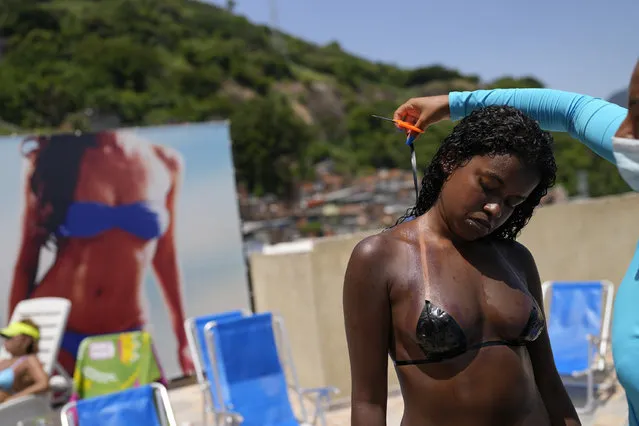
Sabrina Crespo da Silva removes electrical tape from a client at her Sabrina Bronze rooftop salon, where she offers the service of taping on bikini tops which create crisp tan lines, in the Turano favela of Rio de Janeiro, Brazil, Thursday, January 27, 2022. Even though beaches reopened amid the COVID-19 pandemic, some clients using Sabrina's rooftop service say they are still anxious about returning to the crowded seashore and potentially catching the virus. (Photo by Silvia Izquierdo/AP Photo)

Sabrina Crespo da Silva removes electrical tape from a client at her Sabrina Bronze rooftop salon, where she offers the service of taping on bikini tops which create crisp tan lines, in the Turano favela of Rio de Janeiro, Brazil, Thursday, January 27, 2022. Even though beaches reopened amid the COVID-19 pandemic, some clients using Sabrina's rooftop service say they are still anxious about returning to the crowded seashore and potentially catching the virus. (Photo by Silvia Izquierdo/AP Photo)
Details
29 Jan 2022 07:06:00
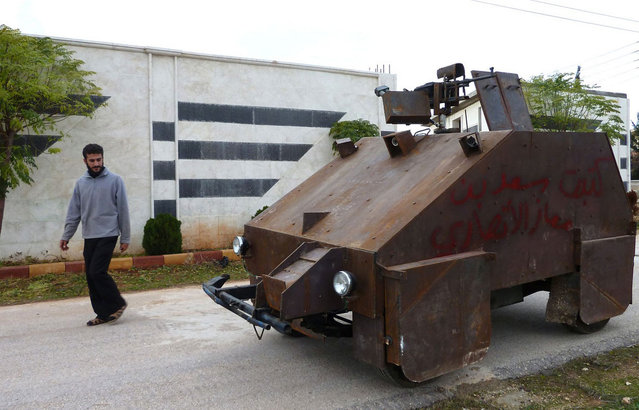
A Syrian rebel walks past Sham 2, a homemade armored vehicle, in Bishqatin, Syria, on December 8, 2012. From a distance it looks rather like a big rusty metal box but closer inspection reveals a homemade armored vehicle waiting to be deployed. Sham II, named after ancient Syria, is built from the chassis of a car and touted by rebels as “100 percent made in Syria”. (Photo by Herve Bar/AFP Photo)

A Syrian rebel walks past Sham 2, a homemade armored vehicle, in Bishqatin, Syria, on December 8, 2012. From a distance it looks rather like a big rusty metal box but closer inspection reveals a homemade armored vehicle waiting to be deployed. Sham II, named after ancient Syria, is built from the chassis of a car and touted by rebels as “100 percent made in Syria”. (Photo by Herve Bar/AFP Photo)
Details
03 Sep 2013 09:30:00
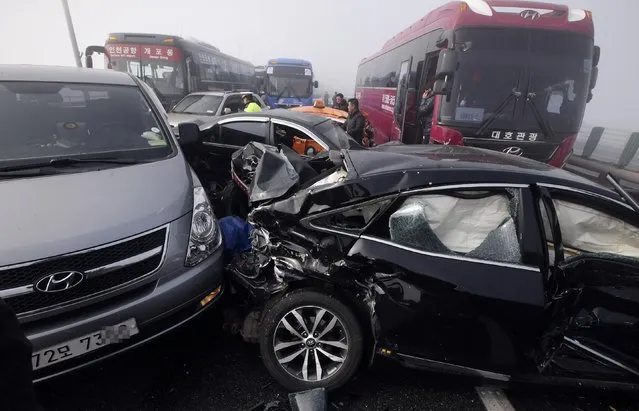
Damaged vehicles sit on Yeongjong Bridge in Incheon, South Korea, Wednesday, February 11, 2015. Two people were killed and at least 42 were injured on Wednesday after a pileup involving about 100 vehicles in foggy weather on the bridge near the Incheon International Airport, South Korean officials said. (Photo by Suh Myung-gon/AP Photo/Yonhap)

Damaged vehicles sit on Yeongjong Bridge in Incheon, South Korea, Wednesday, February 11, 2015. Two people were killed and at least 42 were injured on Wednesday after a pileup involving about 100 vehicles in foggy weather on the bridge near the Incheon International Airport, South Korean officials said. (Photo by Suh Myung-gon/AP Photo/Yonhap)
Details
12 Feb 2015 12:20:00
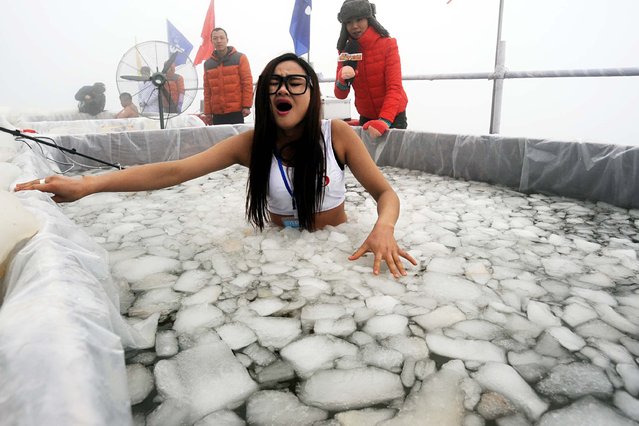
This picture taken on January 25, 2015 shows a participant taking part in an ice water challenge in Zhangjiajie, central China's Hunan province. Participants were required to stay in an ice pond, holding an ice block while eating ice-cream with an electric fan blowing at them. (Photo by AFP Photo/Stringer)

This picture taken on January 25, 2015 shows a participant taking part in an ice water challenge in Zhangjiajie, central China's Hunan province. Participants were required to stay in an ice pond, holding an ice block while eating ice-cream with an electric fan blowing at them. (Photo by AFP Photo/Stringer)
Details
31 Jan 2015 12:58:00
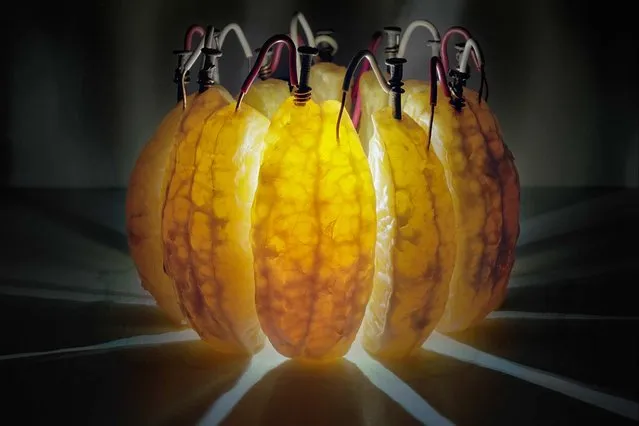
Wedges of an orange generate enough current and electrical juice – 3.5 volts – to power an LED. The fruit’s citric acid helps electrons flow from galvanized nails to copper wire in this 14-hour exposure. This image was published in September’s Visions of Earth, a trio of photos that appear in each issue of National Geographic. (Photo by Caleb Charland/National Geographic)

Wedges of an orange generate enough current and electrical juice – 3.5 volts – to power an LED. The fruit’s citric acid helps electrons flow from galvanized nails to copper wire in this 14-hour exposure. This image was published in September’s Visions of Earth, a trio of photos that appear in each issue of National Geographic. (Photo by Caleb Charland/National Geographic)
Details
06 Jan 2014 12:09:00