Loading...
Done


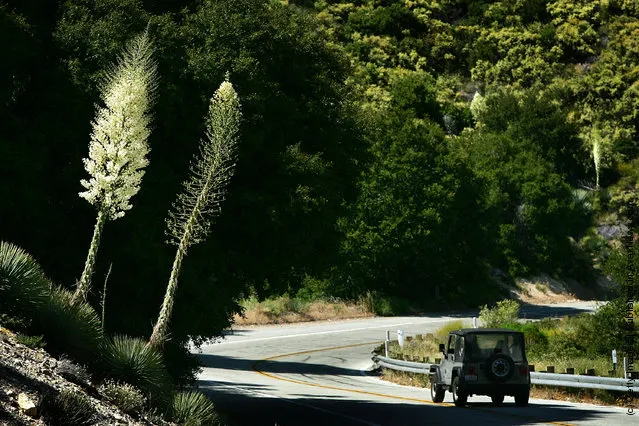
“Yucca is a genus of perennial shrubs and trees in the agave family, Agavaceae. Its 40-50 species are notable for their rosettes of evergreen, tough, sword-shaped leaves and large terminal panicles of white or whitish flowers. They are native to the hot and dry (arid) parts of North America, Central America, South America, and the Caribbean. Early reports of the species were confused with the cassava (Manihot esculenta). Consequently, Linnaeus mistakenly derived the generic name from the Carib word for the latter, yuca. It is also colloquially known in the midwest United States as “Ghosts in the graveyard”, as it is commonly found growing in rural graveyards and when in bloom the flowers appear as an apparition floating.” – Wikipedia

Photo: A yucca standing among flowers bursts forth a very large stalk of flowers as a heavy wildflower bloom on June 21, 2005 in the Angeles National Forest northwest of La Canada, California. (Photo by David McNew/Getty Images)
Details
29 Mar 2011 07:31:00
Skullptures by Hedi Xandt

Hedi Xandt imagines impressive sculptures. Mixing styles and materials with talent, the artist invites us to discover his dark and intense universe.
Details
15 Oct 2013 11:32:00
The Mongrel Mob

New Zealand is known more for its breathtaking scenery, as shown in Lord of The Rings, than for its gang activity, a dark side unknown to most
.
Details
01 Aug 2015 04:01:00
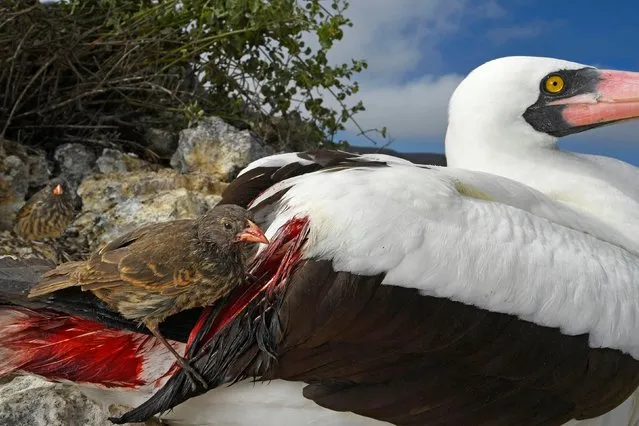
Bloodthirsty by Thomas P Peschak, Germany/South Africa — winner, Behaviour: birds. When rations run short on Wolf Island, in the remote northern Galápagos, the sharp-beaked ground finches become vampires. Their sitting targets are Nazca boobies and other large birds. The finches rely on a scant diet of seeds and insects, which regularly dries up, so they drink blood to survive. ‘I’ve seen more than half a dozen finches drinking from a single Nazca booby,’ says Tom. Rather than leave their nests the boobies tolerate the vampires, and the blood loss doesn’t seem to cause permanent harm. (Photo by Thomas P Peschak/2018 Wildlife Photographer of the Year)

Bloodthirsty by Thomas P. Peschak, Germany/South Africa — winner, Behaviour: birds. When rations run short on Wolf Island, in the remote northern Galápagos, the sharp-beaked ground finches become vampires. Their sitting targets are Nazca boobies and other large birds. The finches rely on a scant diet of seeds and insects, which regularly dries up, so they drink blood to survive. ‘I’ve seen more than half a dozen finches drinking from a single Nazca booby,’ says Tom. Rather than leave their nests the boobies tolerate the vampires, and the blood loss doesn’t seem to cause permanent harm. (Photo by Thomas P. Peschak/2018 Wildlife Photographer of the Year)
Details
19 Oct 2018 00:05:00
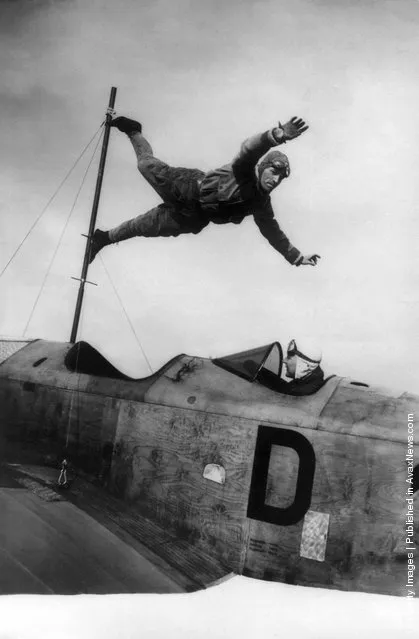
Aerial Acrobat

Aerial acrobat Schindler, notorious for his foolhardy stunts, practising one of his tricks listing out of the vertical, from a Klemp plane piloted by Richard Perlia. (Photo by General Photographic Agency/Getty Images). Circa 1927
Details
22 Aug 2011 12:18:00
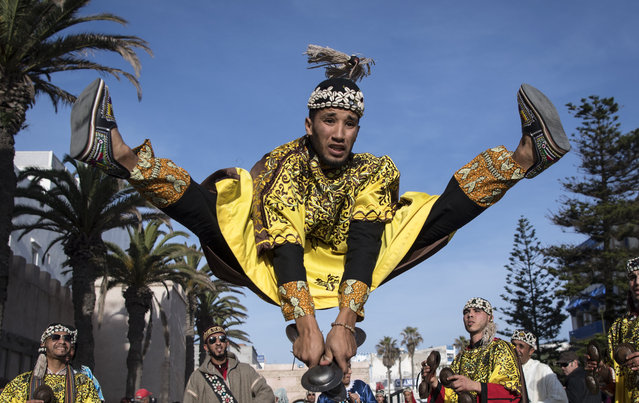
A Gnawa traditional group performs in the city of Essaouira on December 14, 2019, to celebrate the decision of adding the Gnawa culture to UNESCO's list of Intangible Cultural Heritage of Humanity. Gnawa culture, a centuries-old Moroccan practice rooted in music, African rituals and Sufi traditions, was added to UNESCO's list of Intangible Cultural Heritage of Humanity earlier in the week. Gnawa refers to a “set of musical productions, fraternal practices and therapeutic rituals where the secular mixes with the sacred”, according to the nomination submitted by Morocco. Often dressed in colourful outfits, Gnawa musicians play the guenbri, a type of lute with three strings, accompanied by steel castanets called krakebs. (Photo by Fadel Senna/AFP Photo)

A Gnawa traditional group performs in the city of Essaouira on December 14, 2019, to celebrate the decision of adding the Gnawa culture to UNESCO's list of Intangible Cultural Heritage of Humanity. Gnawa culture, a centuries-old Moroccan practice rooted in music, African rituals and Sufi traditions, was added to UNESCO's list of Intangible Cultural Heritage of Humanity earlier in the week. Gnawa refers to a “set of musical productions, fraternal practices and therapeutic rituals where the secular mixes with the sacred”, according to the nomination submitted by Morocco. Often dressed in colourful outfits, Gnawa musicians play the guenbri, a type of lute with three strings, accompanied by steel castanets called krakebs. (Photo by Fadel Senna/AFP Photo)
Details
18 Dec 2019 00:05:00
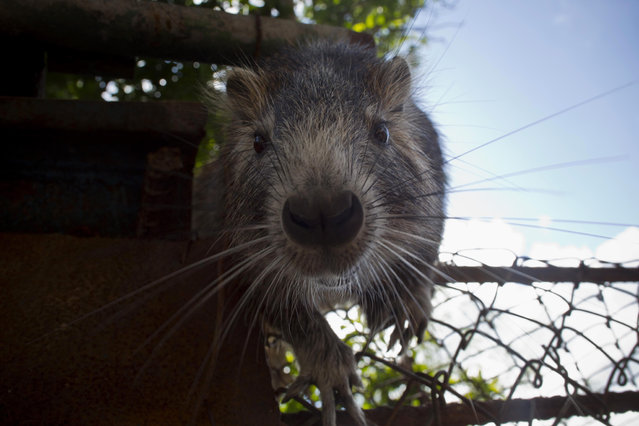
In this November 17, 2014 photo, Pancho, a domesticated huitia, confronts a camera, in Bainoa, Cuba. With their rope-like, dark tails, long front teeth, and whiskers that appear to be vibrating, huitias look like giant rats. They measure nearly a foot long (about 30 centimeters), with the largest ones weighing in bigger than a small dog. (Photo by Ramon Espinosa/AP Photo)

In this November 17, 2014 photo, Pancho, a domesticated huitia, confronts a camera, in Bainoa, Cuba. With their rope-like, dark tails, long front teeth, and whiskers that appear to be vibrating, huitias look like giant rats. They measure nearly a foot long (about 30 centimeters), with the largest ones weighing in bigger than a small dog. (Photo by Ramon Espinosa/AP Photo)
Details
21 Nov 2014 12:58:00
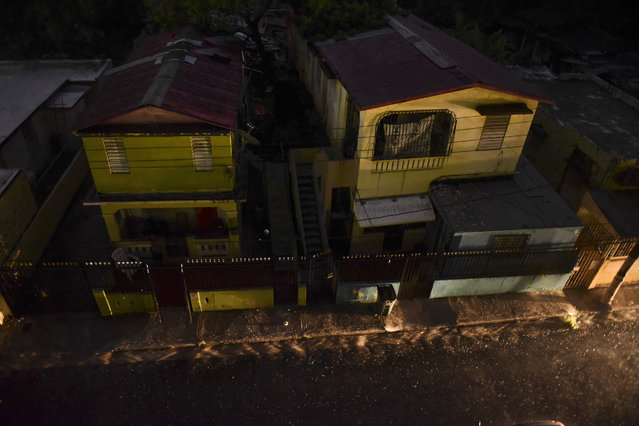
Vehicle lights illuminate a street after a massive blackout, in San Juan, Puerto Rico, Thursday, September 22, 2016. Puerto Ricans faced another night of darkness Thursday as crews slowly restored electricity a day after a fire at a power plant caused the aging utility grid to fail and blacked out the entire island. (Photo by Carlos Giusti/AP Photo)

Vehicle lights illuminate a street after a massive blackout, in San Juan, Puerto Rico, Thursday, September 22, 2016. Puerto Ricans faced another night of darkness Thursday as crews slowly restored electricity a day after a fire at a power plant caused the aging utility grid to fail and blacked out the entire island. (Photo by Carlos Giusti/AP Photo)
Details
24 Sep 2016 10:31:00