Loading...
Done
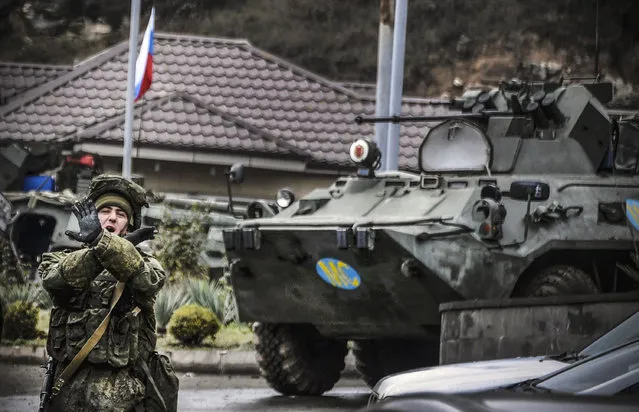
A Russian peacekeeper shouts “No pictures!” at a checkpoint outside the city of Stepanakert on November 13, 2020, during a ceasefire in the military conflict between Armenia and Azerbaijan over the breakaway region of Nagorno-Karabakh. Russian began deploying 2,000 peacekeepers to Nagorno-Karabakh on November 10 after Armenia and Azerbaijan agreed a peace deal to end weeks of fierce fighting over the disputed region. The Moscow-brokered agreement came after a string of Azerbaijani victories in its fight to retake the ethnic Armenian enclave. It sparked celebrations in Azerbaijan but fury in Armenia, where protesters took to the streets to denounce their leaders for losses in the territory, which broke from Azerbaijan's control during a war in the early 1990s. (Photo by Alexander Nemenov/AFP Photo)

A Russian peacekeeper shouts “No pictures!” at a checkpoint outside the city of Stepanakert on November 13, 2020, during a ceasefire in the military conflict between Armenia and Azerbaijan over the breakaway region of Nagorno-Karabakh. Russian began deploying 2,000 peacekeepers to Nagorno-Karabakh on November 10 after Armenia and Azerbaijan agreed a peace deal to end weeks of fierce fighting over the disputed region. (Photo by Alexander Nemenov/AFP Photo)
Details
15 Nov 2020 00:07:00
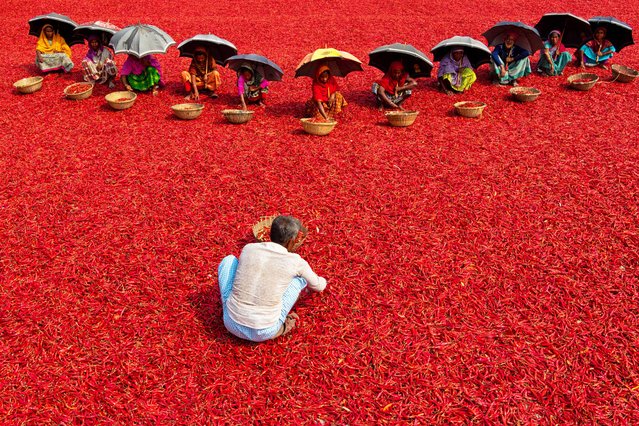
Rows of workers shelter under umbrellas from the scorching heat as they painstakingly sort through a red carpet of millions of chilli peppers in Bogra, Bangladesh on October 3, 2023. They sort the rotten and broken chilli peppers out to separate the poor quality ones which won't sell. In a line, the pickers who are paid less than £3 for a 10-hour shift slowly move forward with their baskets to separate the bad from the good after the chilies have been dried in the sun for a week. The dried & sorted chillies are then packaged and taken to the local market where they are brought mainly by companies to be made into chilli powder. The workers sort them in a warm environment, with temperatures reaching up to 45°C. More than 5,000 people work in almost 100 chilli farms in the Bogra district of Bangladesh to supply local spice companies with chillies for their recipes. Known as “Lal Morich” to the locals, chilli peppers are a major part of Bengali cuisine and are used as part of a combination of spices for various meat dishes, including chicken and beef. (Photo by Joy Saha/Rex Features/Shutterstock)

Rows of workers shelter under umbrellas from the scorching heat as they painstakingly sort through a red carpet of millions of chilli peppers in Bogra, Bangladesh on October 3, 2023. They sort the rotten and broken chilli peppers out to separate the poor quality ones which won't sell. In a line, the pickers who are paid less than £3 for a 10-hour shift slowly move forward with their baskets to separate the bad from the good after the chilies have been dried in the sun for a week. (Photo by Joy Saha/Rex Features/Shutterstock)
Details
21 Oct 2023 04:04:00
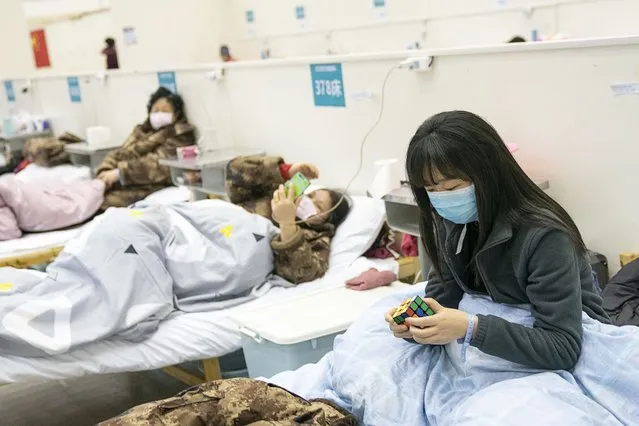
A patient solves a rubik's cube at a temporary hospital converted from “Wuhan Livingroom” in central China's Hubei Province on February 10, 2020. In face of the outbreak of the novel coronavirus pneumonia epidemic, Wuhan authorities have transformed public venues such as exhibition centers and gymnasiums into temporary hospitals. The hospitals have a large capacity of treating patients with mild symptoms and play an important role in isolating the source of infection and cutting off the routes of infection during epidemic prevention. The first batch of patients was hospitalized on Feb. 5. (Photo by Chine Nouvelle/SIPA Press/Rex Features/Shutterstock)

A patient solves a rubik's cube at a temporary hospital converted from “Wuhan Livingroom” in central China's Hubei Province on February 10, 2020. In face of the outbreak of the novel coronavirus pneumonia epidemic, Wuhan authorities have transformed public venues such as exhibition centers and gymnasiums into temporary hospitals. The hospitals have a large capacity of treating patients with mild symptoms and play an important role in isolating the source of infection and cutting off the routes of infection during epidemic prevention. The first batch of patients was hospitalized on Feb. 5. (Photo by Chine Nouvelle/SIPA Press/Rex Features/Shutterstock)
Details
17 Feb 2020 00:07:00
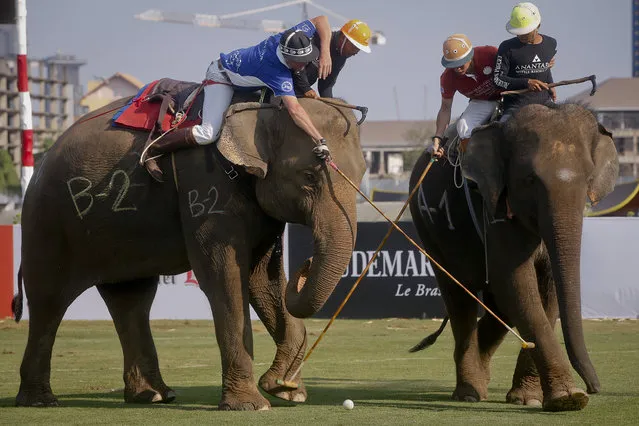
Elephant polo players in action during the King's Cup Elephant Polo event 2016 final between teams King Power (blue) and The Elephant Story, in Bangkok, Thailand, March 13, 2016. Team King Power won the annual charity event, which is now in its 14th edition. This year's edition involved 18 elephants brought from tourist trekking camps in Pattaya as well as some unemployed in Surin, and a total of 10 teams encompassing over 40 players, in this event directed at raising funds to improve the lives of elephants and elephant conservation. (Photo by Diego Azubel/EPA)

Elephant polo players in action during the King's Cup Elephant Polo event 2016 final between teams King Power (blue) and The Elephant Story, in Bangkok, Thailand, March 13, 2016. Team King Power won the annual charity event, which is now in its 14th edition. This year's edition involved 18 elephants brought from tourist trekking camps in Pattaya as well as some unemployed in Surin, and a total of 10 teams encompassing over 40 players, in this event directed at raising funds to improve the lives of elephants and elephant conservation. (Photo by Diego Azubel/EPA)
Details
14 Mar 2016 11:11:00
Nguyen Manh Quan (top), 26, a civil servant, carries a girl using his throat area as he performs during a showcase of the traditional Thien Mon Dao kung fu at Du Xa Thuong village, southeast of Hanoi, Vietnam May 10, 2015. (Photo by Reuters/Kham)

Nguyen Manh Quan (top), 26, a civil servant, carries a girl using his throat area as he performs during a showcase of the traditional Thien Mon Dao kung fu at Du Xa Thuong village, southeast of Hanoi, Vietnam May 10, 2015. Thien Mon Dao, a traditional Vietnamese martial art, was formed by 18th century villagers in Du Xa Thuong village, who believed the art form could help improve health as well as fight against foreign invaders. There are currently about 3,000 practitioners including farmers, industry workers and state servants. These practitioners say they are able to bend metal against their bodies and carry heavy objects using their throats, eyes or tongues, as well as run across the surface of a river, according to Thien Mon Dao kung fu master Nguyen Khac Phan. (Photo by Reuters/Kham)
Details
11 May 2015 12:27:00
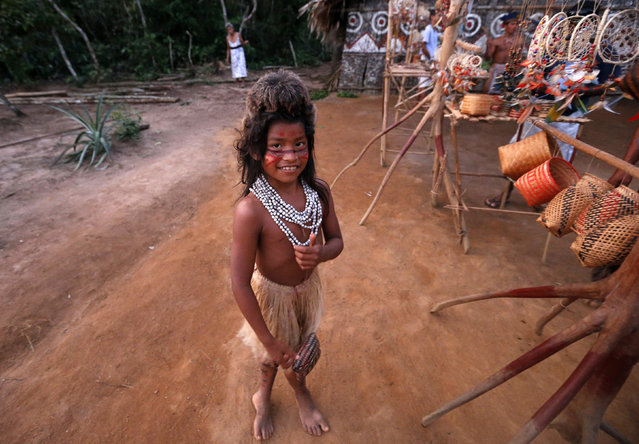
A girl of the Amazonian Tatuyo tribe poses while waiting to sell crafts to tourists in her village in the Rio Negro (Black River) near Manaus city, a World Cup host city, June 23, 2014. Because of their proximity to host city Manaus and their warm welcome, the Tatuyo have enjoyed three weeks of brisk business thanks to the World Cup. Usually, they host between 10 and 30 tourists a day. During the World Cup, this number has rocketed to 250 a day, They have become richer and other communities now come to them to sell them juices and fishes. (Photo by Andres Stapff/Reuters)

A girl of the Amazonian Tatuyo tribe poses while waiting to sell crafts to tourists in her village in the Rio Negro (Black River) near Manaus city, a World Cup host city, June 23, 2014. Because of their proximity to host city Manaus and their warm welcome, the Tatuyo have enjoyed three weeks of brisk business thanks to the World Cup. Usually, they host between 10 and 30 tourists a day. During the World Cup, this number has rocketed to 250 a day, They have become richer and other communities now come to them to sell them juices and fishes. (Photo by Andres Stapff/Reuters)
Details
27 Jun 2014 10:30:00
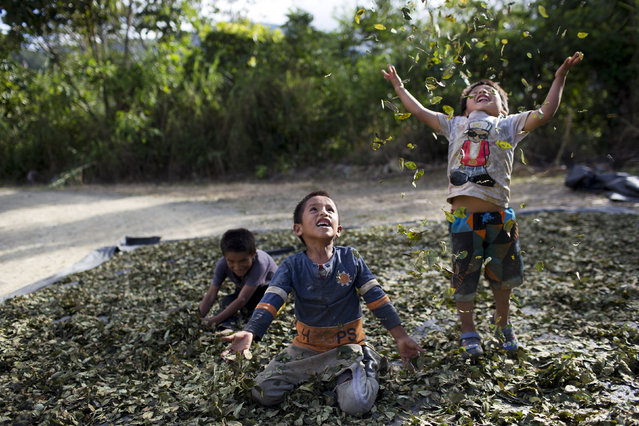
In this March 13, 2015 photo,  Yohan, 4, from left, Cristian, 7, and Angelo, 6, playfully toss coca leaves into the air, singing: “I have a lot of money, look at all the money I have”, in La Mar, province of Ayacucho, Peru. Hauling cocaine out of the remote valley is about the only way to earn decent cash in this region where a farmhand earns less than $10 a day. Beyond extinguishing young lives, the practice has packed Peru's highland prisons with cocaine backpackers while their bosses evade incarceration. (Photo by Rodrigo Abd/AP Photo)

In this March 13, 2015 photo, Yohan, 4, from left, Cristian, 7, and Angelo, 6, playfully toss coca leaves into the air, singing: “I have a lot of money, look at all the money I have”, in La Mar, province of Ayacucho, Peru. Hauling cocaine out of the remote valley is about the only way to earn decent cash in this region where a farmhand earns less than $10 a day. Beyond extinguishing young lives, the practice has packed Peru's highland prisons with cocaine backpackers while their bosses evade incarceration. (Photo by Rodrigo Abd/AP Photo)
Details
12 May 2015 12:40:00
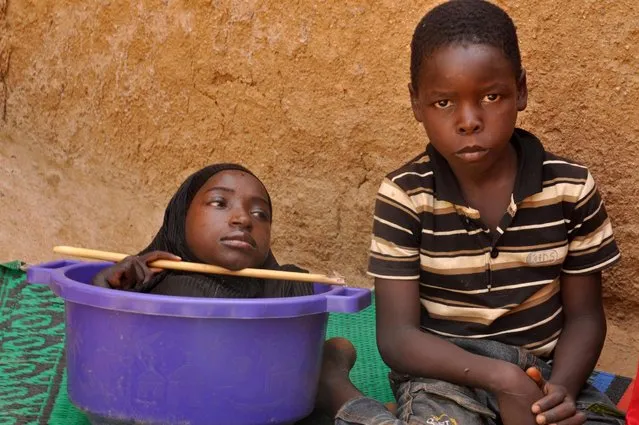
Rahma, 19, pictured with her 10-year old brother Fahad on June 21, 2016 in Kano, Nigeria. A teenage girl born without limbs lives her life in a plastic bowl. Rahma Haruna is a bright, happy girl, despite suffering from a mystery condition that stopped her arms and legs developing properly – leaving her practically limbless and in constant pain. The 19-year- old, from Kano, Nigeria, was born a healthy baby but when she turned six months old her growth came to a sudden halt and she stopped hitting key development milestones. Rahma’s family do their best to provide her with a fulfilling life and transport her around the village in a plastic bowl. Rahma said: “They help me a lot. How do they? They give me anything I need”. Rahma died on 25 December 2016. (Photo by Sani Maikatanga/Barcroft Images)

Rahma, 19 (L), pictured with her 10-year old brother Fahad on June 21, 2016 in Kano, Nigeria. A teenage girl born without limbs lives her life in a plastic bowl. Rahma Haruna is a bright, happy girl, despite suffering from a mystery condition that stopped her arms and legs developing properly – leaving her practically limbless and in constant pain. The 19-year- old, from Kano, Nigeria, was born a healthy baby but when she turned six months old her growth came to a sudden halt and she stopped hitting key development milestones. Rahma’s family do their best to provide her with a fulfilling life and transport her around the village in a plastic bowl. Rahma said: “They help me a lot. How do they? They give me anything I need”. Rahma died on 25 December 2016. (Photo by Sani Maikatanga/Barcroft Images)
Details
30 Dec 2016 10:52:00