Loading...
Done
“Say cheese”. Cheetahs jumped on the vehicle of tourists in Masai Mara national park, Kenya. (Photo and caption by Yanai Bonneh/National Geographic Traveler Photo Contest)

“Say cheese”. Cheetahs jumped on the vehicle of tourists in Masai Mara national park, Kenya. (Photo and caption by Yanai Bonneh/National Geographic Traveler Photo Contest)

ATTENTION! All pictures are presented in high resolution. To see Hi-Res images – just TWICE click on any picture. In other words, click small picture – opens the BIG picture. Click BIG picture – opens VERY BIG picture.
Details
26 Jun 2013 06:33:00
The “Escape Velocity” moving sculpture by artist group Poetic Kinetics looms over Coachella festivalgoers on the Empire Polo Field, on the first day of the 2014 Coachella Music and Arts Festival in Indio, California, on April 11, 2014. (Photo by Chris Pizzello/Invision)

The “Escape Velocity” moving sculpture by artist group Poetic Kinetics looms over Coachella festivalgoers on the Empire Polo Field, on the first day of the 2014 Coachella Music and Arts Festival in Indio, California, on April 11, 2014. (Photo by Chris Pizzello/Invision)
Details
12 Apr 2014 12:55:00
A zookeeper counts penguins through an observation window during the annual stocktake at ZSL London Zoo in central London on January 3, 2023. (Photo by Justin Tallis/AFP Photo)

A zookeeper counts penguins through an observation window during the annual stocktake at ZSL London Zoo in central London on January 3, 2023. (Photo by Justin Tallis/AFP Photo)
Details
05 Jan 2023 00:39:00
A boy and a woman run across a railway track as a train approaches in Chengdu, Sichuan province, China, October 8, 2015. Many residents disregard sign prohibiting this kind of illegal crossing and choose to do so to save time, local media reported. (Photo by Hao Fei/Reuters/Western China Metropolis Daily)

A boy and a woman run across a railway track as a train approaches in Chengdu, Sichuan province, China, October 8, 2015. Many residents disregard sign prohibiting this kind of illegal crossing and choose to do so to save time, local media reported. (Photo by Hao Fei/Reuters/Western China Metropolis Daily)
Details
18 Oct 2015 08:04:00
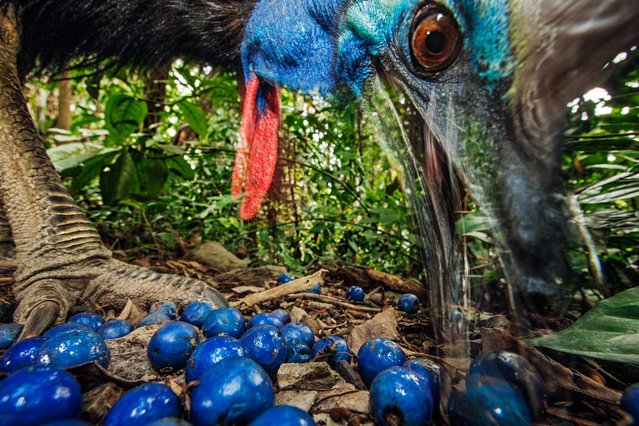
“Cassowaries are large, flightless birds related to emus and (more distantly) to ostriches, rheas, and kiwis”, writes Olivia Judson in the September issue of National Geographic magazine. (Photo by Christian Ziegler/National Geographic)

“Cassowaries are large, flightless birds related to emus and (more distantly) to ostriches, rheas, and kiwis”, writes Olivia Judson in the September issue of National Geographic magazine. How large? People-size: Adult males stand well over five foot five and top 110 pounds. Females are even taller, and can weigh more than 160 pounds. Dangerous when roused, they’re shy and peaceable when left alone. But even birds this big and tough are prey to habitat loss. The dense New Guinea and Australia rain forests where they live have dwindled. Today cassowaries might number 1,500 to 2,000. And because they help shape those same forests – by moving seeds from one place to another – “if they vanish”, Judson writes, “the structure of the forest would gradually change” too. (Photo by Christian Ziegler/National Geographic)
Details
06 Jan 2014 12:21:00
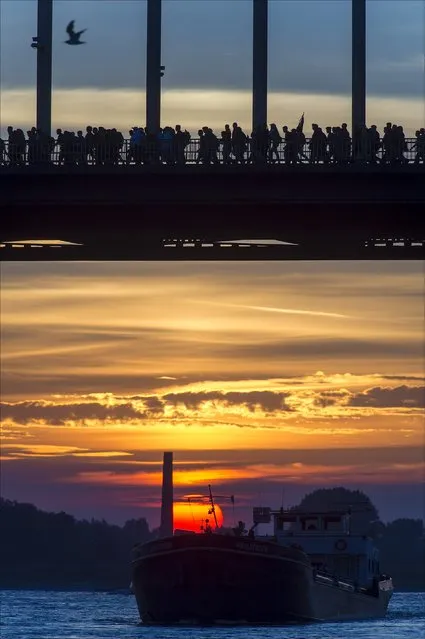
Walkers cross the river Waalbrug during the first day of the 98th annual four-days walking event, the “Vierdaagse” in Nijmegen, Netherlands, July 15, 2014. The “Nijmeegse Vierdaagse” is an annual public four-day field march which is held since 1909 in the third week of July. (Photo by Erik van 't Wout/EPA)

Walkers cross the river Waalbrug during the first day of the 98th annual four-days walking event, the “Vierdaagse” in Nijmegen, Netherlands, July 15, 2014. The “Nijmeegse Vierdaagse” is an annual public four-day field march which is held since 1909 in the third week of July. (Photo by Erik van 't Wout/EPA)
Details
27 Jul 2014 11:11:00
“Show us our butts! Mucawana tribe – Angola. In Soba village, the Muhacaona (Mucawana) tribe, perhaps the best place i have visited. They use cow dung and fat to make this so nice haircut, and love the beads. They asked me to make pictures of their backs... and butts to see on the camera screen if everything was perfect!”. (Eric Lafforgue)

“Show us our butts! Mucawana tribe – Angola. In Soba village, the Muhacaona (Mucawana) tribe, perhaps the best place i have visited. They use cow dung and fat to make this so nice haircut, and love the beads. They asked me to make pictures of their backs... and butts to see on the camera screen if everything was perfect!”. (Photo and comments by Eric Lafforgue)
Details
09 Nov 2012 15:04:00
circa 1925:  A Zulu woman playing the piano while a group of others sit and listen.  (Photo by General Photographic Agency/Getty Images)

“The Zulu are the largest South African ethnic group, with an estimated 10–11 million people living mainly in the province of KwaZulu-Natal. Small numbers also live in Zimbabwe, Zambia, and Mozambique. Their language, Zulu, is a Bantu language; more specifically, part of the Nguni subgroup. The Zulu Kingdom played a major role in South African history during the 19th and 20th centuries. Under apartheid, Zulu people were classed as third-class citizens and suffered from state-sanctioned discrimination. They remain today the most numerous ethnic group in South Africa, and now have equal rights along with all other citizens”. – Wikipedia.

Photo: A Zulu woman playing the piano while a group of others sit and listen (to put it briefly, Englishmen scoff over Zulu). South Africa, circa 1925. (Photo by General Photographic Agency)

Details
03 Feb 2014 09:40:00