Loading...
Done
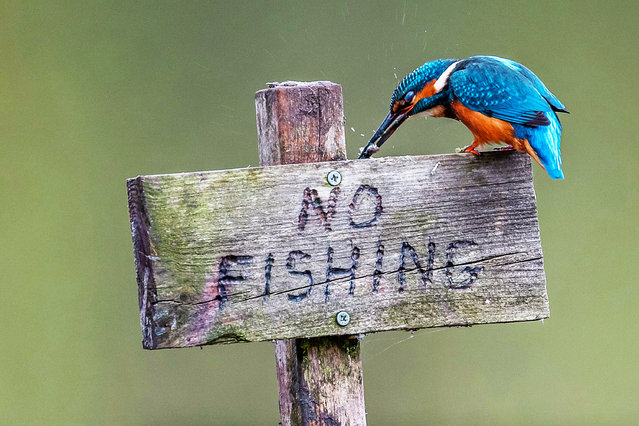
This little kingfisher clearly didn't read the sign when it landed itself a minnow in a no fishing zone. Taxi driver Paul Bird, 52, from Newmarket, Suffolk, UK, captured this amusing moment whilst out looking to photograph kingfishers in Norfolk, an hour drive from his home. Paul explained: “There are a total of six perches the bird was using from which to fish, one of them being the No Fishing sign”. (Photo by Paul Bird/Solent News & Photo Agency)

This little kingfisher clearly didn't read the sign when it landed itself a minnow in a no fishing zone. Taxi driver Paul Bird, 52, from Newmarket, Suffolk, UK, captured this amusing moment whilst out looking to photograph kingfishers in Norfolk, an hour drive from his home. Paul explained: “There are a total of six perches the bird was using from which to fish, one of them being the No Fishing sign”. (Photo by Paul Bird/Solent News & Photo Agency)
Details
02 Dec 2018 00:03:00
Revellers at the Chin Chin music festival in Amsterdam, Netherlands on July 3, 2021. The festival season has started with a QR code, one can enter, corona proof or vaccination proof in the corona check app. (Photo by Robin Utrecht/Rex Features/Shutterstock)

Revellers at the Chin Chin music festival in Amsterdam, Netherlands on July 3, 2021. The festival season has started with a QR code, one can enter, corona proof or vaccination proof in the corona check app. (Photo by Robin Utrecht/Rex Features/Shutterstock)

Details
14 Mar 2022 04:55:00
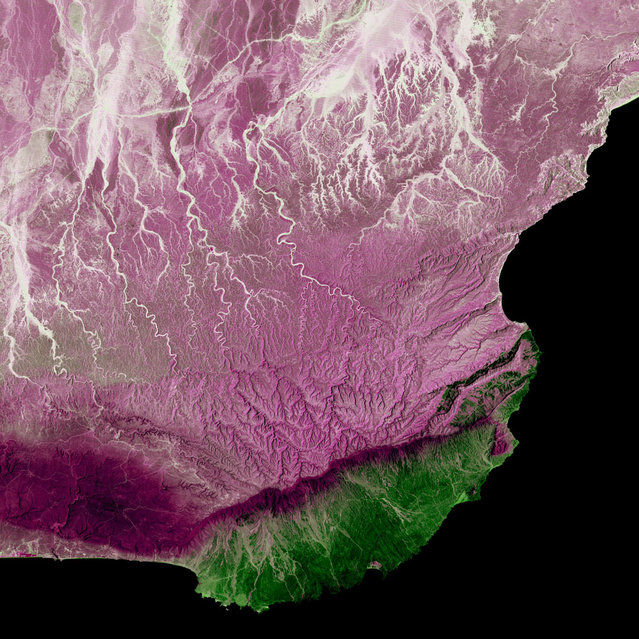
Dhofar Region, Oman. Much of Oman is desert, but the Arabian Sea coast in the Dhofar region represents a startling difference in climate. This coastal region catches the monsoon rains, or khareef, during the summer months. Drenching rains fall primarily on the mountainous ridge that separates the lush, fertile areas along the coast from the arid interior, recharging streams, waterfalls and springs that provide plentiful water supplies in the fertile lowlands for the remainder of the year. Image taken by Landsat 5 on April 2, 2005. (Photo by USGS/NASA)

Dhofar Region, Oman. Much of Oman is desert, but the Arabian Sea coast in the Dhofar region represents a startling difference in climate. This coastal region catches the monsoon rains, or khareef, during the summer months. Drenching rains fall primarily on the mountainous ridge that separates the lush, fertile areas along the coast from the arid interior, recharging streams, waterfalls and springs that provide plentiful water supplies in the fertile lowlands for the remainder of the year. Image taken by Landsat 5 on April 2, 2005. (Photo by USGS/NASA)
Details
25 Dec 2012 11:13:00
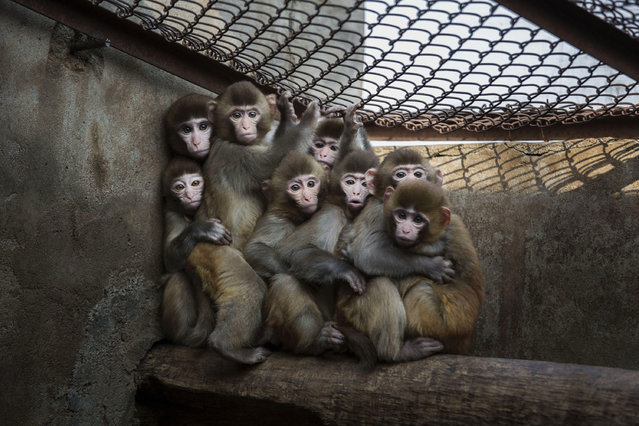
Macaque monkeys crowd together in their cage at a monkey farm on February 3, 2016 in Xinye county, Henan province, China. The area boasts a centuries-long and lucrative history of raising and training monkeys for performance. In Xinye, villagers are seeing an increase in business with the lunar calendar's “Year of the Monkey”. Farmers say most of the monkeys are bred and raised for domestic zoos, circuses, and performing groups, but add that some are also sold for medical research in China and the United States. Despite the popularity of the tradition, critics contend the training methods and conditions constitute animal cruelty. (Photo by Kevin Frayer/Getty Images)

Macaque monkeys crowd together in their cage at a monkey farm on February 3, 2016 in Xinye county, Henan province, China. The area boasts a centuries-long and lucrative history of raising and training monkeys for performance. In Xinye, villagers are seeing an increase in business with the lunar calendar's “Year of the Monkey”. Farmers say most of the monkeys are bred and raised for domestic zoos, circuses, and performing groups, but add that some are also sold for medical research in China and the United States. Despite the popularity of the tradition, critics contend the training methods and conditions constitute animal cruelty. (Photo by Kevin Frayer/Getty Images)
Details
31 Dec 2016 09:56:00
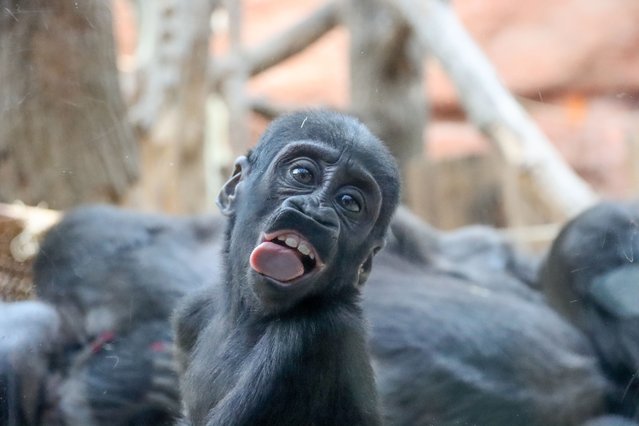
Young gorillas monkey around with zoo visitors, sticking their tongues out and pressing their faces against the glass, February 2025. Mobi, 1, and Gaia, 10 months, are half sisters and often push each other away at the glass to get the attention of their observers at the Prague Zoo. (Photo by Lucie Stepnickova/Solent News & Photo Agency)

Young gorillas monkey around with zoo visitors, sticking their tongues out and pressing their faces against the glass, February 2025. Mobi, 1, and Gaia, 10 months, are half sisters and often push each other away at the glass to get the attention of their observers at the Prague Zoo. (Photo by Lucie Stepnickova/Solent News & Photo Agency)
Details
09 Mar 2025 03:51:00
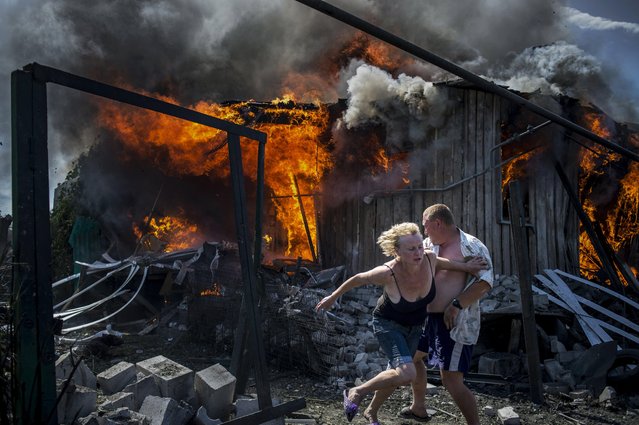
A handout photo made available by the World Press Photo (WPP) organization on 13 February 2017 shows a picture by Rossiya Segodnya photographer Valery Melnikov that won the Long-Term Projects – First Prize award of the 60th annual World Press Photo Contest, it was announced by the WPP Foundation in Amsterdam, The Netherlands on 13 February 2017. Caption: Civilians escape from a fire at a house destroyed by an air attack in the Luhanskaya village. Story: Ordinary people became victims of the conflict between self-proclaimed republics and the official Ukrainian authorities from 2014 onwards in the region of Donbass. Disaster came into their lives unexpectedly. These people were involved in the military confrontation against their will. They experienced the most terrible things: the death of their friends and relatives, destroyed homes and the ruined lives of thousands of people. (Photo by Valery Melnikov/EPA/Rossiya Segodnya/World Press Photo)

A handout photo made available by the World Press Photo (WPP) organization on 13 February 2017 shows a picture by Rossiya Segodnya photographer Valery Melnikov that won the Long-Term Projects – First Prize award of the 60th annual World Press Photo Contest, it was announced by the WPP Foundation in Amsterdam, The Netherlands on 13 February 2017. Caption: Civilians escape from a fire at a house destroyed by an air attack in the Luhanskaya village. (Photo by Valery Melnikov/EPA/Rossiya Segodnya/World Press Photo)
Details
15 Feb 2017 00:06:00
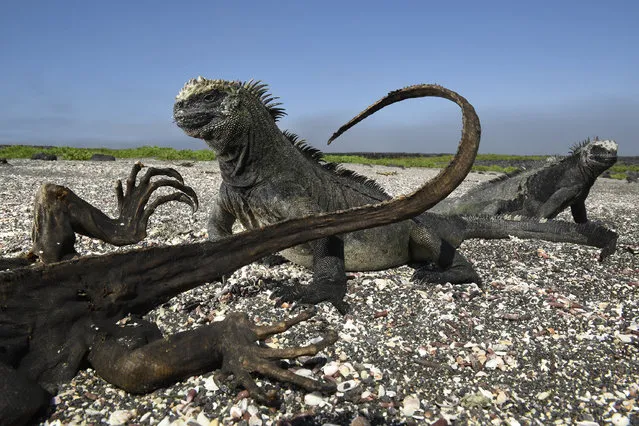
Galapagos – Rocking the Cradle: Four major ocean currents converge along the Galapagos archipelago, creating the conditions for an extraordinary diversity of animal life, April 25, 2016. The islands are home to at least 7,000 flora and fauna species, of which 97 percent of the reptiles, 80 percent of the land birds, 50 percent of the insects and 30 percent of the plants are endemic. The local ecosystem is highly sensitive to the changes in temperature, rainfall and ocean currents that characterize the climatic events known as El Niño and La Niña. These changes cause marked fluctuations in weather and food availability. Many scientists expect the frequency of El Niño and La Niña to increase as a result of climate change, making the Galapagos a possible early-warning location for its effects. (Photo by Thomas P. Peschak for National Geographic/World Press Photo)

Galapagos – Rocking the Cradle: Four major ocean currents converge along the Galapagos archipelago, creating the conditions for an extraordinary diversity of animal life, April 25, 2016. The islands are home to at least 7,000 flora and fauna species, of which 97 percent of the reptiles, 80 percent of the land birds, 50 percent of the insects and 30 percent of the plants are endemic. (Photo by Thomas P. Peschak for National Geographic/World Press Photo)
Details
16 Apr 2018 00:01:00
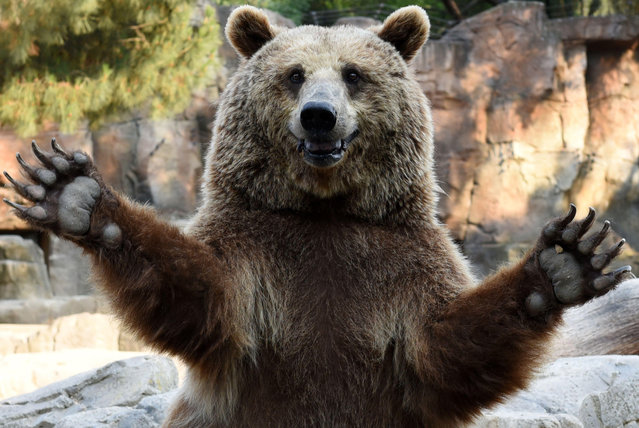
A brown bear waits for food at the zoo in Madrid, Spain on July 30, 2016. (Photo by Jorge Sanz/Pacific Press/SIPA Press/Rex Features/Shutterstock)

A brown bear waits for food at the zoo in Madrid, Spain on July 30, 2016. (Photo by Jorge Sanz/Pacific Press/SIPA Press/Rex Features/Shutterstock)
Details
31 Jul 2016 10:57:00