Loading...
Done
On February 16, 2025, Finna Indriani, a 27-year-old female jockey, showcased her skills in a specialized “sport-action” performance during the “Roda Gila” entertainment event at a traditional night market in Deli Serdang, North Sumatra Province, Indonesia. Including female jockeys in the “roda-gila” attraction exemplifies a significant advancement in challenging gender stereotypes and demonstrates women's competencies in action sports. Action sports are inherently inclusive and accessible to individuals of all genders. Society can foster greater inclusivity and equality by actively promoting and supporting women's involvement in action sports. (Photo by Sutanta Aditya/Rex Features/Shutterstock)

On February 16, 2025, Finna Indriani, a 27-year-old female jockey, showcased her skills in a specialized “sport-action” performance during the “Roda Gila” entertainment event at a traditional night market in Deli Serdang, North Sumatra Province, Indonesia. (Photo by Sutanta Aditya/Rex Features/Shutterstock)
Details
27 Feb 2025 05:09:00
“The knight and his steed”. This picture was taken in a natural but controlled environment. There are pictures that can not be done in nature or that would imply a very high cost of both time and money, thats why photography workshops are run conducted at strategic locations and bringing EVERYONE who is interested, the basic notions (lighting, camera handling, composition, etc...) or the specimens, and afford them the opportunity to take pictures like this. (Photo and caption by Nicolas Reusens Boden (Sweden)/2014 Sony World Photography Awards)

“The knight and his steed”. This picture was taken in a natural but controlled environment. There are pictures that can not be done in nature or that would imply a very high cost of both time and money, thats why photography workshops are run conducted at strategic locations and bringing EVERYONE who is interested, the basic notions (lighting, camera handling, composition, etc...) or the specimens, and afford them the opportunity to take pictures like this. Although controlled, this shot was not prepared at all, I was performing a workshop with the agalychnis callidryas treefrog from Costa Rica when the frog managed to jump to the branch where this huge titan was sleeping... I had my gear ready so I only had to change a few settings and shoot... the rest is history. (Photo and caption by Nicolas Reusens Boden (Sweden)/2014 Sony World Photography Awards)
Details
10 Dec 2013 07:23:00
Pedra da Gavea highline, 850 meters above the city, 100 meters direct exposure, March 24, 2013. Brian Mosbaugh on the line. Carefully tiptoeing almost 3000 metres above Rio de Janeiro on a thin wire got a bit too much for this adrenaline junkie – so he decided to have a LIE DOWN. Fearless Brian Mosbaugh is so used to the perilous heights he decided he deserved a short break and proceeded to kick back and relax over the famous Brazilian city. (Photo by Scott Rogers/Caters)

Pedra da Gavea highline, 850 meters above the city, 100 meters direct exposure, March 24, 2013. Brian Mosbaugh on the line. Carefully tiptoeing almost 3000 metres above Rio de Janeiro on a thin wire got a bit too much for this adrenaline junkie – so he decided to have a LIE DOWN. Fearless Brian Mosbaugh is so used to the perilous heights he decided he deserved a short break and proceeded to kick back and relax over the famous Brazilian city. (Photo by Scott Rogers/Caters)

P.S. All pictures are presented in high resolution. To see Hi-Res images – just TWICE click on any picture. In other words, click small picture – opens the BIG picture. Click BIG picture – opens VERY BIG picture (if available; this principle works anywhere on the site AvaxNews).
Details
30 Mar 2013 12:00:00
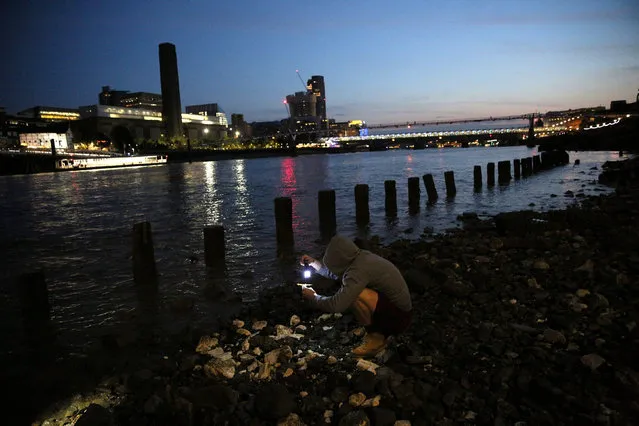
A mudlark uses a torch to look for items on the bank of the River Thames in London, Britain June 06, 2016. Mudlarking is believed to trace its origins to the 18th and 19th century, when scavengers searched the Thames' shores for items to sell. These days, history and archaeology fans are the ones hoping to find old relics such as coins, ceramics, artifacts or everyday items from across centuries. They wait for the low tide and then scour specific areas of exposed shores. "If you're in a field you could be out all day long, with the river you're restricted to about two or three hours," mudlark Nick Stevens said. While many just use the naked eye for their searches, others rely on metal detectors for which a permit from the Port of London Authority is needed. Digging also requires consent. (Photo by Neil Hall/Reuters)

A mudlark uses a torch to look for items on the bank of the River Thames in London, Britain June 06, 2016. Mudlarking is believed to trace its origins to the 18th and 19th century, when scavengers searched the Thames' shores for items to sell. These days, history and archaeology fans are the ones hoping to find old relics such as coins, ceramics, artifacts or everyday items from across centuries. their finds with the Portable Antiquities Scheme. Any item over 300 years old must be recorded. (Photo by Neil Hall/Reuters)
Details
27 Aug 2016 10:43:00
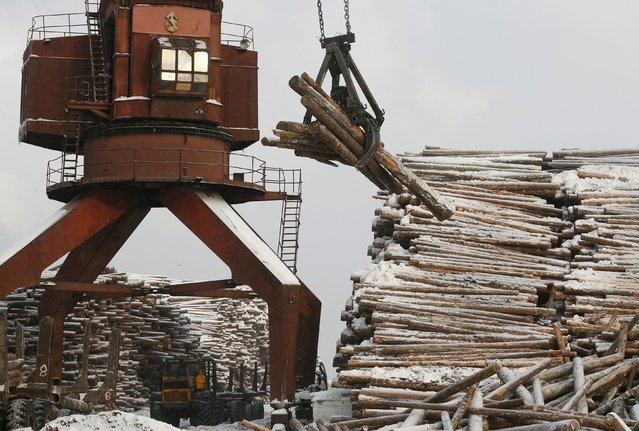
A crane loads logs at the Novoyeniseisk wood processing plant, with the air temperature at about minus 20 degrees Celsius (minus 4 degrees Fahrenheit), in the town of Lesosibirsk in Krasnoyarsk Region, Siberia, Russia, February 16, 2016. The plant exports timber to Europe, Northern Africa and Asia. The Taiga, also known as the boreal forest, on the coast of the Angara River and Yenisei River is one of the main areas for the industrial cutting of wood thanks to the high quality of the Angara pine. (Photo by Ilya Naymushin/Reuters)

A crane loads logs at the Novoyeniseisk wood processing plant, with the air temperature at about minus 20 degrees Celsius (minus 4 degrees Fahrenheit), in the town of Lesosibirsk in Krasnoyarsk Region, Siberia, Russia, February 16, 2016. The plant exports timber to Europe, Northern Africa and Asia. The Taiga, also known as the boreal forest, on the coast of the Angara River and Yenisei River is one of the main areas for the industrial cutting of wood thanks to the high quality of the Angara pine. Open air work continues all year around regardless to temperatures which can drop to minus 52 degrees Celsius (minus 61.6 degrees Fahrenheit), according to employees. (Photo by Ilya Naymushin/Reuters)
Details
18 Feb 2016 13:10:00
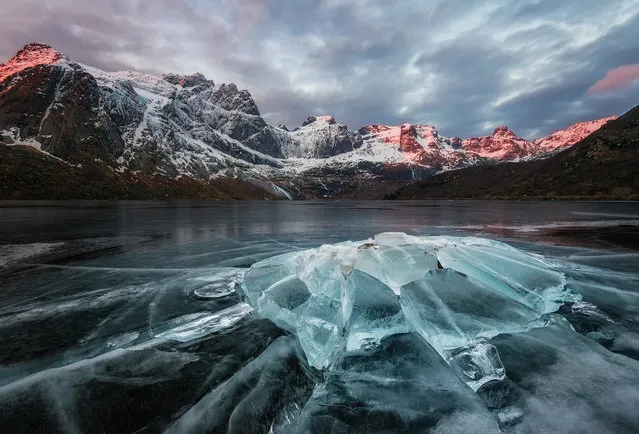
“Lofoten Glow”. I was desperately searching a good sunrise spot this particular morning. Normally Storvatnet Lake is completely covered in snow, so you can only imagine my surprise when I saw these crazy ice formations almost being shot out of the frozen lake. I put my crampons on and took a big risk walking out. Photo location: Storvatnet, Lofoten Islands in Northern Norway. (Photo and caption by Stian Klo/National Geographic Photo Contest)

“Lofoten Glow”. I was desperately searching a good sunrise spot this particular morning. Normally Storvatnet Lake is completely covered in snow, so you can only imagine my surprise when I saw these crazy ice formations almost being shot out of the frozen lake. I put my crampons on and took a big risk walking out. I could hear the ice cracking underneath my feet, and when you’re all alone in a fjord/canyon like this – the cracks are echoed and sound really frightening. Was it worth it? I sure think so! Photo location: Storvatnet, Lofoten Islands in Northern Norway. (Photo and caption by Stian Klo/National Geographic Photo Contest)
Details
08 Apr 2014 09:40:00
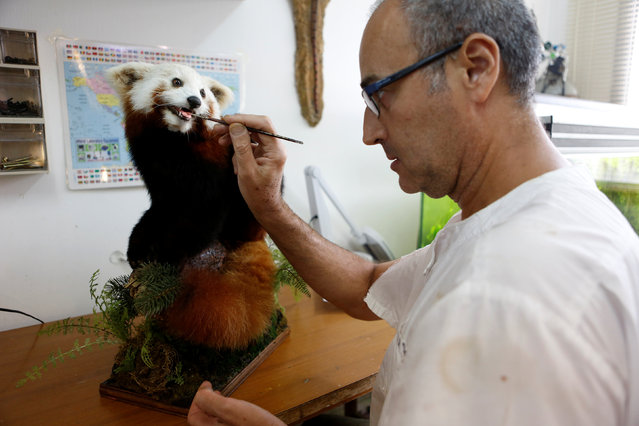
Igor Gavrilov, the main taxidermist of the Zoological centre at Tel Aviv University, works on a taxidermied animal, part of a collection which will be housed at the Steinhardt Museum of Natural History, a new Israeli natural history museum set to open next year in Tel Aviv, Israel June 8, 2016. Legions of insects, sea creatures and ancient fossils are lining up in a new museum shaped liked a giant Noah's Ark, telling the story of a crucial evolutionary byway across Israel. Experts say all humans and other animals had to pass through Israel on their first journey out of Africa into Europe and Asia. (Photo by Nir Elias/Reuters)

Igor Gavrilov, the main taxidermist of the Zoological centre at Tel Aviv University, works on a taxidermied animal, part of a collection which will be housed at the Steinhardt Museum of Natural History, a new Israeli natural history museum set to open next year in Tel Aviv, Israel June 8, 2016. Legions of insects, sea creatures and ancient fossils are lining up in a new museum shaped liked a giant Noah's Ark, telling the story of a crucial evolutionary byway across Israel. (Photo by Nir Elias/Reuters)
Details
25 Aug 2016 09:42:00
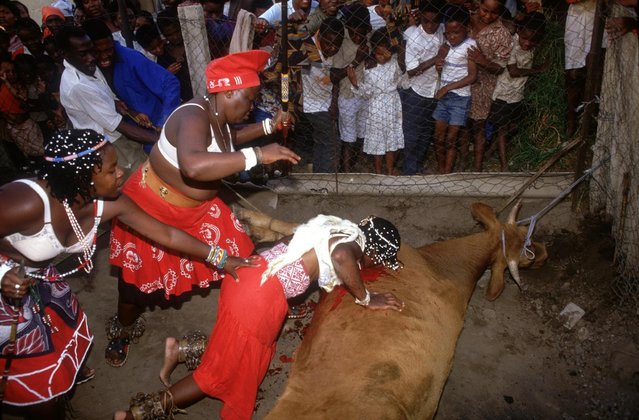
South African Sangomas are wizards and witches who are supposedly chosen by their ancestors to follow a traditional training and go through a rite of passage after which they become Sangomas and can cure and help people. They are so respected and trusted that western medical authorities have actually advised the government of South Africa to develop its cooperation with Sangomas in order to improve hygiene and health among the population. Today is graduation day for Trissa, 25, a Sangoma student in Tembisa, near Pretoria. Thanks to the help of the spirits of her ancestors, she has found a cow that had been hidden. The cow has then been killed by Sangoma Thelma and Trissa is now drinking its blood, thus becoming a Sangoma and changing her name to Nomadlozi. Location: Tembisa, near Pretoria, South Africa. (Photo by Patrick Durand/Sygma via Getty Images)

South African Sangomas are wizards and witches who are supposedly chosen by their ancestors to follow a traditional training and go through a rite of passage after which they become Sangomas and can cure and help people. They are so respected and trusted that western medical authorities have actually advised the government of South Africa to develop its cooperation with Sangomas in order to improve hygiene and health among the population. (Photo by Patrick Durand/Sygma via Getty Images)
Details
24 Feb 2017 00:05:00