Loading...
Done
Upside Down Race Car By Jeff Bloch Aka SpeedyCop

An American inventor has built a unique upside-down racecar – and successfully taken it on a 24-hour spin around the LeMons track. Jeff Bloch – also known as SpeedyCop – built his upside down 1999 Chevrolet Camaro by combining it with a decrepit 1990 Ford Festiva. To enter the latest LeMons race the car had to cost less than $500, which Bloch achieved by picking a Festiva model with a worn-out 1.3-litre engine and more than 300,000 kilometres on the clock.
Details
03 Dec 2013 09:47:00
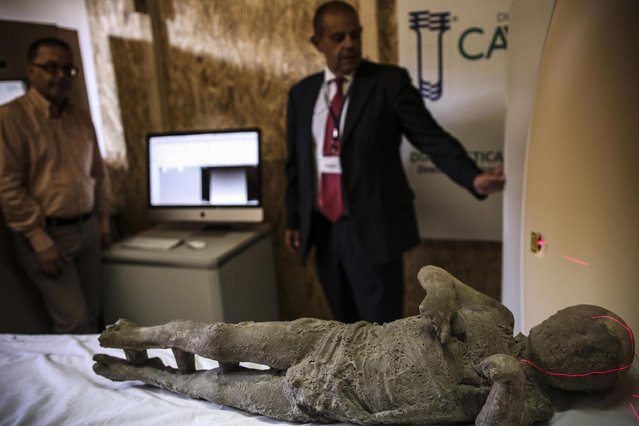
A working team appointed by the Archaeological Superintendence of Pompeii performs a Cat scan (Computerized axial tomography) one out of thirty casts of victims of the eruption of Vesuvius in 79 AD in Pompeii, in Napoli, Italy, 29 September 2015. (Photo by Cesare Abbate/EPA)

A working team appointed by the Archaeological Superintendence of Pompeii performs a Cat scan (Computerized axial tomography) one out of thirty casts of victims of the eruption of Vesuvius in 79 AD in Pompeii, in Napoli, Italy, 29 September 2015. The project which aims to trace the habits of life, employment and social class of the victims, involves a working team of archeologists, anthropologists, radiologists, dentists and engineers to obtain results from the scan. (Photo by Cesare Abbate/EPA)
Details
02 Oct 2015 08:04:00
Vintage Confections

I don't know how good they taste, but they look very interesting.
Details
25 Dec 2012 14:01:00
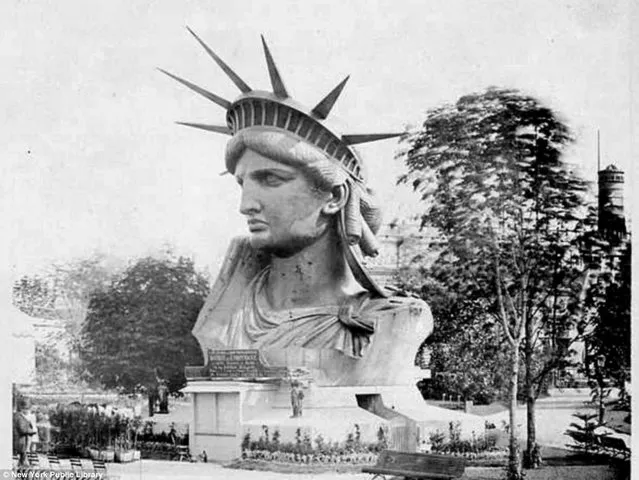
STATUE OF LIBERTY IN PARIS

When a French politician remarked that a monument should be raised in honour of American independence at a dinner party in 1865 he probably didn't imagine that the result would become an international icon of freedom. ...
Details
27 Jul 2012 04:07:00


A demonstrator wears a message on a t-shirt in Tahrir Square on May 27, 2011 in Cairo, Egypt. The ruling Supreme Council of the Armed Forces said that there would be no use of violence against protests dubbed “the Second Revolution of Anger” taking place in Cairo and other cities in Egypt. (Photo by Peter Macdiarmid/Getty Images)
Details
28 May 2011 08:33:00
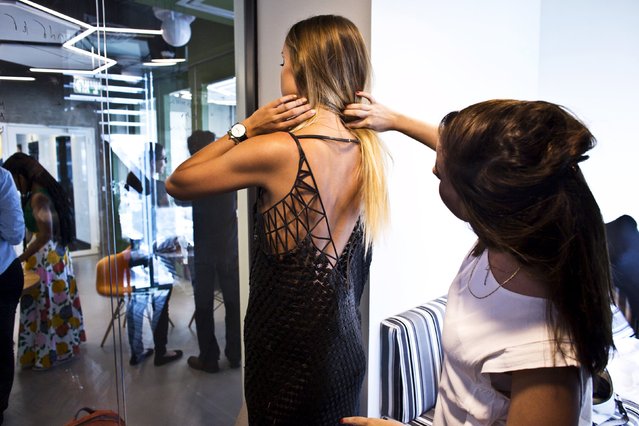
Israeli fashion design student from the Shenkar College of Engineering and Design Danit Peleg (R) assists a fashion blogger to wear an outfit from her graduate collection during a conference on 3-D printing in Tel Aviv, Israel September 3, 2015. (Photo by Nir Elias/Reuters)

Israeli fashion design student from the Shenkar College of Engineering and Design Danit Peleg (R) assists a fashion blogger to wear an outfit from her graduate collection during a conference on 3-D printing in Tel Aviv, Israel September 3, 2015. Peleg, 27, says she spent over 2000 hours to create her graduate collection which is made solely from home 3-D printers. International fashion bloggers, taking part in a project supported by “Stand With Us Israel fellowship”, a non-profit organisation, attended the conference and tried on Peleg's clothing before listening to her talk about her collection. (Photo by Nir Elias/Reuters)
Details
05 Sep 2015 12:08:00
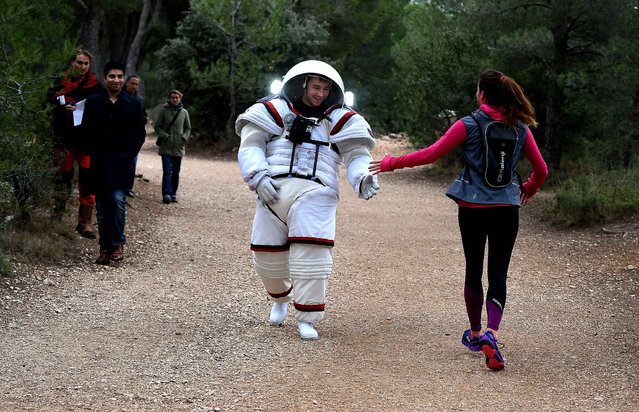
Aeronautics and Space engineer at France's Compagnie Maritime d'Expertises, or Comex, Arnaud Prost (C) meets with a jogger as he tests on the ground the “Gandolfi 2” underwater training suit for spacewalk, on January 20, 2016 in the calanques region (rocky inlets) of Marseille. The underwater training suit “Gandolfi 2”, developed with the European Space Agency (ESA), is designed for training astronauts underwater to simulate space gravity for the astronaut's extravehicular activities (EVAs). (Photo by Boris Horvat/AFP Photo)

Aeronautics and Space engineer at France's Compagnie Maritime d'Expertises, or Comex, Arnaud Prost (C) meets with a jogger as he tests on the ground the “Gandolfi 2” underwater training suit for spacewalk, on January 20, 2016 in the calanques region (rocky inlets) of Marseille. The underwater training suit “Gandolfi 2”, developed with the European Space Agency (ESA), is designed for training astronauts underwater to simulate space gravity for the astronaut's extravehicular activities (EVAs). (Photo by Boris Horvat/AFP Photo)
Details
23 Jan 2016 13:41:00
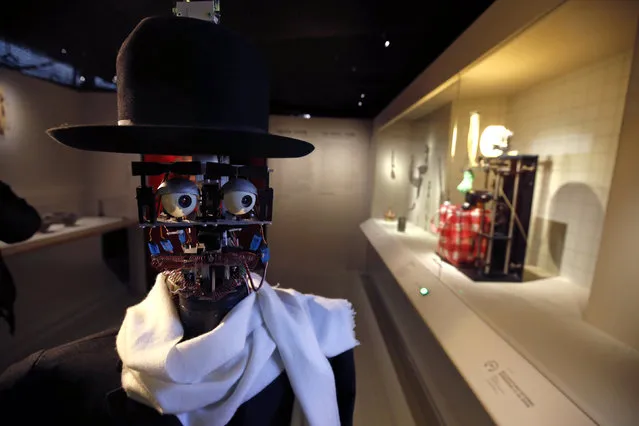
The Berenson robot strolls among visitors during the exhibition “Persona : Oddly Human” at the Quai Branly museum in Paris, France, February 23, 2016. The Berenson robot, developed in France in 2011, is the brainchild of anthropologist Denis Vidal and robotics engineer Philippe Gaussier. Its programming allows it to record reactions of museum visitors to certain pieces of art and then use the data to develop its own unique taste, which allows “Berenson” to judge whether or not it likes a certain work of art within an exhibition. (Photo by Philippe Wojazer/Reuters)

The Berenson robot strolls among visitors during the exhibition “Persona : Oddly Human” at the Quai Branly museum in Paris, France, February 23, 2016. The Berenson robot, developed in France in 2011, is the brainchild of anthropologist Denis Vidal and robotics engineer Philippe Gaussier. Its programming allows it to record reactions of museum visitors to certain pieces of art and then use the data to develop its own unique taste, which allows “Berenson” to judge whether or not it likes a certain work of art within an exhibition. (Photo by Philippe Wojazer/Reuters)
Details
25 Feb 2016 12:26:00