Loading...
Done
While the lido was described as bringing “modernism to the masses” on the British coast it was just the latest example of a trend that had been developing since Victorian times – transforming seaside towns into resorts for leisure and entertainment. In the latter half of the nineteenth century, the fashion was for local authorities to build great piers stretching from the promenade out into the sea

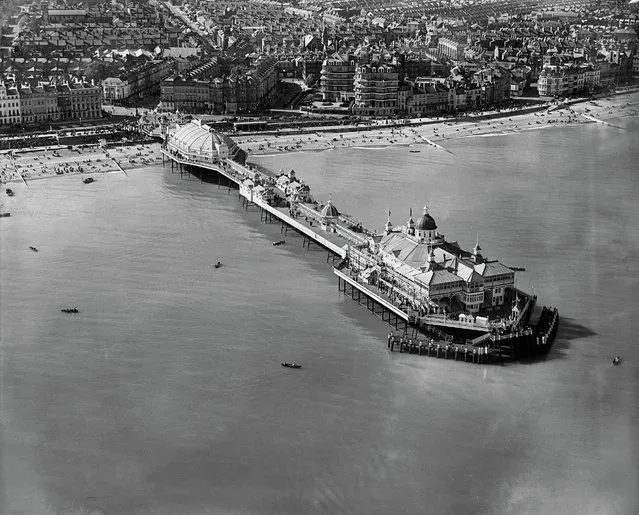
While the lido was described as bringing “modernism to the masses” on the British coast it was just the latest example of a trend that had been developing since Victorian times – transforming seaside towns into resorts for leisure and entertainment. In the latter half of the nineteenth century, the fashion was for local authorities to build great piers stretching from the promenade out into the sea. The Eastbourne Pier, pictured here in May 1931, was erected between 1866 and 1870 to an ingenious design by Eugenius Birch, which saw the structure sitting on special cups allowing the supporting struts to “move” in bad weather. Arranged on the pier's 1,000-foot length were kiosks, a theatre, a ballroom and a camera obscura. 1931. (Photo by Aerofilms Collection via “A History of Britain From Above”)
Details
25 Feb 2014 12:59:00
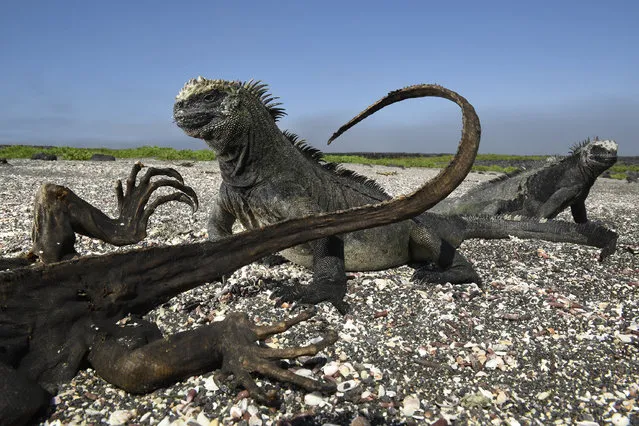
Galapagos – Rocking the Cradle: Four major ocean currents converge along the Galapagos archipelago, creating the conditions for an extraordinary diversity of animal life, April 25, 2016. The islands are home to at least 7,000 flora and fauna species, of which 97 percent of the reptiles, 80 percent of the land birds, 50 percent of the insects and 30 percent of the plants are endemic. The local ecosystem is highly sensitive to the changes in temperature, rainfall and ocean currents that characterize the climatic events known as El Niño and La Niña. These changes cause marked fluctuations in weather and food availability. Many scientists expect the frequency of El Niño and La Niña to increase as a result of climate change, making the Galapagos a possible early-warning location for its effects. (Photo by Thomas P. Peschak for National Geographic/World Press Photo)

Galapagos – Rocking the Cradle: Four major ocean currents converge along the Galapagos archipelago, creating the conditions for an extraordinary diversity of animal life, April 25, 2016. The islands are home to at least 7,000 flora and fauna species, of which 97 percent of the reptiles, 80 percent of the land birds, 50 percent of the insects and 30 percent of the plants are endemic. (Photo by Thomas P. Peschak for National Geographic/World Press Photo)
Details
16 Apr 2018 00:01:00
Italian disabled dancer Simona Atzori (top) performs, before a special audience with disabled athletes led by Pope Francis, in Paul VI hall at the Vatican October 4, 2014. (Photo by Tony Gentile/Reuters)

Italian disabled dancer Simona Atzori (top) performs, before a special audience with disabled athletes led by Pope Francis, in Paul VI hall at the Vatican October 4, 2014. (Photo by Tony Gentile/Reuters)
Details
04 Oct 2014 11:30:00
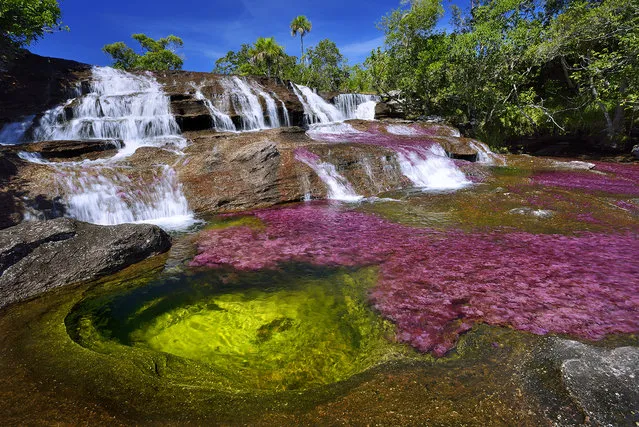
A waterfall is seen at the end of the rainy season, in August, when the water level finally decreases, in the Cano Cristales RIver in the Sierra de la Macarena in Colombia. It has become covered with a bright pink endemic aquatic plant, Macarenia Clavigera. (Photo by Olivier Grunewald)

“El rio mas bonito del Mundo”, the most beautiful river of the world, the “River of five colors”, the “Rainbow River”, or even the “Escaped from Paradise”, are the shimmering appellations that Colombians give to Cano Cristales, a small stream located in the heart of the Macarena National Park, 150 km (93 miles) south of Bogota. Photo: A waterfall is seen at the end of the rainy season, in August, when the water level finally decreases, in the Cano Cristales RIver in the Sierra de la Macarena in Colombia. It has become covered with a bright pink endemic aquatic plant, Macarenia Clavigera. (Photo by Olivier Grunewald)
Details
25 Mar 2014 15:15:00
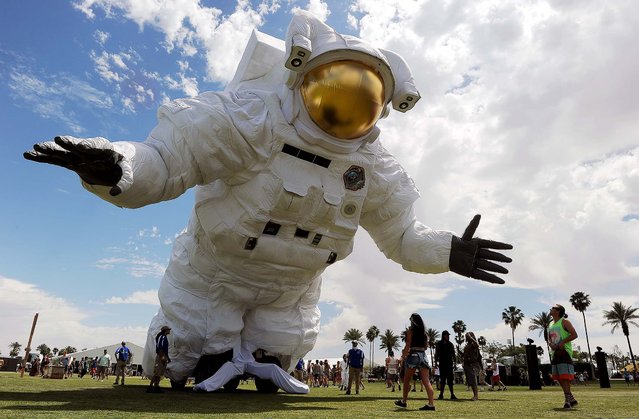
The “Escape Velocity” moving sculpture by artist group Poetic Kinetics looms over Coachella festivalgoers on the Empire Polo Field, on the first day of the 2014 Coachella Music and Arts Festival in Indio, California, on April 11, 2014. (Photo by Chris Pizzello/Invision)

The “Escape Velocity” moving sculpture by artist group Poetic Kinetics looms over Coachella festivalgoers on the Empire Polo Field, on the first day of the 2014 Coachella Music and Arts Festival in Indio, California, on April 11, 2014. (Photo by Chris Pizzello/Invision)
Details
12 Apr 2014 12:55:00
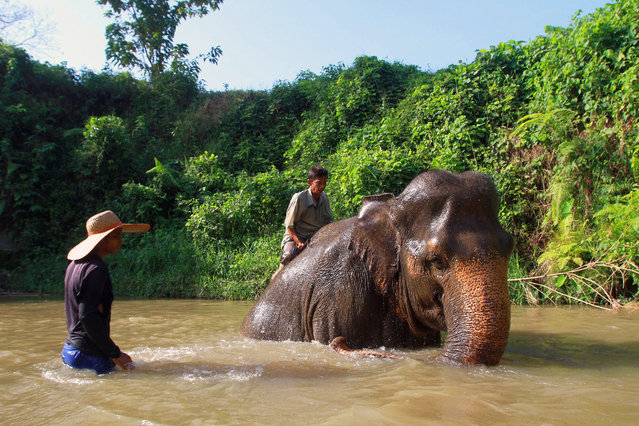
Indonesian mahouts clean their Sumatran elephant in a river near the zoo in Medan, North Sumatra, Indonesia, 12 December 2014. According media reports, the smallest of the Asian elephants, Sumatran elephant (Elephas maximus sumatrensis) is facing serious pressures arising from illegal logging and associated habitat loss and fragmentation in Indonesia. The population has come under increasing threat from rapid forest conversion to plantations. (Photo by Dedi Sahputra/EPA)

Indonesian mahouts clean their Sumatran elephant in a river near the zoo in Medan, North Sumatra, Indonesia, 12 December 2014. According media reports, the smallest of the Asian elephants, Sumatran elephant (Elephas maximus sumatrensis) is facing serious pressures arising from illegal logging and associated habitat loss and fragmentation in Indonesia. The population has come under increasing threat from rapid forest conversion to plantations. (Photo by Dedi Sahputra/EPA)
Details
13 Dec 2014 13:23:00
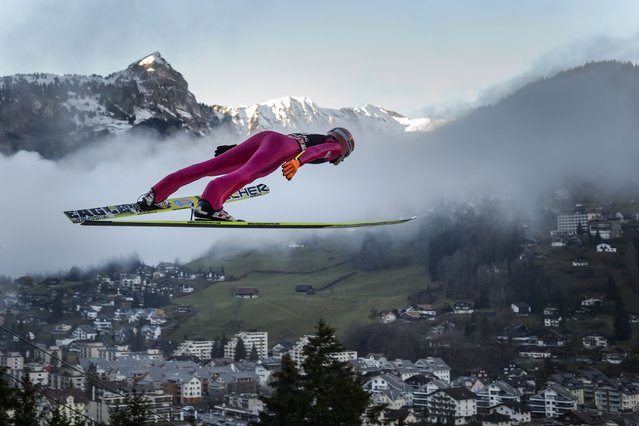
Poland's Dawid Kubacki soars through the air during the men's FIS Ski Jumping World Cup competition in Engelberg, central Switzerland, on December 20, 2014. (Photo by Fabrice Coffrini/AFP Photo)

Poland's Dawid Kubacki soars through the air during the men's FIS Ski Jumping World Cup competition in Engelberg, central Switzerland, on December 20, 2014. (Photo by Fabrice Coffrini/AFP Photo)
Details
27 Dec 2014 12:11:00
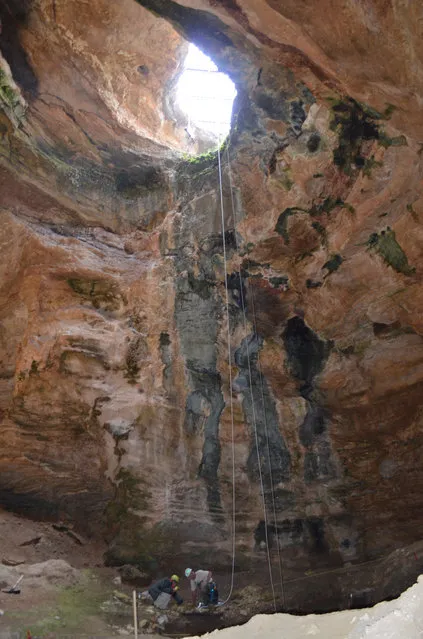
This July 2014 image provided by the Bureau of Land Management shows the interior of the Natural Trap Cave in north-central Wyoming. The cave holds the remains of tens of thousands of animals, including many now-extinct species, from the late Pleistocene period tens of thousands of years ago. Scientists have resumed digging for the first time in more than 30 years. (Photo by AP Photo/Bureau of Land Management)

This July 2014 image provided by the Bureau of Land Management shows the interior of the Natural Trap Cave in north-central Wyoming. The cave holds the remains of tens of thousands of animals, including many now-extinct species, from the late Pleistocene period tens of thousands of years ago. Scientists have resumed digging for the first time in more than 30 years. (Photo by AP Photo/Bureau of Land Management)
Details
10 Aug 2014 10:35:00