Loading...
Done
An explosion at a petrochemical plant is seen in Rizhao, Shandong province, July 16, 2015. According to Xinhua News Agency, a fire broke out after the explosion, which was caused by a liquified hydrocarbon leak at the plant, on Thursday morning. There was no report of casualties yet. (Photo by Reuters/China Daily)

An explosion at a petrochemical plant is seen in Rizhao, Shandong province, July 16, 2015. According to Xinhua News Agency, a fire broke out after the explosion, which was caused by a liquified hydrocarbon leak at the plant, on Thursday morning. There was no report of casualties yet. (Photo by Reuters/China Daily)
Details
17 Jul 2015 14:03:00
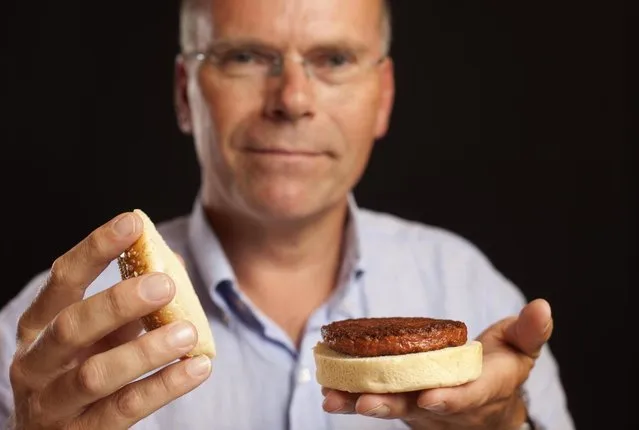
In this handout image provided by Ogilvy, a burger made from cultured beef, which has been developed by Professor Mark Post of Maastricht University in the Netherlands (pictured) is shown to the media during a press conference on August 5, 2013 in London, England. Cultured Beef could help solve the coming food crisis and combat climate change with commercial production of Cultured Beef beginning within ten to twenty years. (Photo by David Parry via Getty Images)

In this handout image provided by Ogilvy, a burger made from cultured beef, which has been developed by Professor Mark Post of Maastricht University in the Netherlands (pictured) is shown to the media during a press conference on August 5, 2013 in London, England. The in-vitro burger, cultured from cattle stem cells, the first example of what its creator says could provide an answer to global food shortages and help combat climate change, was fried in a pan and tasted by two volunteers. The burger is the result of years of research by Dutch scientist Mark Post, a vascular biologist at the University of Maastricht, who is working to show how meat grown in petri dishes might one day be a true alternative to meat from livestock.The meat in the burger has been made by knitting together around 20,000 strands of protein that has been cultured from cattle stem cells in Post's lab. (Photo by David Parry)
Details
06 Aug 2013 08:48:00
Riot police walk in the street as a couple kiss on June 15, 2011 in Vancouver, Canada. Vancouver broke out in riots after their hockey team the Vancouver Canucks lost in Game Seven of the Stanley Cup Finals. (Photo by Rich Lam/Getty Images)

Riot police walk in the street as a couple kiss on June 15, 2011 in Vancouver, Canada. Vancouver broke out in riots after their hockey team the Vancouver Canucks lost in Game Seven of the Stanley Cup Finals. (Photo by Rich Lam/Getty Images)
Details
27 Aug 2014 09:44:00
Nova Scotia Duck Tolling retriever Torrey competes in the 10th annual Petco Unleashed surfing dog contest at Imperial Beach, California August 1, 2015. (Photo by Mike Blake/Reuters)

Nova Scotia Duck Tolling retriever Torrey competes in the 10th annual Petco Unleashed surfing dog contest at Imperial Beach, California August 1, 2015. Proceeds raised at the event go to benefit the San Diego Humane Society. (Photo by Mike Blake/Reuters)
Details
02 Aug 2015 13:28:00


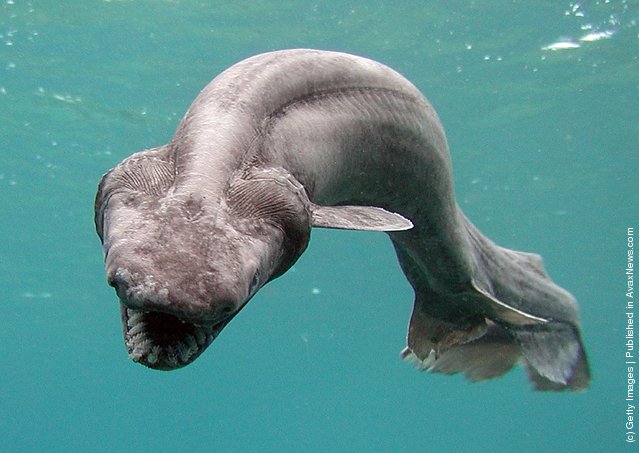
“The frilled shark (Chlamydoselachus anguineus) is one of two extant species of shark in the family Chlamydoselachidae, with a wide but patchy distribution in the Atlantic and Pacific Oceans. This uncommon species is found over the outer continental shelf and upper continental slope, generally near the bottom though there is evidence of substantial upward movements. It has been caught as deep as 1,570 m (5,150 ft), whereas in Suruga Bay, Japan it is most common at depths of 50–200 m (160–660 ft). Exhibiting several “primitive” features, the frilled shark has often been termed a «living fossil»”. – Wikipedia

Photo: A 1.6 meter long Frill shark swims in a tank after being found by a fisherman at a bay in Numazu, on January 21, 2007 in Numazu, Japan. The frill shark, also known as a Frilled shark usually lives in waters of a depth of 600 meters and so it is very rare that this shark is found alive at sea-level. It's body shape and the number of gill are similar to fossils of sharks which lived 350,000,000 years ago. (Photo by Awashima Marine Park/Getty Images)
Details
05 May 2011 10:01:00


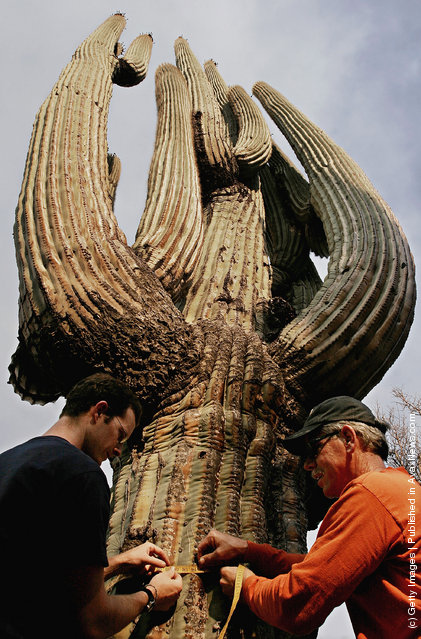
“The saguaro (scientific name Carnegiea gigantea) is a large, tree-sized cactus species in the monotypic genus Carnegiea. It is native to the Sonoran Desert in the U.S. state of Arizona, the Mexican state of Sonora, a small part of Baja California in the San Felipe Desert and an extremely small area of California, U.S. The saguaro blossom is the State Wildflower of Arizona”. – Wikipedia

Photo: Daniel Appel (L), a firefighter with Engine 84 from the Lassen National Forest in California and Mike Hallen, (R), Arizona representative of the National Register of Big Trees, measure the circumference of this Saguaro cactus called the "Grand One," in the Tonto National Forest on July 1, 2005 35 miles north of Phoenix, near Carefree, Arizona. The cactus, estimated to be more than 200 years old, measures a circumference of 7 feet, 10 inches (2.4 meters) and stands 46 feet high (14 meters). The cactus was burned in the Cave Creek Complex fire and may not survive. It was once the largest Saguaro in the world, two others have been found recently that have tied it's measurements. The fire has burned more than 214,000 acres of the Sonoran desert. (Photo by Jeff Topping/Getty Images)

Details
26 Jul 2011 12:27:00
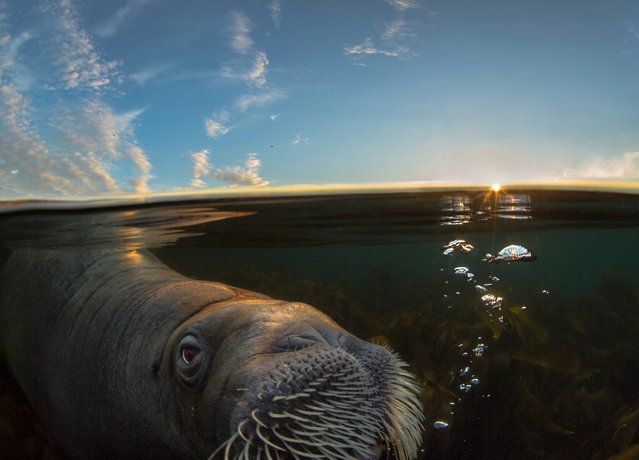
The Wildscreen festival is the world’s biggest celebration of screen-based natural history storytelling which takes place every two years in Bristol. Here: “Walrus in Midnight Sun”. Walrus feed mostly on bivalves in productive, shallow and often sandy habitats in the Arctic. This individual, though, arrived on a beach outside Tromsø, northern Norway, and found comfort on a stranded dead sperm whale. After two weeks he approached Audun, and only half a metre away he stretched his tusk forward and touched his hand gently. “This was one of the most memorable moments of my life”, Rikardsen says. He named the 500kg male Buddy. After two months, the dead whale was decomposed and Buddy suddenly disappeared. (Photo by Audun Rikardsen/Wildscreen 2016)

The Wildscreen festival is the world’s biggest celebration of screen-based natural history storytelling which takes place every two years in Bristol. Here: “Walrus in Midnight Sun”. Walrus feed mostly on bivalves in productive, shallow and often sandy habitats in the Arctic. This individual, though, arrived on a beach outside Tromsø, northern Norway, and found comfort on a stranded dead sperm whale. After two weeks he approached Audun, and only half a metre away he stretched his tusk forward and touched his hand gently. “This was one of the most memorable moments of my life”, Rikardsen says. He named the 500kg male Buddy. After two months, the dead whale was decomposed and Buddy suddenly disappeared. (Photo by Audun Rikardsen/Wildscreen 2016)
Details
07 Oct 2016 10:02:00
A child wearing a costume runs up the steps during Purim celebrations at the Coral Temple synagogue in Bucharest, Romania, Wednesday, March 20, 2019. Children put on fancy costume dress joining dozens of believers from Romania's Jewish community who attended a Purim service to celebrate the Jews' salvation from genocide in ancient Persia, as recounted in the Book of Esther. (Photo by Vadim Ghirda/AP Photo)

A child wearing a costume runs up the steps during Purim celebrations at the Coral Temple synagogue in Bucharest, Romania, Wednesday, March 20, 2019. Children put on fancy costume dress joining dozens of believers from Romania's Jewish community who attended a Purim service to celebrate the Jews' salvation from genocide in ancient Persia, as recounted in the Book of Esther. (Photo by Vadim Ghirda/AP Photo)
Details
22 Mar 2019 00:07:00